

When Jeff Bezos, the visionary founder of Amazon, referred to Google as a “mountain,” he wasn’t just speaking metaphorically about its size. He was encapsulating the sheer, overwhelming scale of its operations, its pervasive influence across countless aspects of modern life, and its relentless pursuit of ambitious, even audacious, technological frontiers.
Google isn’t merely a company; it’s an ecosystem, a digital colossus that has redefined how we interact with information, each other, and the world around us. So, how big is this mountain, really? Let’s delve into the vastness of Google’s empire, from its foundational pillars to its most futuristic ventures.
The Bedrock of Billions: Search, Browser, and Mobile
At its core, Google’s immense scale begins with its unparalleled dominance in fundamental digital utilities. The Google Search engine remains the undisputed king of the internet, handling an estimated 90% or more of global search queries. Every second, millions of questions are posed to Google, and billions of pages are indexed and retrieved, making it the primary gateway to information for most of humanity. This isn’t just a search bar; it’s a global oracle, shaping perceptions and connecting users with data at an unimaginable speed.
Hand-in-hand with its search dominance is Google Chrome, the world’s most popular web browser. With well over 60% of the browser market share, Chrome is the preferred window through which most internet users experience the web. Its seamless integration with Google’s other services creates a cohesive and powerful user experience that keeps billions tethered to the Google ecosystem.
Now (in 2025), companies like OpenAI, Perplexity, and Yahoo are queued up to acquire Chrome from Google, as U.S Justice Department may force Google to sell Chrome, over its monopolistic behavior. Indeed, Perplexity proposed a $34.5 billion bid to acquire Chrome, which is nearly 2x of Perplexity’s valuation.
Then there’s Android. While not a Google product in the traditional sense, Android is Google’s mobile operating system, powering over 70% of the world’s smartphones. This isn’t just software; it’s the digital pulse of billions of devices, from premium flagships to budget-friendly handsets. Through Android, Google’s services—Maps, Gmail, YouTube, Google Play Store—are embedded directly into the daily lives of a vast global population, making it an indispensable part of the mobile experience.
A Universe of Services
Google’s footprint extends far beyond these foundational services. YouTube, acquired by Google in 2006, is the world’s largest video-sharing platform, hosting billions of hours of content and attracting billions of unique viewers monthly. It’s not just entertainment; it’s a sprawling hub for education, news, and creator economies. Google Maps, meanwhile, has revolutionized navigation, guiding millions of journeys daily, while also providing rich, localized information about businesses and places globally.
In the corporate sphere, Google Cloud is a rapidly growing player in the competitive cloud computing market, providing businesses with infrastructure, platforms, and software services that power everything from startups to Fortune 500 companies. Its advertising arm, Google Ads, remains the primary engine of Alphabet’s revenue, leveraging Google’s vast data insights to connect businesses with potential customers across its myriad platforms. Each of these services, on its own, could be considered a tech giant. Together, they form an interconnected web that is truly colossal.
The Moonshot Factory: Projects at X
Part of what makes Google a “mountain” is its audacious ambition to tackle problems that seem almost insurmountable. This spirit is embodied by X, Alphabet’s “moonshot factory.” X is where Google explores radical new technologies to solve some of the world’s most pressing challenges. These aren’t just R&D projects; they are long-term, high-risk, high-reward ventures designed to create breakthrough technologies.
Consider Waymo, X’s autonomous driving company, which is at the forefront of developing self-driving car technology, aiming to revolutionize transportation and enhance safety. Another example is Wing, which is pioneering drone delivery services, striving to make on-demand delivery faster, quieter, and more efficient. These projects, even when years away from widespread commercialization, demonstrate Google’s commitment to pushing the boundaries of what’s possible, investing heavily in the future, and seeking to build the next generation of industry-defining technologies.
Peering into the Future: The Quantum Leap
Perhaps one of the most exciting and futuristic peaks on Google’s mountain after AI is its ambitious foray into quantum computing. This is not just about faster computers; it’s about an entirely new paradigm of computation that could solve problems currently intractable for even the most powerful supercomputers. Google’s Quantum AI lab is at the cutting edge of this field.
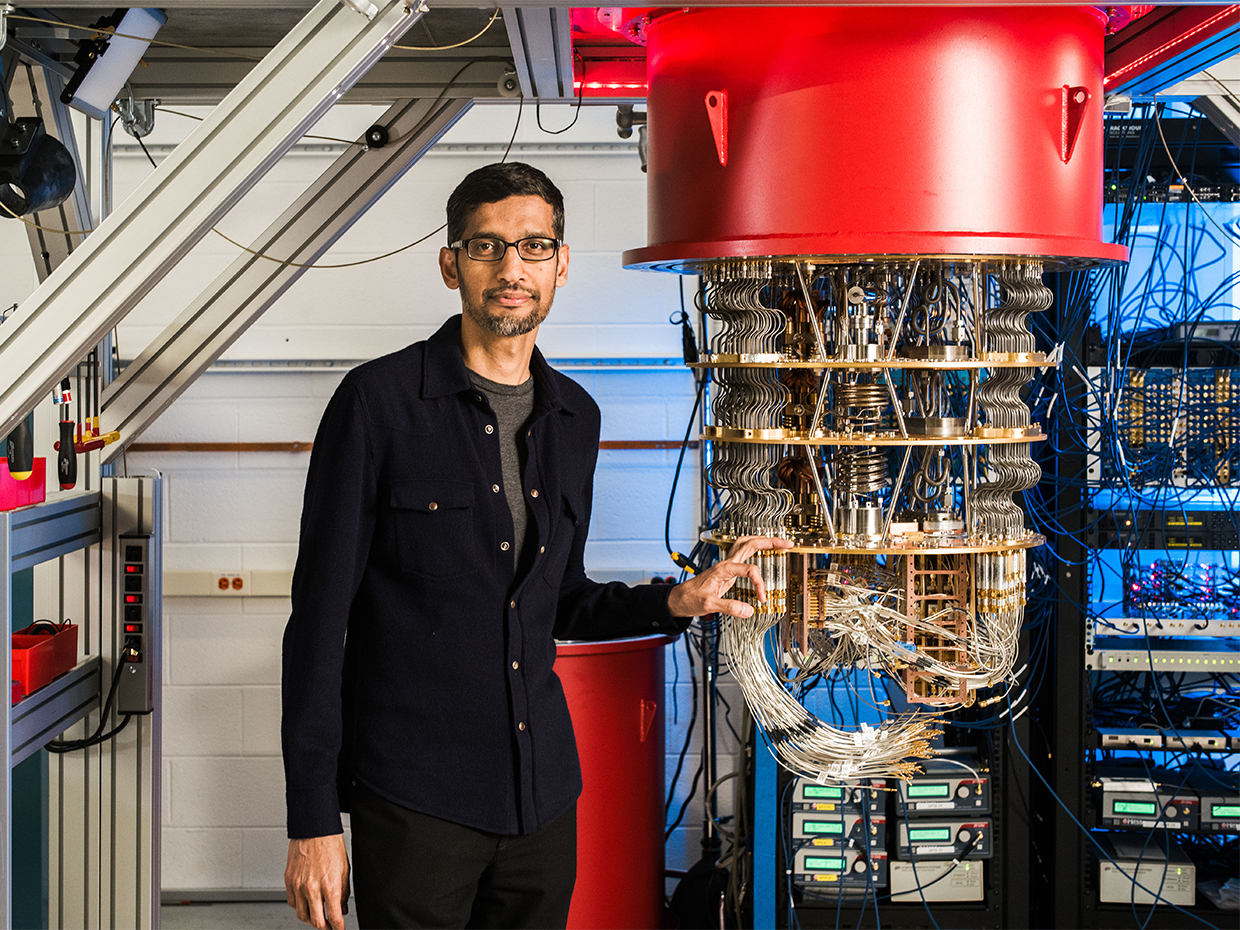
In a landmark achievement in 2019, Google’s Sycamore processor demonstrated what it termed “quantum supremacy.” This feat involved performing a specific calculation in just a few minutes that would have taken the world’s most powerful classical supercomputer thousands of years. While still in its nascent stages, this breakthrough illustrated the immense potential of quantum computing to revolutionize fields like medicine, materials science, artificial intelligence, and cryptography.
Google is one of the first few companies to achieve “quantum error-correction“, which was once considered an impossible knot to be untied. This feat by Google pushed the company few years ahead in the quantum research. Later on, the tech-giant revealed its first ‘Quantum-Chip’ – “Willow”. Willow focuses on reducing errors as the system scales, a major challenge in quantum computing. It achieved a computation in under five minutes that would take a classical supercomputer 10 septillion years. This makes Google’s quantum chip a potential game-changer for fields like medicine, energy, and AI.
Google’s pursuit of quantum computing isn’t just about technological leadership; it’s about fundamentally reshaping the computational landscape of the future.
The Invisible Giant: Data and Its Dominion
Underpinning this sprawling empire, and contributing significantly to its “mountain” status, is the unimaginable volume of data Google manages. Billions of daily searches, trillions of indexed web pages, billions of Android users, hundreds of hours of video uploaded to YouTube every minute – this generates a continuous torrent of information. Google processes, stores, and analyzes exabytes of data, gaining profound insights into human behavior, trends, and preferences.
- Search Queries: Google processes over 13.7 billion searches per day, which equates to more than 5 trillion searches annually.
- Searches Per Second: On average, Google handles over 158,000 search queries every single second.
- Data Processing: Google is estimated to handle over 20 petabytes of data each day across its various services.
That’s How Big Google is!
Jeff Bezos’s description of Google as a “mountain” is profoundly apt. He said, “Treat Google like a Mountain. You can climb over it, but you can’t move it.”
It speaks to the sheer elevation of its market dominance, built on the solid bedrock of search, browser, and mobile operating systems. It encompasses the vast and varied landscape of its services, from video streaming to cloud computing, each a giant in its own right. It acknowledges the audacious ambition of its “moonshot” projects that aim for nothing less than paradigm shifts. And it recognizes the forward-looking vision embedded in its quantum computing efforts, which seek to define the future of computation itself.
In 2024, Google reported total revenues of $350.02 billion. This substantial figure represents a strong Year-over-Year (YoY) growth of 14%. Beyond top-line revenue, the company also demonstrated remarkable profitability, with a net income totaling $100.1 billion. This secured Google’s position as one of the most profitable public companies in the world. Despite recent share price fluctuations in 2025, Google has shown strong long-term performance with cumulative returns of 206.3% over five years as of March 20, 2025. Get a detailed breakdown of Google’s revenue in 2024.
Above all, it highlights the immense, almost incomprehensible, power derived from managing and understanding the world’s most valuable resource: information. Google is a mountain not just because of its height, but because of its immense breadth, depth, and the relentless upward climb of its innovation.
Key Takeaways
- Google’s dominance is built on its search engine, Chrome browser, and Android mobile operating system.
- YouTube, Google Maps, and Google Cloud significantly expand Google’s influence beyond its core services.
- “Moonshot” projects at X, like Waymo and Wing, represent Google’s commitment to radical innovation.
- Google’s work in quantum computing has the potential to revolutionize numerous fields.
- The immense volume of data Google manages provides invaluable insights and powers its AI capabilities.
Join our community by subscribing to our Weekly Newsletter to stay updated on the latest AI updates and technologies, including the tips and how-to guides. (Also, follow us on Instagram (@inner_detail) for more updates in your feed).
(For more such interesting informational, technology and innovation stuffs, keep reading The Inner Detail).