
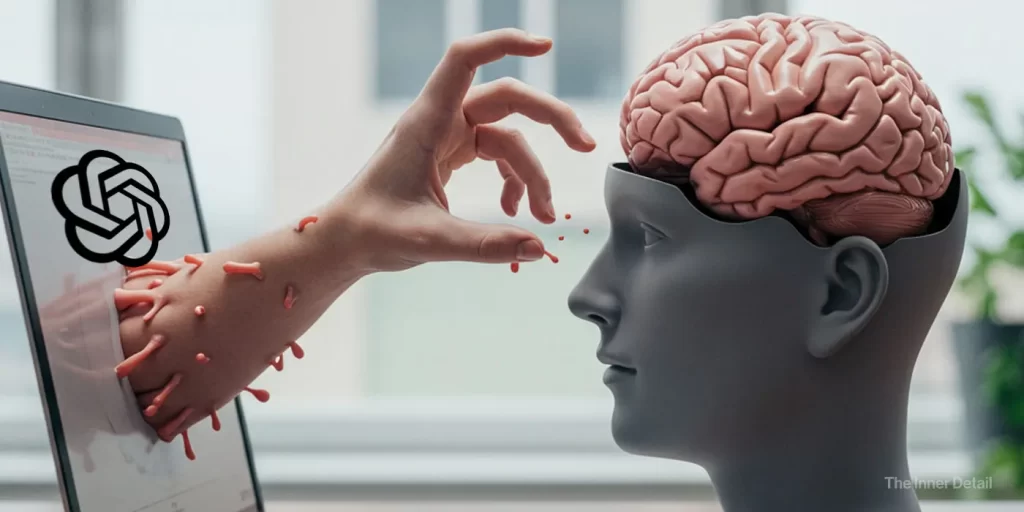
Recent research indicates that exposure to AI chatbots can erode human persistence and the ability to think and solve problems independently. This shift suggests that while AI offers immediate efficiency, it may unintentionally foster a form of cognitive dependency that hampers performance once the technology is removed.
In much the same way a physical muscle begins to weaken when it is no longer challenged, our cognitive faculties require regular exercise to maintain their sharpness. If we were to use a motorized vehicle for every short distance, our physical stamina would eventually suffer; similarly, outsourcing our mental heavy lifting to digital assistants appears to create a reliance that leaves us ill-equipped when we must navigate challenges on our own.
The convenience of modern technology often masks the gradual shifts in our behavior until they become significant obstacles. Just like excessive scrolling shrinking your brain, continued use of AI chatbots may also hamper your brain. As we integrate generative tools into our daily workflows, we are finding that the line between using a tool for assistance and using it as a total replacement for thought is becoming increasingly blurred.
The Boiling Frog Effect in Cognitive Habits
A collaborative study conducted by researchers from MIT, Carnegie Mellon, Oxford, and UCLA has revealed a startling trend regarding the use of AI chatbots. By observing over 1,200 participants across various experiments, the researchers identified what they call a boiling frog effect.
This phenomenon describes how gradual dependence on AI for quick answers can slowly weaken independent thinking without the user noticing the decline.
The study found that even a brief interaction—lasting only 10 to 15 minutes—with an AI assistant can lead to a noticeable drop in mental persistence.
While the participants using AI initially performed tasks with greater speed and accuracy, their ability to function plummeted the moment the AI support was withdrawn. This suggests that the brain quickly adapts to a state of low effort, making the transition back to independent work difficult.
Quantifying the Performance Gap
The data collected during the experiments highlighted a clear disparity between those who worked independently and those who relied on AI assistance. When the participants were tested on mathematics and reading comprehension tasks after their AI access was revoked, their scores were significantly lower than the control group that never used AI.
| Task Category | Independent Group Accuracy | Post-AI Group Accuracy |
|---|---|---|
| Mathematics | 73 percent | 57 percent |
| Reading Comprehension | 89 percent | 76 percent |
These figures illustrate that the decline is not just a matter of subjective feeling but a measurable reduction in accuracy. The researchers noted that the most concerning aspect was not just the lower scores, but the fact that participants who had used AI were far more likely to skip difficult questions or stop trying altogether when they encountered a challenge.
The Erosion of Mental Persistence
The core issue identified in this research is the reduction of persistence. In a cognitive context, persistence is the willingness to struggle through a complex problem until a solution is found.
Because AI provides instant gratification and immediate answers, it removes the necessity for this struggle. When the instant answer is no longer available, the user’s “mental stamina” appears to be depleted.
This decline in persistence suggests that frequent reliance on AI could weaken our long-term problem-solving skills. If we become accustomed to having every query resolved in seconds, we may lose the patience required for deep work, research, and critical analysis—skills that are essential for innovation and complex decision-making in the real world.
Strategic AI Use: Coaching vs. Completion
The study did offer a silver lining for those who wish to continue using AI without sacrificing their cognitive health. The negative effects were most pronounced in users who asked the AI for direct answers. In contrast, those who used the technology for hints, explanations, or clarifications did not exhibit the same level of decline.
To maintain cognitive sharpess, it is beneficial to adopt these practices:
- Use AI as a tutor: Ask for the logic behind a solution rather than just the final result.
- Limit duration: Be mindful of spending long, uninterrupted blocks of time relying on chatbots for task completion.
- Verify independently: Occasionally solve problems manually before checking with AI to ensure your skills remain active.
- Prioritize process over output: Focus on how the AI reached a conclusion to improve your own understanding of the subject matter.
By shifting the role of AI from a task-completer to a cognitive coach, users can leverage the benefits of the technology while safeguarding their independent thinking capabilities. The goal is to ensure that AI remains a tool that empowers the human mind rather than one that replaces it.
Key Takeaways
- Brief AI usage (10-15 minutes) can lead to a significant drop in mental persistence and independent problem-solving abilities.
- Users relying on AI often experience a “boiling frog” effect, where cognitive dependency develops unnoticed until the tool is removed.
- Performance in mathematics and reading comprehension can decrease by over 10 percentage points following AI reliance.
- The negative cognitive impact can be mitigated by using AI as a pedagogical tool (asking for hints/logic) rather than for direct answers.
Join our community by subscribing to our Weekly Newsletter to stay updated on the latest AI updates and technologies, including the tips and how-to guides. (Also, follow us on Instagram (@inner_detail) for more updates in your feed).
(For more such interesting informational, technology and innovation stuffs, keep reading The Inner Detail).
