

Chinese AI start-up Moonshot AI unveiled its newest creation, Kimi K3, a behemoth of a model that proves China is rapidly erasing the features / capabilities gap of AI with the West.
For years, the artificial intelligence narrative has been dominated by a familiar rivalry centered in Silicon Valley: OpenAI versus Anthropic. However, the global tech landscape experienced a massive seismic shift at the World Artificial Intelligence Conference in Shanghai on July 16, 2026 with the release of Kimi K3.
Boasting a staggering 2.8 trillion parameters, Kimi K3 is the world’s first open-source model in the 3-trillion-parameter class. It is not just a proof of concept; it is actively going toe-to-toe with the most elite models on the planet, including GPT-5.6 and Claude Fable 5. With its weights scheduled for a full public release on July 27, 2026, Kimi K3 threatens to completely upend Silicon Valley’s commercial dominance.
Here is everything you need to know about China’s new frontier AI, how it performs against its American rivals, and what it means for the future of global technology.
Key Takeaways
- Kimi K3 is the first 3-trillion-parameter class open-source model, featuring 2.8 trillion parameters and a 1-million-token context window.
- The model utilizes proprietary Kimi Delta Attention (KDA) and Stable LatentMoE architecture to achieve 2.5x the scaling efficiency of its predecessor.
- Kimi K3 outperforms 97 percent of models on the Artificial Analysis Intelligence Index and ranks first globally in frontend web interface engineering.
- Despite US export controls, Moonshot AI has developed a competitive frontier model, signaling significant progress in domestic Chinese AI sovereignty.
- While highly capable in coding and agentic tasks, the model is currently expensive for basic queries due to its mandatory deep-thinking “max” reasoning mode.
The 3-Trillion-Parameter Behemoth: Architecture and Efficiency
To understand why Kimi K3 is making such massive waves, you have to look under the hood. The model operates at an unprecedented scale for an open-weight release. While Moonshot AI rounds the 2.8 trillion parameters up to the “3T-class”, this massive size successfully steals the open-source scale crown from DeepSeek’s 1.6T v4 Pro.
Despite its gargantuan size, Kimi K3 is incredibly efficient. It is built on a proprietary hybrid linear attention mechanism called Kimi Delta Attention (KDA) and utilizes Attention Residuals (AttnRes). These architectural breakthroughs are specifically designed to allow information to flow smoothly through much longer sequences and significantly deeper model layers.
Furthermore, Moonshot heavily increased the sparsity of its Mixture of Experts (MoE) architecture. Using the Stable LatentMoE framework, the model only activates 16 out of a total of 896 experts during processing.
Combined with vast improvements in data recipes and training methodologies, Kimi K3 achieves roughly 2.5x the overall scaling efficiency of its predecessor, K2, converting raw compute power into actual intelligence far more effectively. The model also boasts a massive 1-million-token context window and features native visual understanding baked right into the foundation.
Explanation of the Kimi K3 Architecture
Evolution of Architectures
- Original Transformer (2017): Utilized standard multi-head attention and dense feed-forward networks, which are computationally expensive as sequence length grows.
- Mixture of Experts (MoE) (e.g., Switch Transformer, GPT-4 style): Introduced sparse activation, where only a subset of network parameters (experts) is used for any given input, allowing for massive model sizes with manageable compute costs.
- Kimi K3 (Current): This architecture represents a modern hybrid approach, combining sparse MoE with advanced attention mechanisms (KDA) and residual learning techniques to optimize deep long-context processing.
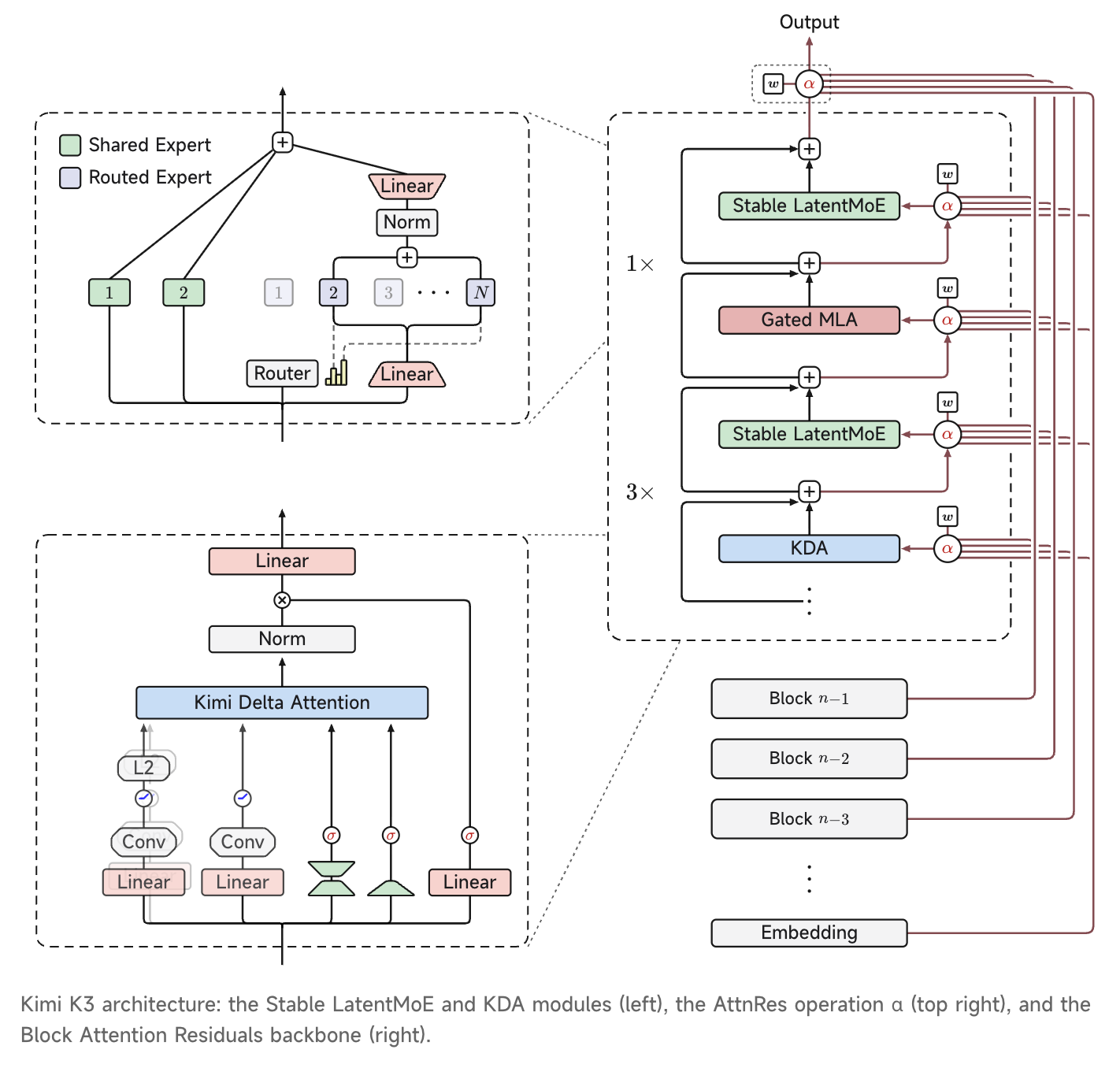
The Kimi K3 architecture image (above) details a highly specialized, modular block design focused on efficiency and signal preservation across deep layers.
- Stable LatentMoE (Top-Left): Unlike standard Mixture of Experts (MoE), which routes inputs to specific experts, this module uses a “Shared Expert” for base information and a “Routed Expert” system for specialized tasks. This ensures stability in training and inference by keeping some components permanently active while others are dynamic.
- Kimi Delta Attention (KDA) (Bottom-Left): This module is designed to handle complex dependencies. By using convolutional layers (which looks for patterns rather isolated words) and linear projections combined with normalization, it likely helps the model focus on local patterns alongside global attention, effectively capturing “delta” or change information between tokens.
- Block Attention Residuals (Right): This is the core backbone structure. Instead of a simple serial stack, the model uses an “AttnRes operation” (labeled $\alpha$). This creates “skip connections” that pull information directly from previous blocks (labeled $n-1, n-2$, etc.) into the current output. This allows the model to maintain long-range context and prevent the “vanishing gradient” problem, which is crucial for Kimi’s strength in long-context tasks.
In essence, Kimi K3 moves beyond the monolithic blocks of earlier Transformers by using a sophisticated gating mechanism that decides exactly which part of the network needs to process information, while ensuring that deep, long-context information is preserved through its skip-connection backbone.
Taking on the Titans: Benchmarks and Capabilities
When Moonshot AI claimed Kimi K3 could rival top American firms, they brought the receipts. In self-reported benchmarks, Kimi K3 consistently beats Anthropic’s Claude Opus 4.8 max and OpenAI’s GPT-5.5 high, though it slightly trails the absolute top-tier models like Claude Fable 5 and GPT-5.6 Sol.
However, independent third-party evaluations paint an even more impressive picture. According to the Artificial Analysis Intelligence Index, Kimi K3 scores a 57.1, placing it ahead of 97% of all compared models.
In the highly competitive Arena.ai blind human-preference tests for Frontend Code, Kimi K3 actually ranked first globally in web interface engineering, successfully outperforming Anthropic’s flagship Fable system.
Here is a breakdown of how Kimi K3 performs across major industry benchmarks:
| Metric / Benchmark | Score / Detail |
|---|---|
| Total Parameters | 2.8 Trillion (3T Class) |
| Context Window | 1 Million Tokens |
| Artificial Analysis Intelligence Index | 57.1 (Better than 97% of models) |
| Artificial Analysis Coding Index | 76.2 (Better than 95% of models) |
| Artificial Analysis Agentic Index | 50.1 (Better than 97% of models) |
| GPQA Diamond (Scientific Reasoning) | 93.5% |
| Humanity’s Last Exam (HLE) | 44.3% |
| AA-LCR (Long Context Reasoning) | 74.7% |
Long-Horizon Coding and Vision
Kimi K3 shines brightest in complex, long-horizon coding tasks. The system is uniquely built to operate with “minimal human supervision,” allowing it to sustain long-running engineering tasks, coordinate terminal tools, and understand massive codebases autonomously.
It excels at tasks that blend software engineering with visual reasoning. By natively accepting screenshots and visual feedback, K3 can vastly improve workflows in game development, computer-aided design (CAD), and frontend engineering.
Beyond coding, Kimi K3 advances end-to-end knowledge work. On the Artificial Analysis private long-horizon knowledge work evaluation, Kimi K3 achieved an impressive overall Elo rating of 1547, jumping 732 points ahead of Kimi K2.6 and trailing only Claude Fable 5.
Unsurprisingly, the model is already seeing massive adoption in production environments. On OpenRouter, Kimi K3 is currently powering some of the most popular autonomous AI tools, including Hermes Agent (processing over 20 billion tokens), Anthropic’s own Claude Code, and the open-source OpenClaw agent.
Geopolitics: Bypassing US Export Controls
The arrival of Kimi K3 comes at a highly sensitive geopolitical moment for the global technology sector. Long-held assumptions in the West suggested that Chinese developers would continually trail their American peers due to severe US restrictions on advanced hardware sales.
The US government increasingly views advanced AI software as critical national infrastructure. Just weeks prior to the K3 launch, Washington forced Anthropic to temporarily withdraw its flagship Fable and Mythos models due to severe cybersecurity concerns. While those restrictions have since been lifted, they highlight the intense national security lens applied to frontier models.
Yet, heavily backed by domestic tech giants Alibaba and Tencent, Moonshot AI’s rapid development of K3 suggests that Chinese firms are successfully bypassing these regulatory barriers and advancing independently.
By making a 3-trillion-parameter frontier model completely open-source—meaning it can be freely downloaded, run, and customized globally—Moonshot is directly threatening the closed, proprietary business models of Silicon Valley giants like OpenAI, and Anthropic.
The disruption is not limited to the West; the announcement sent shockwaves through the local Chinese market as well. Immediately following the unveiling of Kimi K3, shares in Moonshot’s domestic competitors plummeted, with Zhipu tumbling by roughly 27% and MiniMax dropping 16% in Hong Kong.
Pricing, Tool Calling, and Developer Experience
For developers looking to integrate Kimi K3, Moonshot AI has made the transition remarkably smooth. The API is fully compatible with the OpenAI SDK, meaning most applications can adopt K3 simply by swapping the base URL and initializing the client once.
Deep Tool Integration: Kimi K3 is built for complex tool calling. Developers can use the tool_choice=”required” parameter to force the model to execute at least one tool call before responding. Furthermore, Moonshot offers “Official tools” integrated directly through its Formula endpoint, allowing developers to fetch definitions and submit function arguments seamlessly. (It is worth noting that Moonshot advises against using their native web search tool in near-term production workflows while it undergoes updates).
For outputs that require strict formats, developers can enforce structured JSON outputs by utilizing json_schema with strict: true, ensuring the final message matches the required structure perfectly. Additionally, the massive 1-million-token context window features automatic context caching. Developers do not need to manage cache IDs or TTL parameters; as long as the long prefix remains unchanged, later requests will automatically attempt a cache hit.
Pricing Structure: Operating a 3-trillion-parameter model is not cheap, and Moonshot has priced K3 accordingly. At $3 per million input tokens and $15 per million output tokens, Kimi K3 is the most expensive model released by a Chinese AI lab to date, representing a significant price hike over Kimi K2.6’s $0.95/$4 pricing. The pricing places it on the same level as Anthropic’s Claude Sonnet series.
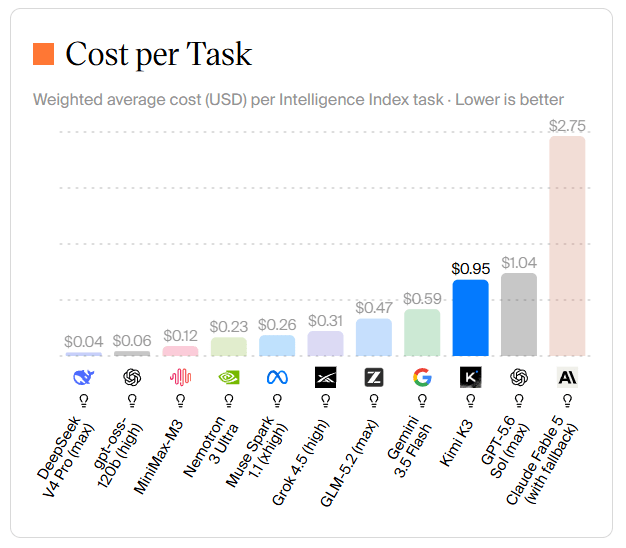
However, with the automatic context caching, real-world costs can drop dramatically. OpenRouter data reveals that with a 94.4% cache hit rate, the effective average input price paid by customers plunges to just $0.45 per million tokens, making it highly competitive for repetitive, long-context workflows.
What We Learn From the “Pelican” Benchmark
While standardized benchmarks are helpful, real-world stress tests often reveal a model’s true characteristics. AI researcher Simon Willison ran Kimi K3 through his infamous “Pelican riding a bicycle” benchmark—asking the model to generate a raw SVG image of the animal from scratch.
Willison’s test uncovered several fascinating quirks about K3. First, Kimi K3 only supports one reasoning effort level right now: “max”. K3 always has its thinking mode enabled. Because of this, the model consumed a staggering 13,241 reasoning tokens just to output 3,417 tokens of actual SVG code. This immense computational effort made the simple SVG generation quite expensive, costing 25 cents.
Furthermore, Willison noted a discrepancy in token counting. A simple prompt like “Generate an SVG of a pelican riding a bicycle” registered as 95 input tokens on Kimi K3, whereas OpenAI’s tokenizer counts it as 10 tokens. Even prompting a simple “hi” registered 86 tokens, leading researchers to suspect that Kimi K3 forces an 85-token hidden system prompt into every single request, which the model refuses to leak.
Despite the high reasoning token usage, the results were stellar. The generated SVG was high quality, and when Willison fed the generated image back into Kimi K3’s vision model to ask for alt-text, the model produced a highly accurate, detailed description for just 0.6 cents. Notably, when using vision inputs, K3 requires the content to be an array of objects rather than a serialized string, and it does not currently support public image URLs (requiring base64 encoding or file IDs instead).
What is Kimi K3 Good For? Best Use Cases and Current Limitations
| Purpose / Use Case | Recommendation | Why? |
|---|---|---|
| Complex, Long-Horizon Coding | Should Use | Excels at sustaining long-running engineering tasks autonomously. |
| Visual Software Engineering | Should Use | Native visual understanding for CAD and frontend development. |
| Agentic Knowledge Work & Tool Calling | Should Use | Designed for autonomous orchestration and complex tool execution. |
| Massive Document Processing | Should Use | High efficiency with 1M context window and cache hits. |
| Strict Data Extraction | Should Use | Supports strict structured JSON outputs. |
| Simple, Low-Budget Queries | Shouldn’t Use | Always-on deep thinking makes simple tasks too expensive. |
| Native Web Searching | Shouldn’t Use | Currently under development and not recommended for production. |
| Vision Tasks via Image URLs | Shouldn’t Use | Does not support public URLs; requires base64 or file IDs. |
Conclusion
The launch of Kimi K3 is a watershed moment for the global AI industry. By delivering a 2.8 trillion parameter model that rivals the best proprietary systems from OpenAI and Anthropic, Moonshot AI has definitively proven that Chinese developers can operate at the absolute frontier of artificial intelligence.
With its unparalleled open-source scale, massive 1-million-token context window, and elite proficiency in long-horizon coding and visual reasoning, Kimi K3 is poised to become a foundational pillar for developers worldwide. As the full model weights drop on July 27, 2026, the open-source community will gain unprecedented access to 3T-class reasoning. The AI arms race is no longer just a battle for Silicon Valley—it is now a truly global arena.
Join our community by subscribing to our Weekly Newsletter to stay updated on the latest AI updates and technologies, including the tips and how-to guides.
(Also, follow us on Instagram (@inner_detail) for more updates in your feed and our WhatsApp Channel to get daily news straight to your Messaging App).
