
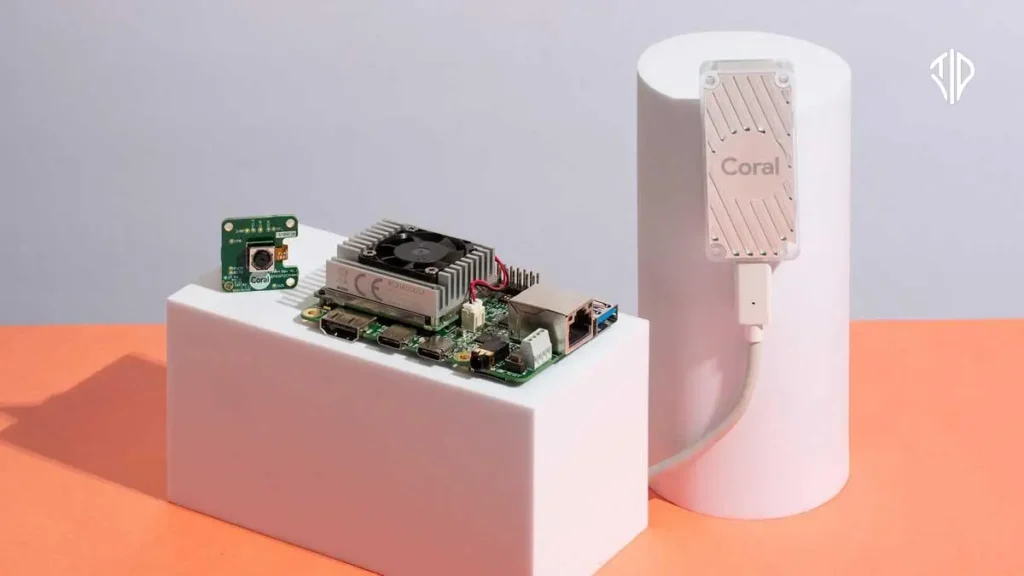
Google unveils a new neural processing unit (NPU) “Coral” which stands as a pivotal advancement, offering a full-stack, open-source platform designed to empower developers in building the next generation of Edge AI devices.
This initiative directly tackles critical challenges—performance, fragmentation, and privacy—that have previously limited the widespread adoption of powerful, always-on AI in low-power environments.
For years, the cutting edge of artificial intelligence has largely resided in the cloud, leveraging immense computational power to deliver sophisticated models for generative AI and complex data processing. Think of the vast data centers powering virtual assistants or sophisticated image recognition systems that require constant internet connectivity.
However, the future of AI isn’t solely about making these cloud models bigger; it’s about embedding intelligence directly into our immediate, personal environments. Just as smartphones revolutionized how we interact with information, Edge AI seeks to bring real-time, context-aware intelligence directly to the devices we carry and wear, transforming them into proactive, assistive companions.
The Rise of Edge AI and Its Challenges
The vision of ambient AI—proactively helping us navigate our day, translating conversations in real-time, or understanding our physical context without constant cloud dependency—requires a fundamental shift. This intelligence must run directly on battery-constrained edge devices, ensuring privacy and enabling truly all-day assistive experiences. Yet, this ambition faces three significant hurdles:
- The Performance Gap: State-of-the-art machine learning (ML) models demand substantial compute power. Edge devices, with their limited power, thermal, and memory budgets, simply cannot keep pace with these requirements, leading to compromises in model complexity or real-time responsiveness.
- The Fragmentation Tax: The landscape of proprietary processors for ML is highly diverse. Compiling and optimizing ML models for each unique hardware architecture is a complex, costly, and time-consuming endeavor, hindering consistent performance and broader adoption across devices.
- The User Trust Deficit: For personal AI to be genuinely helpful and accepted, it must prioritize the privacy and security of sensitive personal data and context. Relying solely on cloud processing for such intimate data raises significant trust concerns.
Introducing Coral NPU: An AI-First Architecture
To address these critical problems, Google introduces Coral NPU, a full-stack platform that builds upon the foundational work of the original Coral project.
Co-designed in partnership with Google Research and Google DeepMind, Coral NPU represents an AI-first hardware architecture. This means its design prioritizes ML efficiency from the silicon up, specifically optimizing for ultra-low-power, always-on edge AI.
Traditionally, chip designers have faced a fundamental trade-off between general-purpose CPUs, which offer flexibility but lack ML efficiency, and specialized accelerators, which are efficient for ML but inflexible for general tasks.
Coral NPU reverses this approach by prioritizing the ML matrix engine over scalar compute, creating a platform purpose-built for efficient, on-device inference.
As a complete, reference Neural Processing Unit (NPU) architecture, Coral NPU provides the essential building blocks for the next generation of energy-efficient, ML-optimized systems on chip (SoCs).
The architecture is based on a set of RISC-V ISA compliant architectural IP blocks—meaning it adheres to the open standard RISC-V instruction set architecture, offering flexibility and extensibility to SoC designers.
The base design delivers performance in the range of 512 giga operations per second (GOPS) while consuming just a few milliwatts, making it ideal for powerful on-device AI in:
- Edge devices
- Hearables
- Augmented Reality (AR) glasses
- Smartwatches
The Coral NPU architecture includes three core components:
- A Scalar Core: A lightweight, C-programmable RISC-V frontend that manages data flow to the back-end cores. It operates on a simple “run-to-completion” model, ensuring ultra-low power consumption for traditional CPU functions.
- A Vector Execution Unit: A robust single instruction multiple data (SIMD) co-processor compliant with the RISC-V Vector instruction set (RVV) v1.0. This unit enables simultaneous operations on large datasets, crucial for many ML algorithms.
- A Matrix Execution Unit: A highly efficient quantized outer product multiply-accumulate (MAC) engine, specifically designed to accelerate fundamental neural network operations. (Note: The matrix core is currently under development and slated for a future GitHub release).
A Unified Developer Experience
Beyond its innovative hardware, Coral NPU aims to simplify the development process, offering a unified developer experience. It provides a simple, C-programmable target that seamlessly integrates with modern compilers like IREE and TFLM, enabling easy support for popular ML frameworks such as TensorFlow, JAX, and PyTorch.
The comprehensive software toolchain includes:
- A specialized TFLM compiler for TensorFlow models.
- A general-purpose MLIR (Multi-Level Intermediate Representation) compiler.
- A standard C compiler.
- Custom kernels for specific optimizations.
- A simulator for testing and debugging.
This robust suite simplifies the journey of an ML model from a high-level framework to efficient execution on an edge device. For instance, a model from a framework like JAX is first imported into the MLIR format using the StableHLO dialect.
This intermediate file then enters the IREE compiler, which applies a hardware-specific plug-in to recognize the Coral NPU’s architecture. Through a process called progressive lowering, the code is systematically translated and optimized through a series of dialects, moving closer to the machine’s native language, ultimately generating a compact binary file for efficient execution.
Coral NPU’s co-design process focuses on efficiently accelerating leading encoder-based architectures used in current on-device vision and audio applications. Moreover, Google is collaborating closely with the Gemma team to optimize Coral NPU for small transformer models, positioning it as the first open, standards-based, low-power NPU designed to bring Large Language Models (LLMs) to wearables.
This dual focus offers developers a single, validated path to deploy both current and future AI models with maximum performance at minimal power.
Target Applications: Where Coral NPU Shines
Coral NPU is engineered to enable ultra-low-power, always-on edge AI applications, with a particular focus on ambient sensing systems. Its core goal is to enable all-day AI experiences on wearables, mobile phones, and Internet of Things (IoT) devices while minimizing battery usage.
Potential use cases include:
- Contextual Awareness: Detecting user activity (e.g., walking, running), proximity, or environment (e.g., indoors/outdoors) to enable “do-not-disturb” modes or other context-aware features.
- Audio Processing: Facilitating voice and speech detection, keyword spotting, live translation, transcription, and audio-based accessibility features.
- Image Processing: Enabling on-device person and object detection, facial recognition, gesture recognition, and low-power visual search.
- User Interaction: Empowering control via hand gestures, audio cues, or other sensor-driven inputs without relying on cloud services.
Hardware-Enforced Privacy and Ecosystem Building
A fundamental principle underpinning Coral NPU is building user trust through hardware-enforced security. The architecture is designed to support emerging technologies like CHERI (Capability Hardware Enhanced RISC Instructions), which provides fine-grained memory-level safety and scalable software compartmentalization.
This approach aims to isolate sensitive AI models and personal data in a hardware-enforced sandbox, significantly mitigating memory-based attacks and bolstering privacy.
Open hardware projects thrive on strong partnerships. To foster a vibrant ecosystem, Google is collaborating with Synaptics, a leader in embedded compute and multimodal sensing for the IoT. Synaptics has already announced their new Astra™ SL2610 line of AI-Native IoT Processors, which features their Torq™ NPU subsystem—the industry’s first production implementation of the Coral NPU architecture.
This partnership, built on an open-source compiler and runtime based on IREE and MLIR, marks a significant step toward a shared, open standard for intelligent, context-aware devices.
With Coral NPU, Google is laying a foundational layer for the future of personal AI. By providing a common, open-source, and secure platform, the goal is to foster a vibrant ecosystem that empowers developers and silicon vendors.
This initiative moves the industry beyond today’s fragmented landscape, encouraging collaboration on a shared standard for edge computing and enabling faster innovation for truly intelligent, context-aware devices.
Key Takeaways
- Addresses Edge AI Challenges: Coral NPU directly tackles critical issues in Edge AI, including performance limitations, hardware fragmentation, and privacy concerns, paving the way for wider adoption.
- AI-First Hardware Architecture: Co-designed with Google Research and DeepMind, Coral NPU is purpose-built for ultra-low-power, always-on ML, prioritizing ML efficiency from the silicon up.
- Unified Developer Experience: The platform offers a comprehensive software toolchain, integrating with modern compilers (IREE, TFLM, MLIR) and popular ML frameworks, simplifying deployment from high-level models to efficient edge execution.
- Enables Diverse Edge Applications: With performance in the range of 512 GOPS at low power, Coral NPU is ideal for ambient sensing, contextual awareness, audio/image processing, and user interaction in wearables, AR glasses, smartwatches, and IoT devices.
- Hardware-Enforced Privacy & Open Ecosystem: It supports advanced security features like CHERI for memory safety and partners with industry leaders like Synaptics to build an open, standards-based ecosystem for intelligent edge devices.
Join our community by subscribing to our Weekly Newsletter to stay updated on the latest AI updates and technologies, including the tips and how-to guides. (Also, follow us on Instagram (@inner_detail) for more updates in your feed).
(For more such interesting informational, technology and innovation stuffs, keep reading The Inner Detail).
