
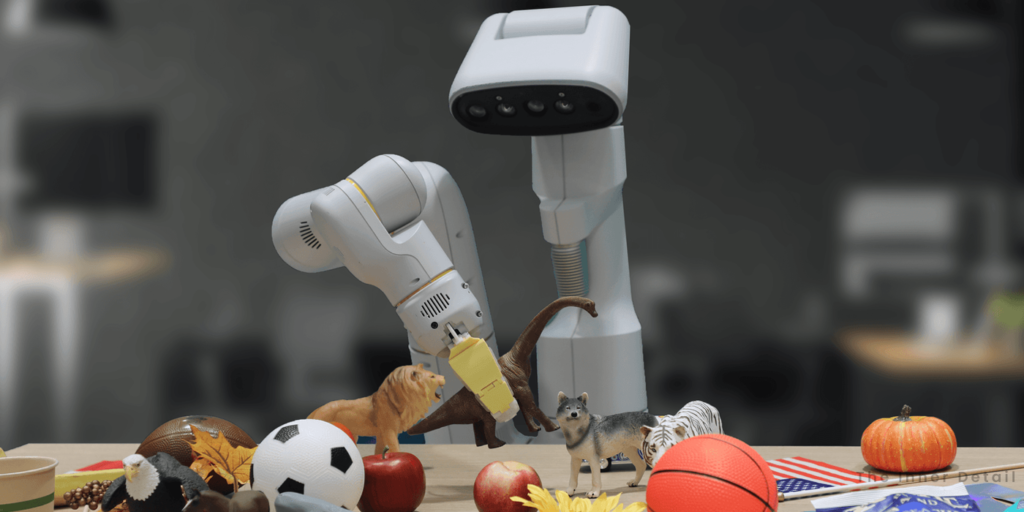
The shift from Generative AI to Physical AI represents the move from chatbots that can write about the world to robots that can actually navigate it. While the former focuses on digital content, Physical AI—often called Embodied AI—integrates large-scale reasoning with physical sensors and actuators.
As mentioned by Jensen Huang, CEO of Nvidia, Physical AI takes the stage as a successor to generative-AI, aiming to bridge the gap between AI tech and real world. As every electrical appliance in the home could able to solve the problem that it was intended to, Physical AI may visit your homes to solve the problem that even machines weren’t capable of solving – routine tasks such as cleaning, brooming, fold laundry and more.
The following article explores the critical infrastructure required to bridge this gap, specifically focusing on the recent 2026 breakthroughs from NVIDIA and its partners.
Key Takeaways
- Physical AI bridges the digital-physical divide by integrating reasoning with sensors and actuators governed by the laws of physics.
- The NVIDIA Physical AI Data Factory Blueprint unifies training, simulation, and edge computing to solve the robotics data bottleneck.
- Omniverse DSX allows for gigawatt-scale digital twins, enabling companies to optimize factories in a virtual environment before physical implementation.
- Sim2Real training allows robots like Hexagon’s AEON to master complex industrial tasks in simulation before being deployed in the real world.
Defining the Physical AI Paradigm
Most people are familiar with Generative AI as a tool for creating text, images, or code. However, Physical AI is fundamentally different because it must contend with the laws of physics, such as friction, gravity, and material density. In a digital environment, a mistake costs a few tokens; in a factory, a mistake can cost millions of dollars in hardware damage or human safety.
Physical AI is the integration of perception, reasoning, and action. To reach this stage, a robot cannot simply be programmed with if-then statements. It must possess a world model that understands spatial relationships and can predict the physical consequences of its movements before it executes them.
The NVIDIA Physical AI Data Factory Blueprint
On March 26, 2026, NVIDIA announced the Physical AI Data Factory Blueprint, a reference architecture designed to solve the biggest bottleneck in robotics: data. Unlike Generative AI, which can scrape the internet for text, Physical AI requires high-fidelity, physically accurate data that is nearly impossible to collect at scale in the real world.
The blueprint unifies three distinct compute environments. The first is the training computer, where foundation models like NVIDIA Cosmos are pre-trained. The second is the simulation computer, which uses the Omniverse DSX platform to create a virtual proving ground.
The third is the edge computer, such as the Jetson Thor, which lives inside the robot and executes the learned skills in real-time. This architecture transforms raw compute power into the high-quality synthetic data necessary to train the next generation of autonomous systems.
Omniverse DSX and the Digital Twin Advantage
The centerpiece of this new blueprint is Omniverse DSX, a simulation platform built on OpenUSD (Universal Scene Description). Omniverse DSX allows companies to build a gigawatt-scale digital twin of an entire factory before a single brick is laid.
This is not just a visual 3D model; it is a live, functional simulation that accounts for thermal cooling, electrical loading, and robot-to-human traffic patterns.
By simulating the factory in software, operators can run what-if scenarios. For instance, they can test how a power failure might affect automated assembly lines or how a new robot fleet will interact with legacy machinery.
This virtual staging reduces the time to first production and ensures that the physical facility is optimized for the AI agents that will eventually run it.
Sim2Real Training for the Hexagon AEON Humanoid
A primary beneficiary of this simulation-first approach is Hexagon’s AEON humanoid. AEON is designed for complex industrial tasks like inspecting equipment in cramped corridors or managing logistics in hazardous zones.
Training a humanoid robot to walk and manipulate objects in the real world is slow and dangerous; however, using Omniverse DSX and Isaac Sim, Hexagon can accelerate this process through Simulation-to-Reality (Sim2Real) training. In the virtual factory, AEON can practice a specific task—such as checking a valve or moving a crate—millions of times in parallel across different lighting conditions and floor textures.
The robot learns from synthetic data, mastering perception and coordination in a fraction of the time it would take in a physical lab. Once the neural network achieves a high success rate in the digital twin, the policy is deployed to the physical AEON robot, allowing it to perform with industrial-grade precision from day one.
The Future of the Autonomous Factory
The transition toward Physical AI suggests that every industrial company will eventually become a robotics company. As world foundation models like Cosmos 3 continue to unify vision reasoning and action simulation, the barrier between digital planning and physical execution will vanish.
The goal of the Physical AI Data Factory is to reach a state where the digital twin is always in sync with the physical facility. In this future, robots like AEON act as a bridge, continuously capturing spatial data and feeding it back into the digital twin to refine the factory’s efficiency. This closed-loop system ensures that as the AI gets smarter, the factory itself becomes a more resilient and productive organism.
Join our community by subscribing to our Weekly Newsletter to stay updated on the latest AI updates and technologies, including the tips and how-to guides. (Also, follow us on Instagram (@tid_technology) for more updates in your feed and our WhatsApp Channel to get daily news straight to your Messaging App).
