
Generative Artificial Intelligence (AI) has rapidly transformed how we think about work, but which professions are truly on the front lines of this change? A new study by Microsoft Research, dubbed the “Working with AI” report, offers a compelling look at how these advanced language models are already reshaping daily tasks across various industries, implying the professions which are at direct risk of getting replaced.
By analyzing a massive dataset of 200,000 anonymized Bing Copilot conversations, researchers have identified key trends, distinguishing between jobs that are highly susceptible (risky) to AI’s influence and those that remain largely untouched.
Unpacking the Study’s Insights
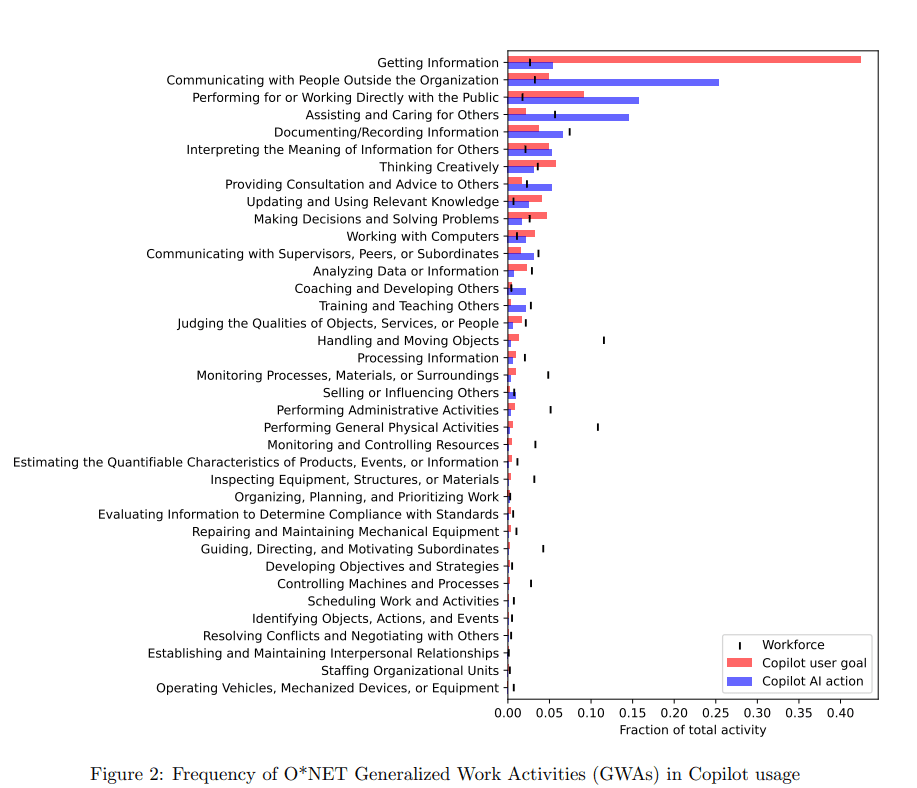
The Microsoft study dives deep into how generative AI interacts with human work by drawing a crucial distinction: what people want to accomplish (the “user goal”) versus what the AI actually does (the “AI action”). This analysis revealed that in a significant 40 percent of cases, the user’s goal and the AI’s activity involved different sets of tasks. This highlights AI’s role not as a direct replacement, but often as a coach or advisor, supporting and enhancing human capabilities rather than simply taking over.
To measure AI’s impact, the researchers developed an “AI Applicability Score,” which considers how frequently AI is used for certain tasks, its success rate, and how completely AI can handle those tasks. This score helps quantify the potential influence of AI on different occupations. The study also mapped user goals and AI actions to the O*NET database, which categorizes U.S. jobs by their core activities, providing a robust framework for their findings.
Where AI Shines: The Most Affected Professions
The study found that AI is currently making its biggest waves in areas involving knowledge work, communication, and sales. Tasks where AI performs best—and where user satisfaction and completion rates are highest—include:
- Collecting information and research: This is a core strength, aligning with R&D needs like literature reviews.
- Writing and editing: AI excels at drafting reports and refining written materials.
- Communicating ideas: This includes tasks like explaining technical details.
- Analyzing data and developing models: While some complex aspects might be challenging for AI, it significantly assists in foundational data analysis.
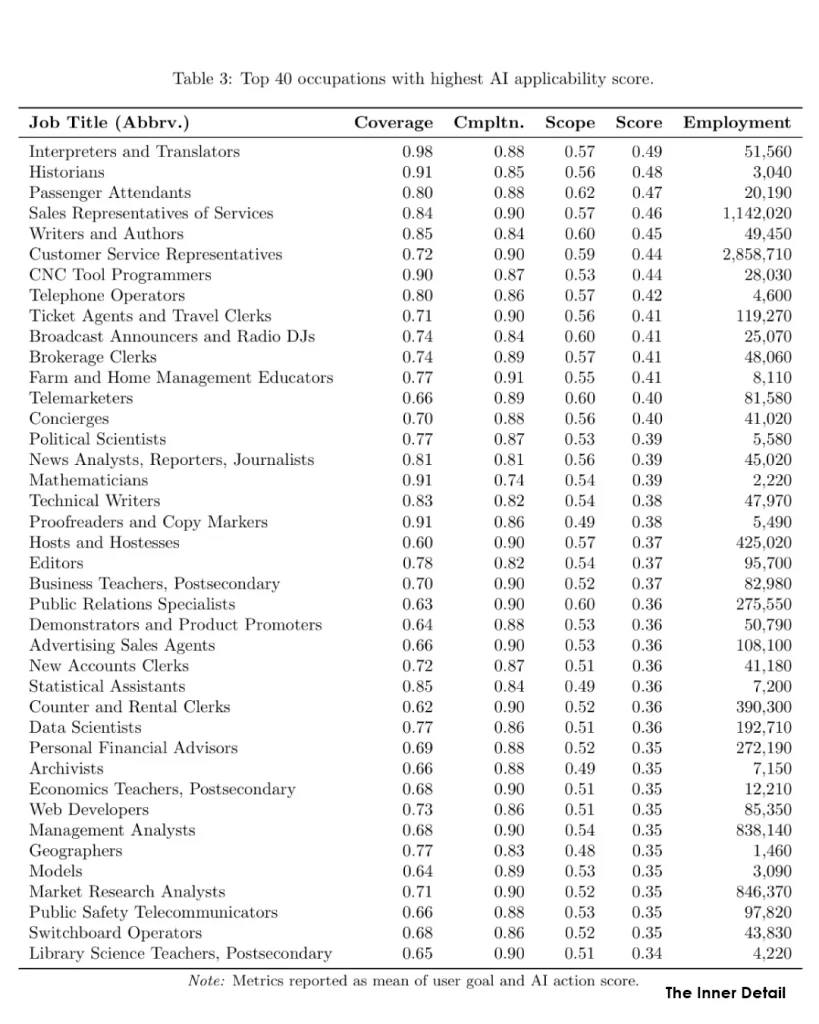
Given these strengths, the professions with the highest “AI Applicability Scores” were:
- Translators
- Historians
- Writers (including technical writers)
- Media professionals
- Customer advisors
- Salespeople
- Technical roles like CNC Programmers (scoring 0.44, highest among STEM-relevant occupations)
- Mathematicians (scoring 0.39, benefiting from AI’s strength in data analysis and model development)
- Data Scientists (scoring 0.36)
- Market research analysts (scoring 0.35)
- Web developers (scoring 0.35)
Read this: Future of Jobs – 2025: Fastest Growing & Declining Jobs in next 5 Years
These findings suggest that roles heavily reliant on information processing, linguistic tasks, and structured analysis are most likely to see their everyday work tasks shaped by generative AI.
Where AI Struggles: The Least Affected Professions
Conversely, the study identified a significant category of jobs where current generative AI tools have little to no impact. These are primarily physical jobs or those requiring real-world interaction and hands-on work. AI systems, particularly large language models like Copilot, struggle with tasks that demand:
- Physical activity (e.g., handling and moving objects)
- Monitoring physical processes or equipment
- On-site problem-solving (e.g., repairs)
- Direct caregiving
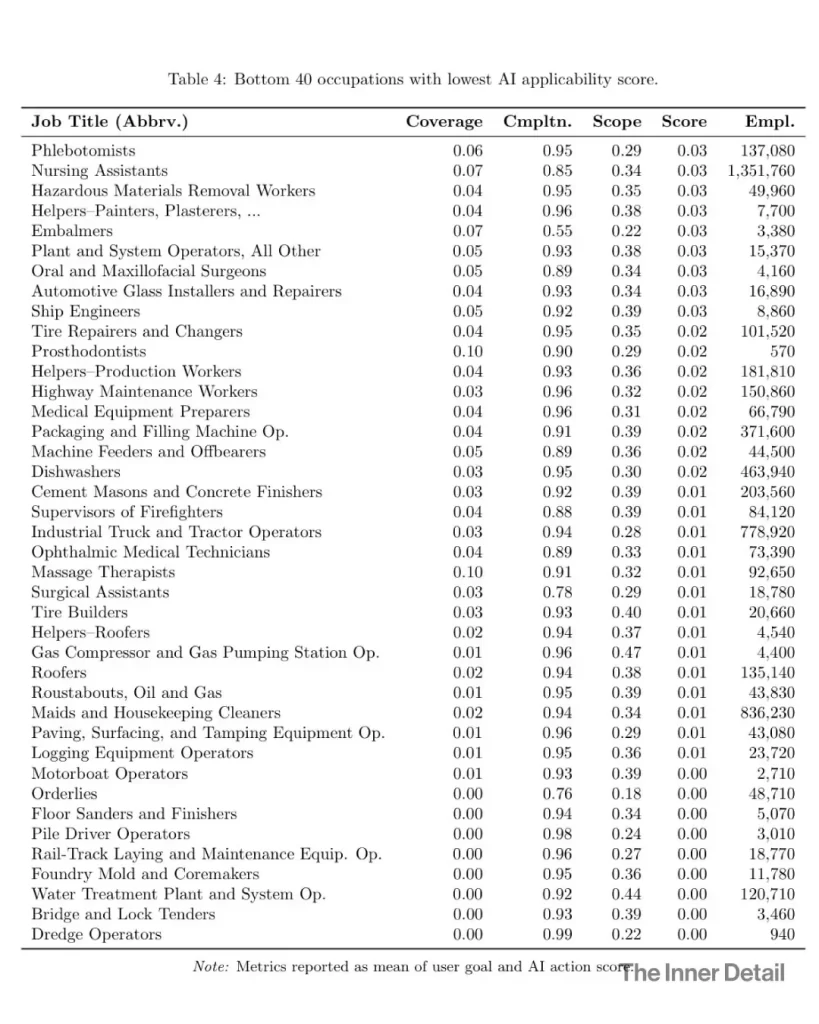
Professions at the lower end of the AI applicability scale include:
- Caregivers
- Tradespeople
- Cleaners
- Machine operators
- Medical equipment preparers (scoring 0.02)
- Ophthalmic medical technicians (scoring 0.01)
- Chemical plant operators (scoring 0.00)
- Foundry mold and coremakers (scoring 0.00)
You may like to read this: 2025 Tech Jobs Market – Hiring Trends, in-Demand Skills & Salaries (includes a Dashboard)
This highlights a clear divide: while AI excels at “desk work” like literature synthesis and report drafting, it has minimal “bench impact” on hands-on experimental work or equipment operation. Interestingly, the study found almost no correlation between a job’s AI suitability and its pay or education level, although roles requiring a bachelor’s degree were only slightly more affected.
AI: Not a Replacement, But an Assistant
A crucial takeaway from this Microsoft study is a caution against assuming that AI capability will automatically lead to widespread automation or job loss. Instead, the report strongly emphasizes AI’s role as an assistant, supporting and enhancing human work. The authors draw parallels to the introduction of ATMs in banking: automation changed how people worked and even created new roles, rather than simply eliminating them.
Read this: How to prepare to be AI-Ready?
This means that while certain tasks within professions may be transformed, the human element—especially in creative problem-solving, real-world interaction, and nuanced decision-making—remains invaluable.
Important Considerations
It’s vital to remember that these findings are based entirely on Microsoft Copilot usage in the U.S. and may not fully represent trends on other platforms or in different countries. The study also did not include informal work, tasks outside standard job categories like household labor, or the rapidly advancing field of AI-robotics integration.
Microsoft study offers a fascinating and valuable roadmap for understanding AI’s current impact on the job market. It underscores that generative AI is a powerful tool for transforming knowledge work, communication, and sales, while physical and hands-on professions remain largely distinct. The future of work, it seems, will be less about outright replacement and more about a dynamic partnership between humans and intelligent machines.
Key Takeaways
- AI is significantly impacting knowledge work, communication, and sales professions.
- Professions requiring physical labor and real-world interaction are less affected by current AI technologies.
- AI is primarily acting as an assistant, enhancing human capabilities rather than replacing jobs entirely.
- The impact of AI varies based on the platform and geographic location.
Join our community by subscribing to our Weekly Newsletter to stay updated on the latest AI updates and technologies, including the tips and how-to guides. (Also, follow us on Instagram (@inner_detail) for more updates in your feed).
(For more such interesting informational, technology and innovation stuffs, keep reading The Inner Detail).
