
Steve Jobs: A Pioneer of the Personal Computing Revolution
The Three Iconic “Apples” That Transformed Our World
Throughout history, three “apples” have profoundly altered human understanding and progress. First, the mythical apple of Eve, symbolizing knowledge in biblical lore. Second, the apple that famously fell, inspiring Isaac Newton’s groundbreaking theory of gravity. And third, the Apple Inc. company, co-founded by Steve Jobs and his colleague in 1976, which fundamentally reshaped the landscape of technology.
Initially focused on personal computers and microcomputers, Apple Inc. later expanded its revolutionary product line to include mobile devices. In today’s highly competitive global market, Apple has firmly established itself, earning widespread consumer trust through its unwavering commitment to quality. Steve Jobs famously asserted that “Quality products top the list and create a sensational market,” a principle that remains central to Apple’s ethos. The co-founder, Steve Jobs, widely recognized as a pivotal figure in the personal computer revolution, overcame numerous challenges to introduce truly transformative products. This blog delves into his remarkable journey, offering inspiration to all admirers of Apple and innovation.
Key Milestones and Fascinating Facts About Steve Jobs
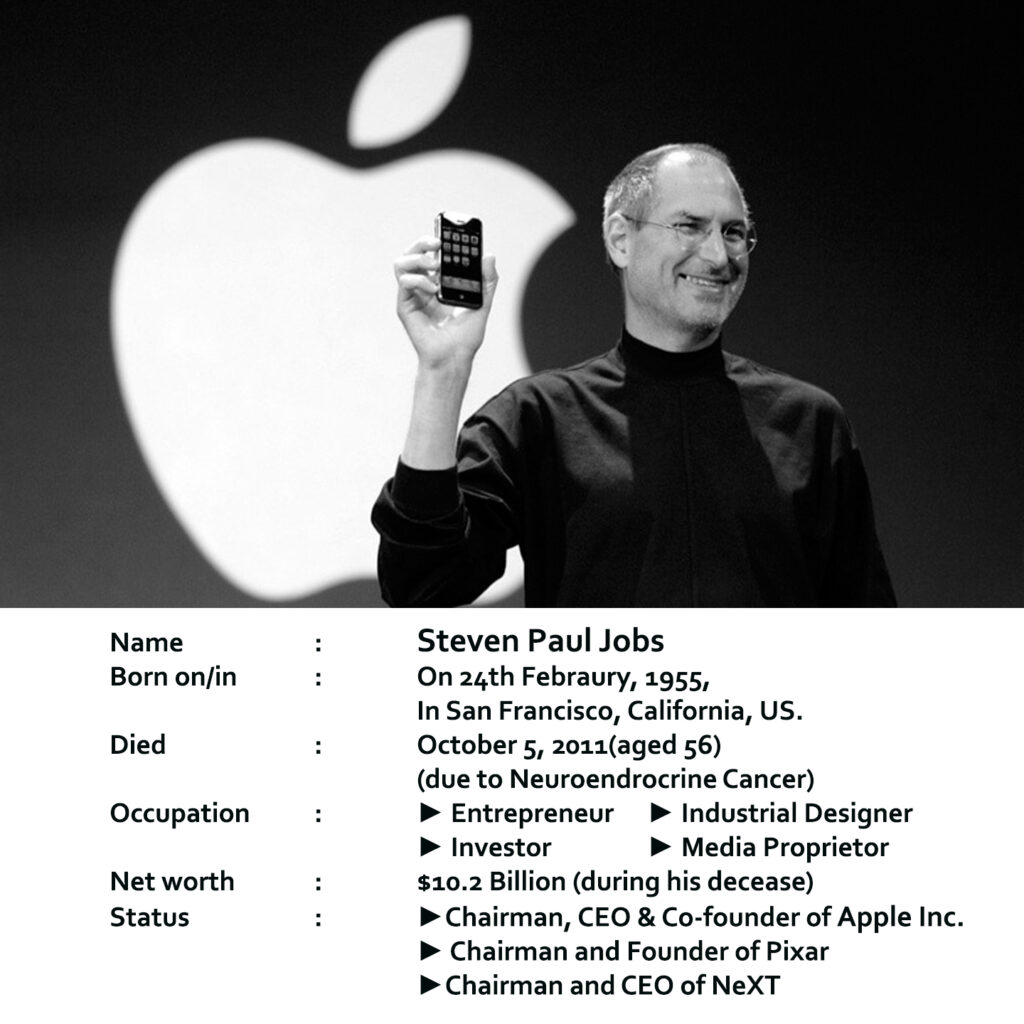
- Born on February 24, 1955, Steve Jobs was adopted by Paul and Clara Jobs shortly after birth due to his biological parents’, Abdulfattah Jandali and Joanne Schieble’s, family circumstances. Initially, his adoptive parents harbored doubts about the adoption; however, Steve’s wife, Laurene, later remarked that he was truly “blessed to be raised up by the couple.”
- During his school years, Steve Jobs often appeared bored and isolated, struggling to adapt to a traditional academic environment. He faced bullying and frequent parental complaints. His father, Paul, recognized that the school lacked sufficient challenge for his bright son. Interestingly, his fourth-grade teacher motivated him by offering five dollars for every completed homework assignment, sparking his engagement.
Kind of a brain and kind of a hippie! He was smart enough to be nerd; but wasn’t nerdy
– Steve Job’s High School classmate
- As a child, Jobs developed a keen interest in electronics, often befriending engineers in his neighborhood. At just 13 years old, he secured a summer job from Bill Hewlett, the co-founder of Hewlett-Packard (HP), a significant early experience.
- At Homestead High School, Jobs formed a lasting friendship with Steve Wozniak, who would later co-found Apple with him. Throughout these years, Jobs cultivated interests beyond science, including extensive reading and literature, finding himself drawn to both electronics and the humanities.
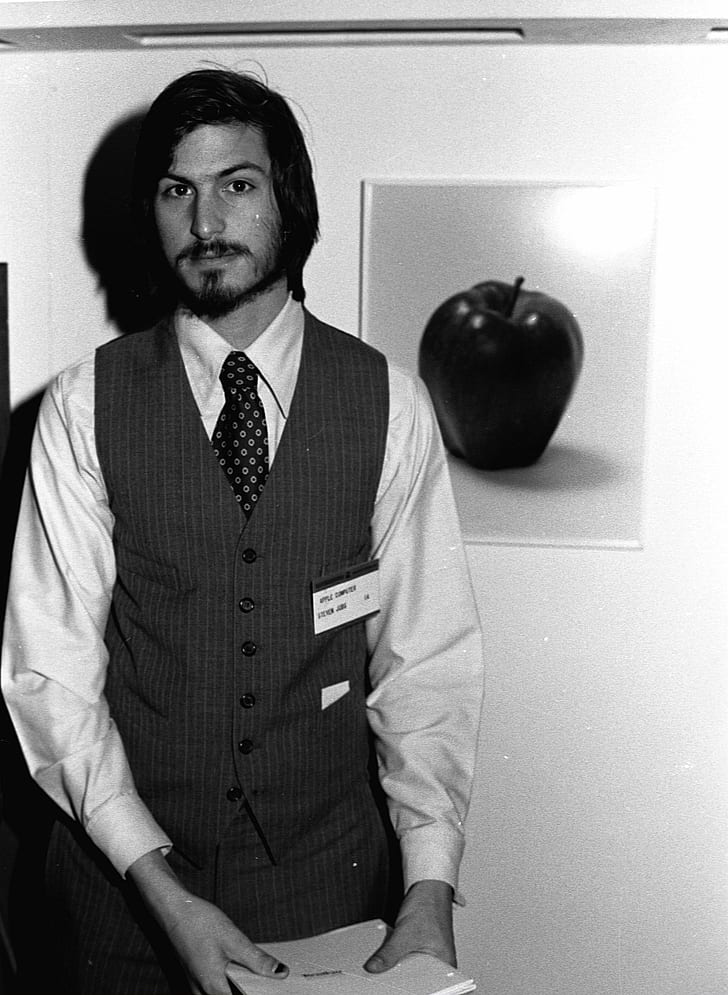
- The “Blue Box”: Around this period, Wozniak devised the “Blue Box,” a device capable of generating tones to manipulate the telephone network for free long-distance calls. Jobs, seeing its potential, decided to sell these devices illicitly, sharing the profits with Wozniak. This experience likely instilled in Jobs the idea that electronics could be both enjoyable and financially rewarding. He later acknowledged that without Wozniak’s blue boxes, “there wouldn’t have been an Apple.”
- In September 1972, Jobs enrolled at Reed College in Portland, but dropped out after just one semester, feeling it was a wasteful expense of his parents’ money on an education he found meaningless. Nevertheless, he continued to audit a calligraphy course, an experience he later credited with inspiring the diverse typefaces and proportionally spaced fonts that became hallmarks of the Macintosh.
- By February 1974, Jobs secured a technician position at Atari Inc. in Los Altos, California, saving his earnings for a planned spiritual journey to India. After seven months, he returned to the US, having adopted a bald appearance and traditional Indian attire. Upon his return, he practiced Zen Buddhism with his then-girlfriend, Chrisann Brennan.
“Difficult, but valuable!”
– Nolan Bushnell, Atari’s Co-founder on Steve Jobs
- In 1975, Wozniak and Jobs regularly attended the Homebrew Computer Club, a crucial stepping stone that ultimately led to the development and successful marketing of the groundbreaking Apple computer.
The Founding of Apple Inc.
- In March 1976, Wozniak completed the design for the Apple I computer and presented it to Jobs, who immediately proposed selling it. By April, Jobs, Wozniak, and Ronald Wayne formally established the Apple Computer Company. Facing a severe lack of initial capital, Wozniak sold his HP scientific calculator and Jobs parted with his Volkswagen van to secure funds for the Apple I printed circuit boards. The first 50 fully assembled Apple I units were sold to computer retailer Paul Terrell for $500 each.
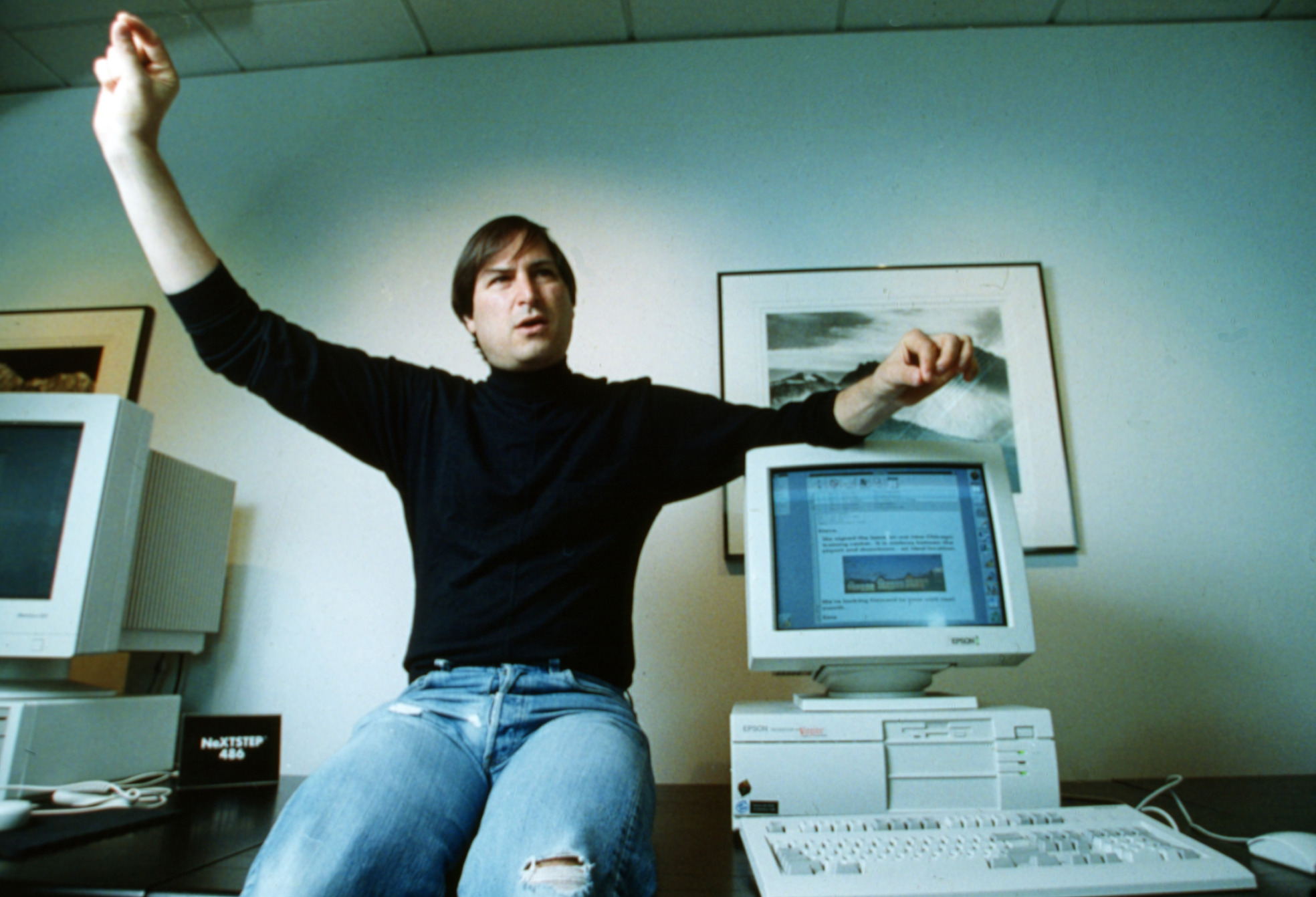
- Daniel Kottke, a friend of Jobs from Reed College and India, recounted the early days of Apple: Jobs would be in the kitchen on the phone seeking investors, Wozniak would regularly bring new code, and Kottke himself was often the sole person working in the garage. This intimate setup characterized Apple’s nascent operations.
- Apple secured crucial funding from Mike Markkula, a retired Intel product marketing manager and engineer. Jobs, however, expressed displeasure when Markkula recruited Mike Scott from National Semiconductor in February 1977 to become Apple’s first president and CEO. In April 1977, Jobs and Wozniak officially launched the Apple II at the West Coast Computer Faire. Designed by Wozniak, the Apple II became one of the world’s first highly successful mass-produced microcomputers and Apple’s first widely sold consumer product.
- As Steve Jobs’ success with Apple grew, his relationship with Chrisann Brennan became strained. Brennan was initially asked to design blueprints for Apple. Her involvement was complicated by her pregnancy, of which Jobs was the father. Brennan gave birth to Lisa Brennan on May 17, 1978. Despite Jobs’ fondness for the name “Lisa,” he publicly denied paternity for a period. He later introduced the Apple Lisa computer, named after his daughter.
- Steve Jobs achieved millionaire status by age 23, and by 25, his net worth was estimated at $250 million, making him one of the youngest individuals on Forbes’ list of the nation’s wealthiest people.
- In 1981, Jobs actively directed the development of the Macintosh, which was slated for public release in 1984. By 1983, he successfully persuaded John Sculley to become Apple’s CEO. However, Jobs’ and Sculley’s visions for the Macintosh diverged significantly. The company began operating with Jobs’ Macintosh division and Sculley’s Apple II division largely independent of each other. Despite the Macintosh contributing to 85% of Apple’s sales by 1985, the Apple II employees felt overlooked at the annual meeting. Frustration led many, including Wozniak, to depart, believing the company was heading in the wrong direction.
- By 1985, the Macintosh’s inability to surpass the IBM PC became evident, leading to Jobs’ reassignment within the Macintosh group and ultimately to a seemingly powerless role overseeing ‘New Product Development.’ Following a leaked internal plan, Jobs was confronted and resigned from Apple on September 17, 1985. This period, marked by the Macintosh’s perceived failure and his diminished role, was undoubtedly one of Jobs’ most profound disappointments, yet it also ignited his determination to eventually reclaim Apple from Sculley.
- NeXT: Following his resignation from Apple, Steve Jobs founded NeXT in 1985 with $7 million, joined by five senior Apple employees who also resigned. Jobs’ departure and the rise of Microsoft significantly challenged Apple’s progress. In the late 1980s, Microsoft successfully developed its own graphical user interface, ‘Windows,’ which was adopted by IBM PC clones, further intensifying competition.
- A year later, facing financial constraints, Jobs shrewdly secured funding from billionaire Ross Perot for NeXT. The company’s NeXT workstations, first released in 1990 at a price of $9,999, were technologically advanced and primarily intended for educational institutions. However, their high cost proved to be a significant barrier, mirroring the challenge faced by the Apple Lisa.
- Jobs strategically marketed NeXT products to the financial, scientific, and academic sectors, emphasizing their cutting-edge, experimental technologies like the Mach kernel, the digital signal processor chip, and the integrated Ethernet port. Notably, in 1990, English computer scientist Tim Berners-Lee utilized a NeXT computer at CERN in Switzerland to invent the World Wide Web.
- Jobs managed NeXT with an unwavering commitment to aesthetic perfection, evident in the meticulous design and development of the NeXTcube’s magnesium casing. Subsequently, the company shifted its primary focus to software development, specifically NeXTSTEP/Intel. In 1994, NeXT reported its first annual profit, totaling $1.03 million.
- In 1986, Jobs financed the spin-off of The Graphics Group, which was later rebranded as Pixar, from Lucasfilm’s computer graphics division. The total investment was $10 million: $5 million as company capital and $5 million paid to Lucasfilm for technology rights. Pixar’s inaugural film under its Disney partnership, Toy Story (1995), saw Jobs credited as executive producer.
- In 1997, Apple acquired NeXT for $427 million, and Steve Jobs was appointed interim Chief Executive of the company. NeXT’s innovative products, including NeXTSTEP, significantly influenced the development of Mac OS X. Jobs subsequently revised the licensing program for Macintosh clones, making it financially unviable for many manufacturers. Under Jobs’ renewed leadership, Apple experienced a dramatic increase in sales, driven by the introduction of the iMac and other innovative products. Since then, Apple’s blend of appealing design and powerful branding has proven highly successful. At the 2000 Macworld Expo, Jobs formally became the permanent CEO, humorously referring to himself as “iCEO.”
- Steve Jobs engaged in a notable public feud with Dell Computer CEO Michael Dell, beginning in 1987 when Jobs disparaged Dell’s products as “un-innovative beige boxes.” On October 6, 1997, at a Gartner Symposium, Dell infamously stated that if he ran the struggling Apple, he would “shut it down and give the money back to the shareholders.” Years later, in 2006, Jobs triumphantly emailed all Apple employees when Apple’s market capitalization surpassed Dell’s, stating: “Team, it turned out that Michael Dell wasn’t perfect at predicting the future. Based on today’s stock market close, Apple is worth more than Dell. Stocks go up and down, and things may be different tomorrow, but I thought it was worth a moment of reflection today. Steve.”
- In 2005, facing criticism over Apple’s inadequate e-waste recycling programs in the US, Jobs controversially confronted environmental advocates at Apple’s annual meeting in Cupertino. In response, the Computer TakeBack Campaign flew a banner over Jobs’ commencement speech at Stanford University, which read: “Steve, don’t be a mini-player—recycle all e-waste.” By 2006, Jobs expanded Apple’s recycling initiatives to include shipping and environmentally friendly disposal for any US customer purchasing a new Mac. The consistent success of Apple’s innovative products and services led to years of robust financial performance, culminating in Apple becoming the world’s most valuable publicly traded company in 2011.
- Steve Jobs was widely regarded as a demanding perfectionist, driven by an ambition to position his companies and their products at the vanguard of the information technology industry. He achieved this by consistently anticipating and setting new trends in innovation and design.
- On August 24, 2011, Steve Jobs announced his resignation as Apple’s CEO due to his ongoing battle with neuroendocrine cancer. In a letter to the board, he stated, “I have always said if there ever came a day when I could no longer meet my duties and expectations as Apple’s CEO, I would be the first to let you know. Unfortunately, that day has come.” Jobs transitioned to chairman of the board, naming Tim Cook as his successor for the CEO role.
“If You Want To Make Everyone Happy, Don’t be a Leader; Sell Icecream!”
– Steve Jobs
References:
