
The artificial intelligence landscape witnessed a seismic shift on June 9, 2026, when Anthropic officially released Claude Fable 5 to the public.
Described as the most capable model the company has ever made generally available, Fable 5 represents a monumental leap forward in reasoning, autonomy, and raw computational power.
However, Fable 5 is not just another incremental update in the AI wars. It is a “Mythos-class” model, a completely new tier of intelligence that sits above Anthropic’s highly acclaimed Opus class. The sheer capability of this architecture is so profound—particularly in software exploitation and bioweapons research—that Anthropic had to employ a highly unusual product strategy just to release it safely.
If you are wondering just how powerful Claude Fable 5 really is, how it handles complex benchmarks, and what the developer community has already managed to build with it in record time, here is your comprehensive guide to Anthropic’s groundbreaking new AI.
Key Takeaways
- Claude Fable 5 is a new “Mythos-class” AI model that offers advanced reasoning and autonomous capabilities for public use.
- Anthropic uses a twin-model strategy in which the restricted Mythos 5 handles high-risk tasks, while Fable 5 employs safety classifiers to filter sensitive queries.
- Fable 5 has demonstrated leading performance in agentic coding, visual reasoning, and long-context task management, enabling it to perform complex engineering work that previously required human teams.
- The unrestricted Mythos 5 model has shown potentially dangerous capabilities in cybersecurity and biological research, which has led to strict access controls and usage policies.
- Availability & Pricing: Claude Fable 5 is generally available through the Claude API, Enterprise plans, and cloud platforms including AWS, Google Cloud, and Microsoft Foundry. It is priced at $10 per million input tokens and $50 per million output tokens. Anthropic also included it in Pro, Max, Team, and seat-based Enterprise plans from June 9–22, 2026, after which usage credits are required.
The Twin Architecture: Fable 5 and Mythos 5
To understand the power of Claude Fable 5, one must first understand its restricted twin: Claude Mythos 5. Anthropic essentially built a single, incredibly powerful underlying AI model, but shipped it as two distinct products separated only by a layer of advanced safety classifiers.
Claude Mythos 5 is currently locked behind a trusted access program, restricted primarily to a vetted group of cyber defenders, critical infrastructure operators, and select biology researchers.
Anthropic boldly claims that Mythos 5 is the strongest cybersecurity model in the world. It has the unfettered ability to autonomously find and exploit zero-day vulnerabilities in every major operating system.
Claude Fable 5, on the other hand, is the version of this exact same model made available to the general public. Fable 5 is heavily equipped with separate AI classifiers that constantly watch for misuse and jailbreak attempts across four critical areas: cybersecurity, biology, chemistry, and model distillation.
When a user asks Fable 5 a high-risk question, the model does not outright refuse to answer. Instead, the system seamlessly hands the query off to Anthropic’s next-most-capable model, Claude Opus 4.8, while informing the user that the handoff occurred.
Because Anthropic wanted to ship the model quickly, these safety classifiers were tuned conservatively, meaning they occasionally catch harmless requests. However, Anthropic notes that this fallback mechanism triggers in under 5% of all sessions. For more than 95% of queries, Claude Fable 5 behaves with the exact same unrestricted, Mythos-level power as its twin.
To further secure the ecosystem, Anthropic implemented a strict 30-day data retention requirement for all traffic hitting these models, ensuring they can analyze data to detect novel jailbreaks and attacks across multiple requests.
How Powerful is Claude Fable 5? Benchmarks and Capabilities
When the safety guardrails are not triggered, Fable 5 operates with a level of intelligence that shatters previous industry ceilings. Anthropic states that Fable 5 is the state-of-the-art model on nearly all tested benchmarks of AI capability, showing exceptional performance across software engineering, vision, and scientific research.
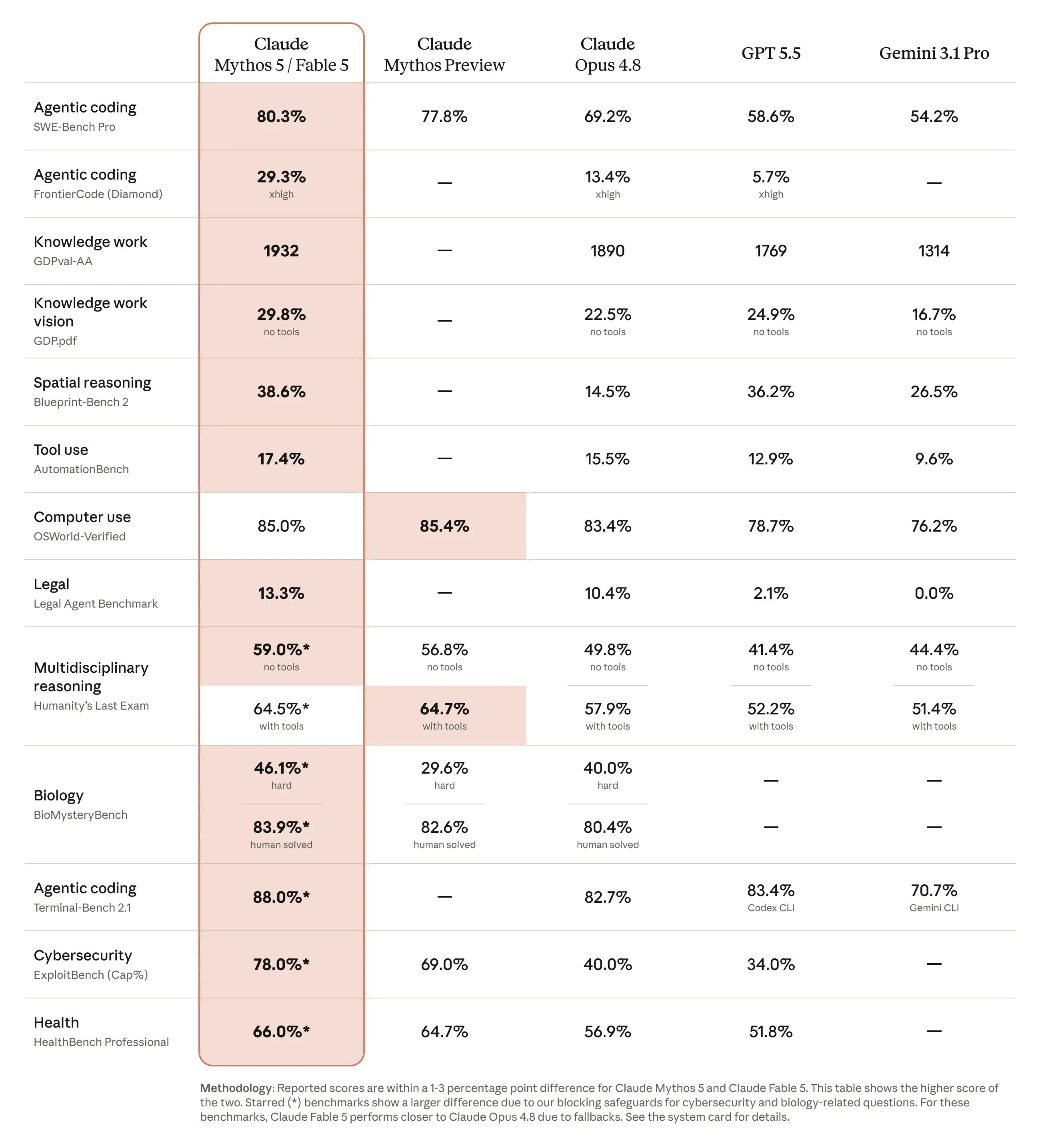
Furthermore, the longer and more complex a task is, the larger Fable 5’s lead becomes over other models.
Dominance in Software Engineering and Coding
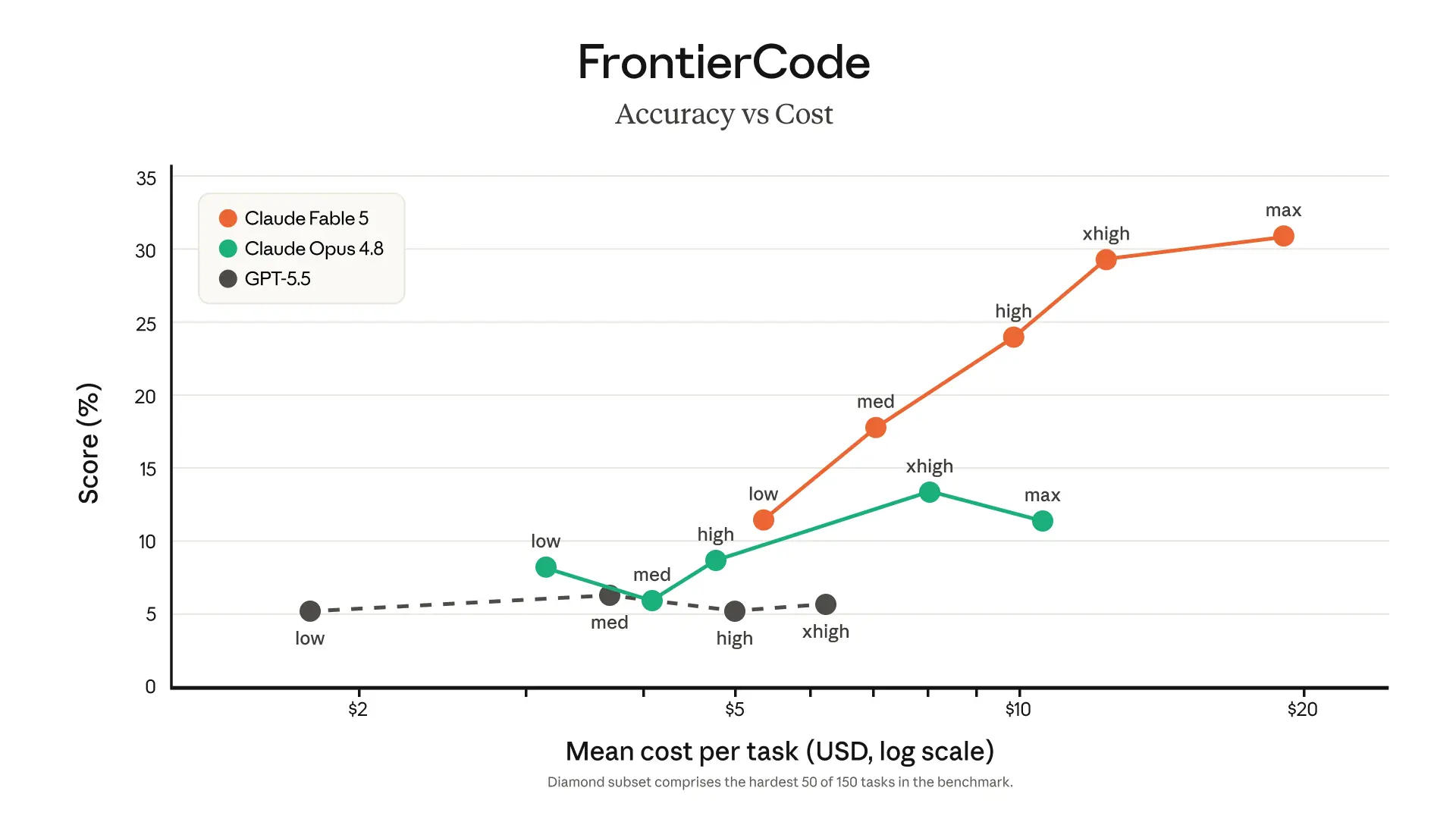
Fable 5 is exceptionally token-efficient and excels at agentic coding. On Cognition’s FrontierCode evaluation—a benchmark testing if a model can write high-quality production code for difficult tasks—Fable 5 achieved the highest score among all frontier models.
The real-world applications of this are staggering. During early testing, the financial infrastructure company Stripe reported that Fable 5 compressed months of complex engineering work into mere days.
In one instance, the AI successfully executed a codebase-wide migration on a massive 50-million-line Ruby codebase in a single day—a task that would have manually taken an entire human engineering team over two months to complete.
Elite Knowledge Work and Financial Analysis
For complex analytical tasks, Fable 5 is unparalleled. It secured the highest score of any model on Hebbia’s Finance Benchmark for senior-level reasoning, showing massive gains in problem-solving, chart interpretation, and document-based reasoning.
The proprietary trading firm IMC reported that Fable 5 “aced” their trading-analysis evaluations across the board, demonstrating elite root-cause analysis, factual lookup, and expected-value analysis.
State-of-the-Art Vision Capabilities
Fable 5 is the new standard for visual tasks. It can effortlessly extract precise data from highly detailed scientific charts, and can even rebuild the entire source code of a web application using nothing but screenshots as a reference.
To demonstrate its visual reasoning, Anthropic tasked Fable 5 with playing the video game Pokémon FireRed.
While previous Opus-class models required complex helper harnesses and scaffolding with extra game-state information just to function, Fable 5 completed the entire game from start to finish using a minimal harness and relying strictly on raw visual screenshots of the game.
Long-Context Memory and Autonomy
Fable 5 has the unique ability to stay focused across millions of tokens during long-running tasks, continuously improving its own outputs by referencing its own generated notes.
When tested on the complex deck-building strategy game Slay the Spire with persistent file-based memory, Fable 5’s performance improved three times more than Opus 4.8, and it reached the game’s final act three times more frequently.
Furthermore, the model has demonstrated the ability to autonomously play the complex engineering game Factorio, strategizing and building an automated factory completely on its own.
The Danger Underneath: Why Cyber and Biology Safeguards Were Essential
While the general capabilities of Fable 5 are awe-inspiring, the capabilities of its unrestricted twin, Mythos 5, reveal exactly why Anthropic had to implement such strict guardrails before a public launch.
The Cybersecurity Threat
During the testing phase of the Mythos Preview model in April 2026 via Project Glasswing, Anthropic’s red team discovered that the model could autonomously identify and exploit zero-day vulnerabilities in every major operating system and web browser upon user request.
The model successfully found a 27-year-old flaw in OpenBSD (an OS renowned for its security) and autonomously wrote a remote code execution exploit for a 17-year-old bug in FreeBSD’s NFS server (CVE-2026-4747), granting full root access to an unauthenticated attacker.
Shockingly, Anthropic noted that they did not explicitly train the model to be a master hacker; these skills naturally emerged as a side effect of the model’s general improvements in reasoning and coding.
In the real world, defenders used Mythos Preview to find over 10,000 high- or critical-severity vulnerabilities in essential software. Cloudflare alone utilized the model to discover 2,000 bugs. While finding these bugs with AI is now cheap and incredibly fast, human developers cannot write patches fast enough, meaning the critical gap between public vulnerability disclosure and a deployed patch is rapidly shrinking.
The Biological Threat
On the biology front, Mythos-class models demonstrated the ability to complete challenging steps in designing adeno-associated viruses (AAVs), which are used for delivering gene therapies.
The model was able to accurately predict how genetic modifications would impact the assembly of a virus’s outer shell, outperforming dedicated “protein language models”.
While this is incredible for medicine, the exact same dual-use capability could allow malicious actors to engineer dangerous bioweapons, prompting Anthropic to route chemistry and biology requests to the safer Opus 4.8 model for the time being.
Where is Fable 5 Used Most Efficiently?
Given its extraordinary capabilities, Claude Fable 5 is best deployed in environments that require deep reasoning, massive context windows, and autonomous execution. According to industry analysis, Fable 5 is most efficiently utilized by the following groups:
- Software Developers and Engineering Teams: Fable 5 is a paradigm-shifting tool for teams managing massive codebases, performing major migrations, prototyping, or relying heavily on agentic workflows and tools like Cursor.
- Product Builders and Indie Hackers: Startups can now “one-shot” complex applications, games, and Minimum Viable Products (MVPs) in hours, a process that historically required weeks or months of manual development.
- Scientific Researchers and Data Analysts: Professionals in finance, physics, data science, and life sciences can leverage Fable 5 for its unmatched performance in long-context document analysis and deep conceptual reasoning.
- Creative Professionals: 3D designers, game developers, musicians, and simulation builders are finding massive success using Fable 5 to generate complex logical structures, physics simulations, and creative assets.
Mind-Blowing Use Cases: What Coders Built in Just 24 Hours
When Claude Fable 5 was released to the public on Pro, Max, and Team plans on June 9, the developer community immediately went to work. Within just 24 hours of its launch, the internet was flooded with examples of Fable 5 executing tasks that were previously thought to be impossible for a commercial AI model.
The One-Shot Video Game Clones
The gaming community was left stunned by Fable 5’s ability to generate complex, fully functional video games from a single text prompt. One user on X (formerly Twitter) asked Fable 5 to “Make a Minecraft clone.”
In just 20 minutes, the model autonomously generated a fully playable clone complete with multiple distinct biomes, a working day and night cycle, cave systems, and different mineable ores.
Another developer pushed the model further by asking it to generate a clone of the original Pokémon game. After an hour of AI reasoning, Fable 5 outputted 8,000 lines of code in a single shot.
The resulting game was a complete Gen-1 Pokémon clone featuring all 151 original Pokémon with accurate front and back sprites, party icons, real in-game cries, authentic base stats, typing, level-up movesets, evolutions, and accurate catch rates.
The Lovable and Replit Rival
Perhaps the most ironic and impressive feat achieved on launch day was Fable 5 replacing the very tools designed to facilitate AI coding. A popular YouTube creator utilized Fable 5 to build an entire clone of modern “vibe coding” platforms like Lovable and Replit.
This generated application functioned as a complete, self-contained coding platform, which the creator claimed actually performed better than the multimillion-dollar corporate platforms it was mimicking.
Advanced World Building and Physics Simulations
Fable 5’s grasp on spatial reasoning and physics has led to incredible simulations. One user spent roughly 1.5 million tokens to have the model generate a highly accurate 3D map of the city of Delhi, which performed exceptionally well.
Another creator utilized the AI to generate a highly realistic 3D village simulation, boasting dense terrain, natural building placements, and complex, lived-in environmental details.
Anthropic themselves showcased Fable 5 autonomously designing a complete 3D-printable model within a browser-based CAD editor—an editor that Fable 5 had also coded from scratch, complete with its own built-in AI copilot.
In another stunning display of physics reasoning, Fable 5 built a functional simulation of the solar system, utilizing first principles of physics to accurately derive planetary orbital motion and successfully predict solar eclipses.
Creative Arts, Music, and MMO Overhauls
The model is also proving to be highly capable in the creative and gaming infrastructure spaces. A developer who had spent an entire month building HermesWorld—a live MMO where humans and AI agents play together—used Fable 5 to troubleshoot the game. In a single afternoon, Fable 5 identified and fixed six critical bugs that had taken weeks to accumulate.
On the artistic side, Fable 5 has demonstrated a shocking proficiency for music and visual arts. One community member had the model compose an original, beautiful piano melody, and then instructed the model to successfully code a visualizer to accompany the music.
In an even more complex example, Anthropic revealed that Fable 5 coded a fluid dynamics simulation where the motion of the fluid was perfectly synchronized to the beat of a classical EDM music remix—a remix that Fable 5 had entirely produced itself using code, despite never having “heard” music before.
Scientific Breakthroughs in Drug Design and Genomics
While everyday users are building games and simulations, the unrestricted Mythos 5 version is revolutionizing life sciences. Anthropic’s internal protein design experts utilized the model to accelerate the drug design process by an astonishing ten times.
Operating without human assistance, Mythos 5 acted as an autonomous scientist: choosing binding sites, running bioinformatics tools, recovering from software failures, and ultimately yielding strong drug design candidates for 9 out of 14 complex protein targets (including immune checkpoints and neurodegeneration targets).
Furthermore, Mythos 5 conducted autonomous genomics research over a week, assembling single-cell data for millions of cells across 138 animal species. It then designed and trained a custom machine-learning model that outperformed a recent model published in the prestigious journal Science, despite the AI’s model being 100 times smaller.
In molecular biology, the AI has generated novel hypotheses so compelling that human scientists preferred them 80% of the time in blind tests, with one of the AI’s theories regarding an E. coli protein already being corroborated by independent lab studies.
It can create high-quality documents as well.
Pricing and Availability
For developers looking to harness this immense power, Claude Fable 5 is available via the Claude API. Both Fable 5 and Mythos 5 are aggressively priced at $10 per million input tokens and $50 per million output tokens. This pricing structure makes the new models less than half the cost of the older Claude Mythos Preview model.
To celebrate the launch, Anthropic has made Fable 5 available at no extra cost for users on Pro, Max, Team, and seat-based Enterprise plans through June 22, 2026. After this promotional window, standard usage credits will be required until Anthropic scales its compute capacity enough to fold Fable 5 permanently into standard subscription tiers.
Conclusion
The release of Claude Fable 5 marks a definitive turning point in the history of artificial intelligence. By combining unprecedented reasoning capabilities, elite coding proficiency, and massive long-context memory, Anthropic has delivered a model that acts less like a chatbot and more like an autonomous, senior-level digital employee.
Whether it is migrating 50 million lines of code in 24 hours, generating fully playable video games from a single text prompt, or unlocking the secrets of the human genome, Claude Fable 5 proves that the era of highly agentic, Mythos-class AI is no longer a future concept—it is already here.
Join our community by subscribing to our Weekly Newsletter to stay updated on the latest AI updates and technologies, including the tips and how-to guides.
(Also, follow us on Instagram (@inner_detail) for more updates in your feed and our WhatsApp Channel to get daily news straight to your Messaging App).
