
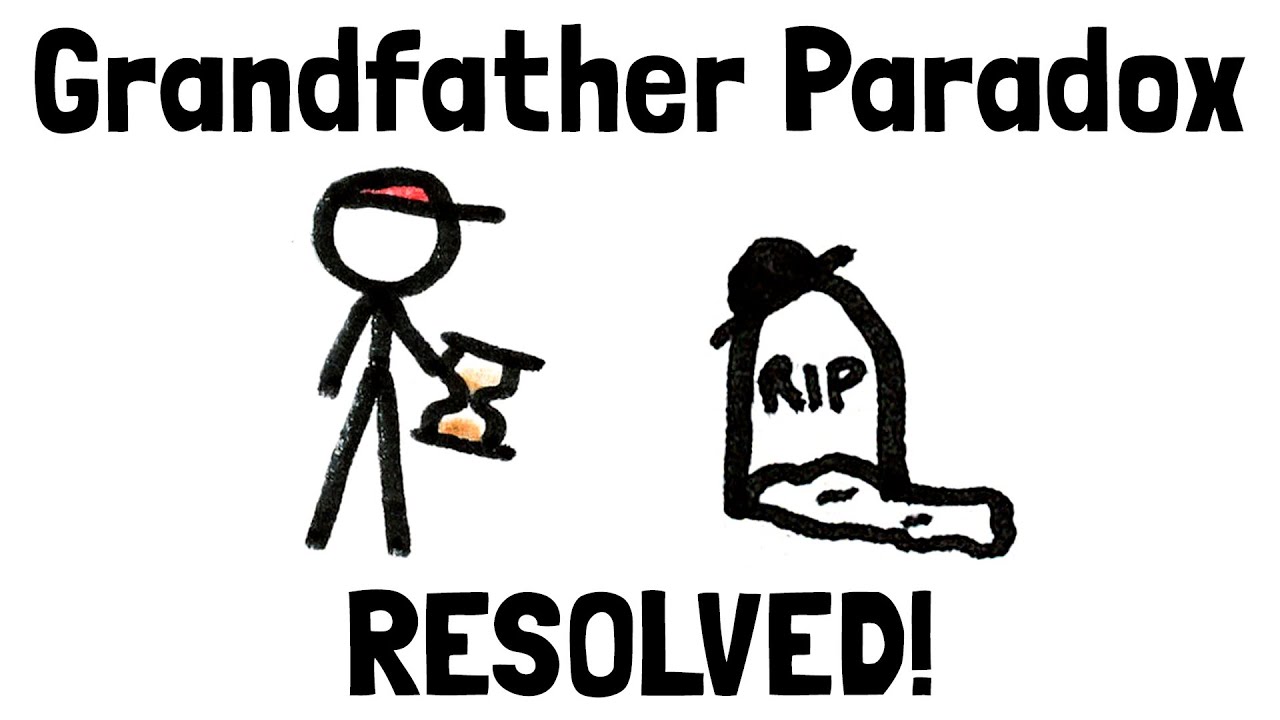
Time travel’s “grandfather paradox” baffling conundrum, a century-old mystery, finds potential clarification. Imagine journeying to the past and inadvertently preventing your parents’ meeting, or perhaps eliminating a grandparent, thereby negating your very existence in the present. This perplexing scenario, known as the “grandfather paradox,” suggests you would never have existed to undertake the time travel in the first place. This long-standing knot in time travel theory has reportedly been untangled by Germain Tobar, a fourth-year undergraduate student at the University of Queensland.
Untangling the Grandfather Paradox in Time Travel
Physicists typically propose two primary theoretical approaches to enable paradox-free time travel. One concept involves “closed time-like curves,” an intriguing idea derived from Albert Einstein’s theory of general relativity. These curves represent solutions to general field equations and could potentially exist in reality. For instance, consider boarding a train at a specific location, visiting various tourist destinations, and then returning to the exact same spatial and temporal point where you initially boarded. The moment you disembark could simultaneously exist in both the past and future relative to your departure time, creating a loop where objects revert to their past positions and times. Mathematically, if these closed curves were to materialize in the real world, they could facilitate smooth, paradox-free journeys through time.
The alternative strategy to avert time travel paradoxes stems from a quantum mechanical model. This approach posits the creation of an entirely new parallel universe whenever a time traveler alters events in the past. Such an alteration could make returning to one’s original universe exceedingly difficult, leading to the conclusion that “time travelers are fundamentally restricted from performing certain actions, such as eliminating historical figures like Osama Bin Laden or Hitler, regardless of their attempts.” This form of time travel would impose significant limitations on an individual’s freedom of choice.
Germain Tobar’s Breakthrough on Time Travel
This is where Germain Tobar, under the guidance of renowned Physicist Dr. Fabio Costa, enters the discussion. Tobar presents a compelling explanation for the paradox riddle that remarkably preserves the concept of “freedom of choice” for time travelers.
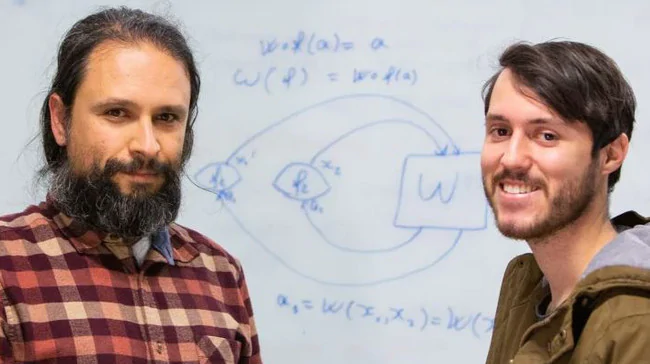
Tobar simplifies the paradox with a relevant example: “Imagine you traveled back in time with the intention of preventing COVID-19’s patient zero from being exposed to the virus. If you successfully prevented that individual from becoming infected, it would logically eliminate the very reason for your initial journey back in time to stop the pandemic.” He further elaborates, “Even if you attempted to stop patient zero from being affected, circumstances would adjust, and you or someone else would inevitably become infected by the pandemic virus, thus becoming patient zero.”
He states, “No matter your actions, the crucial events would simply recalibrate around you.” This implies that, irrespective of a time traveler’s interventions, the original outcome – such as a pandemic occurring – would still manifest, thereby providing the younger self with the motivation to embark on the time travel journey in the first place. Consider going back in time to prevent your parents’ first meeting. Tobar’s theory suggests that time would ultimately reconfigure itself to ensure they still meet, marry, and conceive you, irrespective of your attempts to alter the past.
“No matter how hard you try to create a paradox, events will always self-adjust to maintain consistency,” Tobar concludes. “The spectrum of mathematical processes we’ve uncovered indicates that time travel, even with free will, is logically feasible within our universe without generating any paradoxes.”
The Future of Time Travel Theory
For over a century, the grandfather paradox has served as a significant theoretical barrier to the possibility of time travel. Now, physicists are asserting that this conundrum might no longer be an unsolvable theoretical hurdle. This recent breakthrough by Germain Tobar appears to offer valuable clarification to aspects of Albert Einstein’s theory of general relativity. As scientific understanding advances, perhaps humanity is moving closer to an era where experiencing the past or future becomes a tangible reality.
What intriguing events would you witness or actions would you take if you could time travel? Share your thoughts in the comments below!
Reference:
- https://www.express.co.uk/news/science/1340644/time-travel-paradox-solved-grandfather-paradox-einstein
- https://www.forbes.com/sites/fernandezelizabeth/2020/10/12/now-time-travel-can-be-paradox-free-thanks-to-math/?sh=545539afb7cf
Join our community by subscribing to our Weekly Newsletter to stay updated on the latest AI updates and technologies, including the tips and how-to guides. (Also, follow us on Instagram (@inner_detail) for more updates in your feed).
(For more such interesting informational, technology and innovation stuffs, keep reading The Inner Detail).
