
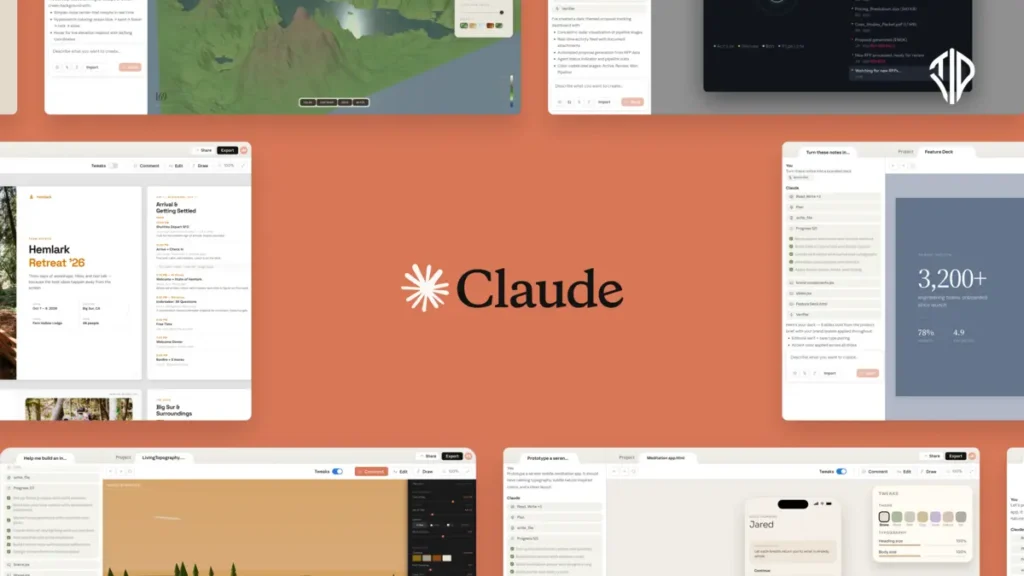
Anthropic has officially disrupted the creative software industry with the launch of Claude Design, a sophisticated platform that translates natural language into professional-grade visual assets. Powered by the groundbreaking Claude Opus 4.7 vision model, this tool bridges the gap between conceptual ideation and production-ready design through a seamless conversational interface.
Traditional design workflows often suffer from a persistent bottleneck where founders, marketers, and product managers struggle to translate abstract ideas into high-fidelity visuals. This friction usually necessitates multiple rounds of revision between stakeholders and specialists, slowing the pace of innovation and limiting the number of creative paths a team can realistically explore.
In the same way that digital spreadsheets revolutionized financial modeling, AI-driven design is shifting the paradigm of visual creation from manual manipulation to strategic guidance. Anthropic’s new offering transforms the canvas from a static drafting board into a collaborative partner that understands aesthetics, brand logic, and technical implementation simultaneously.
Key Takeaways
- AI-Powered Design: Claude Design leverages the Claude Opus 4.7 vision model to translate natural language into professional visual assets.
- Automated Brand Consistency: The platform reads existing codebases and design files to ensure every output aligns with established brand guidelines.
- Seamless Handoff: Integrated features allow for immediate transition from design mockups to production-ready code via Claude Code.
Expanding the Creative Horizon
Claude Design is not merely a tool for generating images; it is a comprehensive design environment available in research preview for Claude Pro, Max, Team, and Enterprise subscribers. It allows users to prototype a dozen directions in the time it previously took to create one.
By describing a need, users receive a first version that can be refined through conversation, direct edits, or custom adjustment knobs—dynamic sliders created by the AI to tweak spacing, color, and layout in real time.
Claude Design renders traditional design tools like Figma legacy by replacing the “picture of an app” with the functional app itself. For years, the industry accepted a fragmented workflow: designers spent weeks in Figma perfecting static vectors and “simulated” prototypes, only to hand them off to developers who then had to rebuild everything from scratch in code.
Claude Design collapses this entire pipeline into a single iterative loop where code is the canvas. By using conversation to manipulate live React components and Tailwind styles in real-time, you are no longer creating a mockup—you are designing the actual production-ready artifact.
This shift effectively eliminates “handoff hell,” as the design is no longer a separate file to be interpreted, but a functional, stateful piece of software that can be deployed the moment the conversation ends.
One of the most significant hurdles in corporate design is maintaining brand consistency. Claude Design solves this by reading a company’s existing codebase and design files to build a bespoke design system. Every subsequent project automatically utilizes the correct typography, color palettes, and components, ensuring that the AI-generated output is indistinguishable from the work of a dedicated internal design team.
From Mockups to Production Reality
The utility of this tool extends across the entire product development lifecycle. Teams are already utilizing the platform for several high-stakes workflows:
- Interactive Prototypes: Designers can transform static mockups into shareable, interactive prototypes that allow for user testing without requiring immediate developer intervention.
- Strategic Wireframing: Product managers can sketch feature flows and hand them directly to Claude Code for implementation, effectively collapsing the distance between a concept and a working feature.
- Professional Presentations: Founders can convert rough outlines into on-brand pitch decks in minutes, with native exports to PPTX or direct integration with Canva.
- Marketing Assets: Marketers can generate landing pages and social media graphics, then loop in designers for final polishing through organization-scoped sharing and group conversations.
The Synergy of Design and Code
The leap from a prototype to a live product has historically been a fragmented process. Anthropic addresses this through a robust handoff bundle. Once a design is finalized, it can be packaged and passed to Claude Code with a single instruction, providing the AI developer with the full design intent and assets needed for production.
The following table highlights how Claude Design compares to traditional design methodologies:
| Feature | Traditional Design Software | Claude Design |
|---|---|---|
| Primary Input | Manual pixel manipulation | Natural language & brand files |
| Brand Alignment | Manual application of style guides | Automatic design system ingestion |
| Prototyping | Requires separate tools or plugins | Built-in interactive vision engine |
| Developer Handoff | Static assets and spec sheets | Integrated Claude Code bundles |
| Learning Curve | Steep; requires specialized training | Low; accessible via conversation |
The Future of Frontier Design
By integrating voice, video, 3D, and shaders—specialized programs used to render sophisticated visual effects—Claude Design allows anyone to build code-powered prototypes that were once the exclusive domain of senior creative engineers. The partnership with Canva further extends this ecosystem, allowing users to bring ideas from Claude Design into Canva’s collaborative environment for final publishing and distribution.
As Anthropic continues to roll out this feature, the focus remains on making complex creative tasks simple. For organizations, this means a dramatic reduction in the “back-and-forth” that typically plagues design cycles. What used to take a week of briefs and reviews can now be accomplished in a single, high-fidelity conversation.
Join our community by subscribing to our Weekly Newsletter to stay updated on the latest AI updates and technologies, including the tips and how-to guides. (Also, follow us on Instagram (@inner_detail) for more updates in your feed).
(For more such interesting informational, technology and innovation stuffs, keep reading The Inner Detail).
