
Google unveils EmbeddingGemma 2, an open, lightweight, natively multimodal AI which runs on-device and offline, mainly helping you to search through texts, images, videos and audios.
Artificial intelligence has traditionally lived in massive, power-hungry cloud data centers, far away from the devices we carry in our pockets every day. However, a major shift is currently underway as developers race to bring sophisticated machine learning capabilities directly to edge hardware like consumer smartphones and laptops.
This transition from cloud-dependent processing to local execution mirrors the early days of personal computing, where bulky mainframe computers gradually gave way to desktop systems capable of running independent applications.
Today, edge AI is undergoing a similar evolution, driven by the pressing need for lightning-fast response times, reduced bandwidth usage, and uncompromised personal data privacy.
Key Takeaways
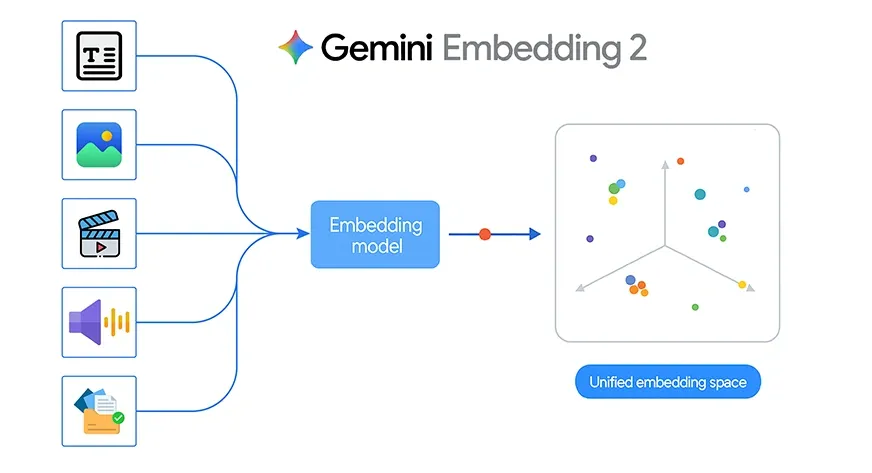
- Multimodal Unity: EmbeddingGemma 2 natively integrates text, code, images, video, and audio into one shared embedding space.
- Modular Design: Features an efficient architecture allowing developers to toggle between text-only (270M parameters) and full multimodal (740M parameters) workloads.
- Storage Optimization: Utilizes Matryoshka Representation Learning to dynamically truncate output vectors, reducing storage needs by up to 6x.
- Enhanced Context: Offers an 8K token context window, enabling the analysis of long-form audio, multiple video frames, and high-resolution image sets locally.
The Evolution of On-Device Embeddings
Last year, Google introduced EmbeddingGemma to provide developers with a lightweight, high-quality option for text embeddings directly on consumer hardware.
An embedding is essentially a mathematical representation of data—such as words, sentences, or files—converted into numerical vectors that capture semantic meaning. This allows applications to organize, search, and connect information efficiently without sending sensitive queries to a remote server.
The developer community embraced the initial release enthusiastically, driving more than 20 million downloads. Builders utilized the lightweight model to power smarter local search tools and privacy-first retrieval augmented generation (RAG) pipelines, which combine search engines with generative text models.
Building upon this massive success, Google DeepMind has officially launched EmbeddingGemma 2, a natively multimodal successor designed to unify code, images, video, and audio within a single shared embedding space.
Key Architectural Innovations and Performance
Built on the advanced Gemma 4 architecture and released under a commercially permissive Apache 2.0 license, EmbeddingGemma 2 packs 740 million parameters into a package optimized explicitly for on-device inference.
Despite its compact size, it punches well above its weight class, offering a compelling mix of modularity, storage efficiency, and extended context handling.
The model is engineered to be exceptionally modular. While the full multimodal version utilizes all 740 million parameters, developers working on text-only workloads can deploy a streamlined version requiring as little as 270 million parameters. Optional vision (170M) and audio (300M) encoders can be toggled on dynamically when full multimodal capabilities are required.
Furthermore, EmbeddingGemma 2 incorporates Matryoshka Representation Learning (MRL), an advanced training technique that lets developers dynamically truncate output vectors from 768 dimensions down to 512, 256, or 128 dimensions. This provides up to a 6x reduction in storage requirements for local vector databases and significantly lowers active memory usage.
Feature Comparison Across EmbeddingGemma 2 Variants
| Feature / Metric | Text-Only Workload | Full Multimodal Workload |
|---|---|---|
| Active Parameters | ~270 Million | 740 Million |
| RAM Requirement (Quantized on Pixel 11 Pro) | ~191 MB | ~567 MB |
| Supported Modalities | Text, Code | Text, Code, Images, Audio, Video |
| Context Window | 8K Tokens | 8K Tokens |
Unprecedented Multimodal and Coding Capabilities
EmbeddingGemma 2 sets a new performance standard for sub-1-billion-parameter models across multiple benchmarks. It matches the stellar multilingual text performance of its predecessor while delivering a massive 9.92-point improvement on code performance in the Massive Text Embedding Benchmark (MTEB Code), jumping from 68.76 to 78.68. This makes the model exceptionally well-suited for local codebase indexing, semantic code search, and advanced coding agent retrieval tasks.
Across image, video, document, and audio tasks, the model frequently outperforms specialist models that are more than twice its size. Its expanded 8K token context window is four times larger than that of the original EmbeddingGemma. This generous context allows the model to process up to 5.5 minutes of continuous audio, 29 high-resolution images, 58 individual video frames, or complex interleaved combinations of these formats directly on local hardware.
Empowering Privacy-First Edge Applications
Running embeddings locally on edge hardware fundamentally changes what mobile and desktop applications can achieve. Because data processing happens entirely on the device, user information never has to leave the local storage environment, guaranteeing absolute privacy. Additionally, eliminating network round-trips drastically reduces pipeline latency, allowing for seamless offline functionality.
When paired with generative models like Gemma 4, EmbeddingGemma 2 enables powerful on-device RAG pipelines that understand complex, mixed-media datasets. Because both models share the same text tokenizer and audio encoder, developers can run them together in a unified pipeline with a remarkably low combined memory footprint.
Practical Use Cases for Developers
The arrival of EmbeddingGemma 2 unlocks a wide variety of innovative application features that can run locally on modern smartphones:
- Instant Media Search: Users can search their personal media libraries using natural text or reference images to find matching photos, graphics, or documents based on deep semantic similarity.
- Video Moments Finder: Developers can build tools that locate exact moments within long video recordings using simple text or voice queries.
- Contextual File Retrieval: Applications can pair EmbeddingGemma 2 for local file retrieval with Gemma 4 for advanced contextual reasoning and text generation.
- Real-Time Decision Engines: Systems can leverage multimodal context for classification, routing, and predictive capabilities using the MediaPipe Decision Task API.
Getting Started with Implementation
Google has collaborated closely with the developer ecosystem to ensure EmbeddingGemma 2 integrates smoothly into existing workflows and deployment pipelines.
- Model Availability: Model weights are readily available on Hugging Face and Kaggle, with availability on the Gemini Enterprise Agent Platform Model Garden arriving soon. Developers can also find optimized versions on the LiteRT Community page on Hugging Face.
- On-Device Deployment: Cross-platform apps can be built using Google AI Edge MediaPipe for turnkey embedding, retrieval, and decision tasks, or LiteRT for custom model integration. Web developers can target the browser using transformers.js or WebGPU.
- Ecosystem Support: The model is supported by popular development tools including transformers, sentence-transformers, MLX, vLLM, llama.cpp, SGLang, Ollama, and LMStudio. Vector storage is supported via platforms like Qdrant, and fine-tuning guides are provided by Unsloth.
As edge hardware continues to grow more capable, EmbeddingGemma 2 represents a monumental leap forward for developers wanting to build intelligent, privacy-respecting, and lightning-fast multimodal applications right on the edge.
Join our community by subscribing to our Weekly Newsletter to stay updated on the latest AI updates and technologies, including the tips and how-to guides. (Also, follow us on Instagram (@inner_detail) for more updates in your feed).
(For more such interesting informational, technology and innovation stuffs, keep reading The Inner Detail).
