
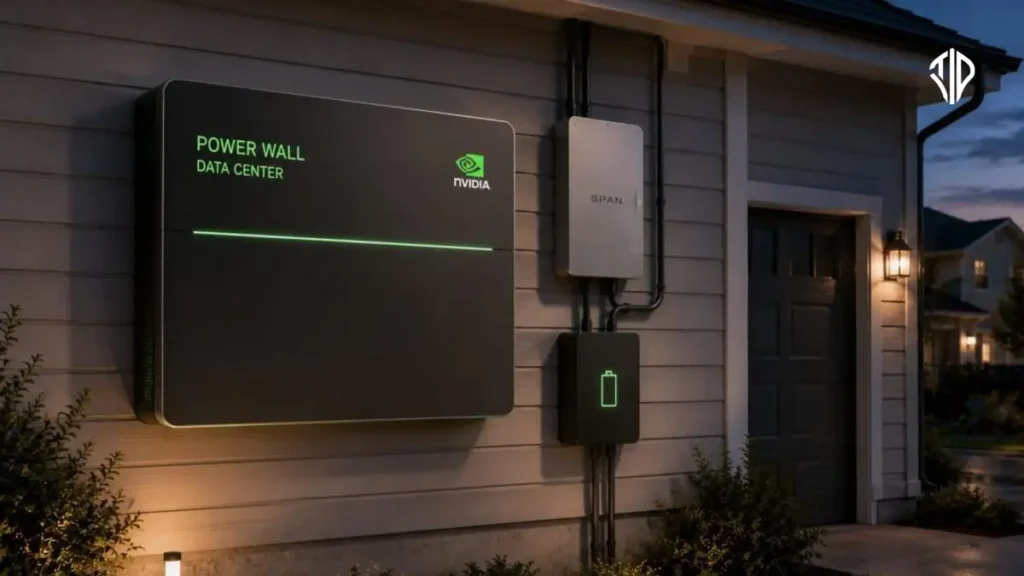
Nvidia is partnering with Span to transform residential homes into a distributed supercomputing network by installing localized AI nodes on exterior walls. This initiative allows homeowners to monetize their unused electrical capacity while benefiting from high-speed, private, and localized artificial intelligence processing.
For decades, we have viewed our homes as passive consumers of energy and data, pulling power from the grid and information from distant server farms. Much like how residential solar panels turned quiet rooftops into active contributors to the power grid, this new era of technology aims to turn the physical footprint of your house into a vital node for the global digital economy.
Instead of relying on massive, centralized data centers located hundreds of miles away, the intelligence that powers our daily lives is moving closer to where we sleep and work.
This shift bridges the gap between industrial-scale computing and personal convenience, making the concept of a smart home literal by integrating professional-grade hardware into the very fabric of our living spaces.
Key Takeaways
- Nvidia and Span are deploying XFRA nodes to create a decentralized, residential supercomputing network.
- Homeowners can generate a new revenue stream by allowing these nodes to utilize unused electrical capacity.
- Local AI processing significantly enhances data privacy and reduces latency by keeping information within the home.
- The technology utilizes advanced hardware like the Grace Blackwell superchip to support 24/7 autonomous agents.
The Concept of Residential Supercomputing
The heart of this initiative lies in a partnership between Nvidia and Span, a company known for reinventing the electrical panel. Together, they are developing what are known as XFRA nodes.
These are compact, ruggedized AI units designed to be mounted on the side of a house, often alongside existing infrastructure like HVAC systems or smart electrical panels. These units act as “mini” data centers, performing complex calculations that would normally be sent to a massive facility owned by a cloud provider.
By distributing the workload across thousands of residential locations, Nvidia can create a decentralized supercomputer. For the homeowner, the primary incentive is a new revenue stream.
These nodes are designed to tap into the unused electrical capacity of a home, and in exchange for providing this “edge” space and power, homeowners receive compensation. It effectively turns your property into a micro-tenant for the world’s most powerful AI company.
Why Move AI from the Cloud to Your Wall?
Currently, most AI interactions involve a round-trip to a distant server, which introduces latency and raises significant privacy concerns. Moving to a model of local inference—where the AI “think” inside your own hardware—solves several modern tech bottlenecks simultaneously.
- Enhanced Privacy: When data is processed locally within your own privacy sandbox, sensitive information such as home security footage, financial documents, and personal schedules never needs to leave your premises.
- Low Latency: Localized hardware allows for near-instantaneous responses, which is critical for future applications like home robotics and real-time autonomous security.
- Grid Efficiency: By utilizing existing residential electrical infrastructure, tech giants can expand their computing power without solely relying on the construction of massive, energy-demanding data centers that often strain local power grids.
The Technology Powering the Home Hub
This transition is supported by a suite of high-end hardware and software designed for the consumer environment. Nvidia’s DGX Spark and the RTX 50-series GPUs are at the forefront of this movement, moving beyond simple gaming to support Autonomous AI Agents.
These are not just chatbots; they are systems capable of managing your energy usage, handling complex digital finances, and acting as a Digital Twin of your digital life.
Comparison of AI Infrastructure Models
| Property | Cloud AI | Local AI Nodes |
|---|---|---|
| Data Privacy | Data sent to remote servers; potential for third-party access. | Data processed on-site; stays within your four walls. |
| Latency | Dependent on internet speed and server distance. | Instantaneous processing; functions even during internet outages. |
| Cost/Benefit | Monthly subscription fees for premium access. | Potential to earn income by sharing unused electrical capacity. |
The Future of Autonomous Agents
As we move toward 2026 and beyond, the industry is shifting away from simple assistants toward agents that require 24/7 autonomy. For an AI to monitor a home’s energy grid or manage security autonomously, it must remain functional even if the internet connection fails. Hardware like the Grace Blackwell superchip enables these systems to run continuously without a constant cloud uplink.
Ultimately, Nvidia is betting that the home of the future will be more than just a place to live; it will be a participant in the global AI infrastructure.
While we may not be installing racks of servers in our basements, the integration of professional-grade AI nodes into our home exteriors represents a significant shift toward a more private, efficient, and decentralized digital future.
Join our community by subscribing to our Weekly Newsletter to stay updated on the latest AI updates and technologies, including the tips and how-to guides. (Also, follow us on Instagram (@inner_detail) for more updates in your feed).
(For more such interesting informational, technology and innovation stuffs, keep reading The Inner Detail).
