
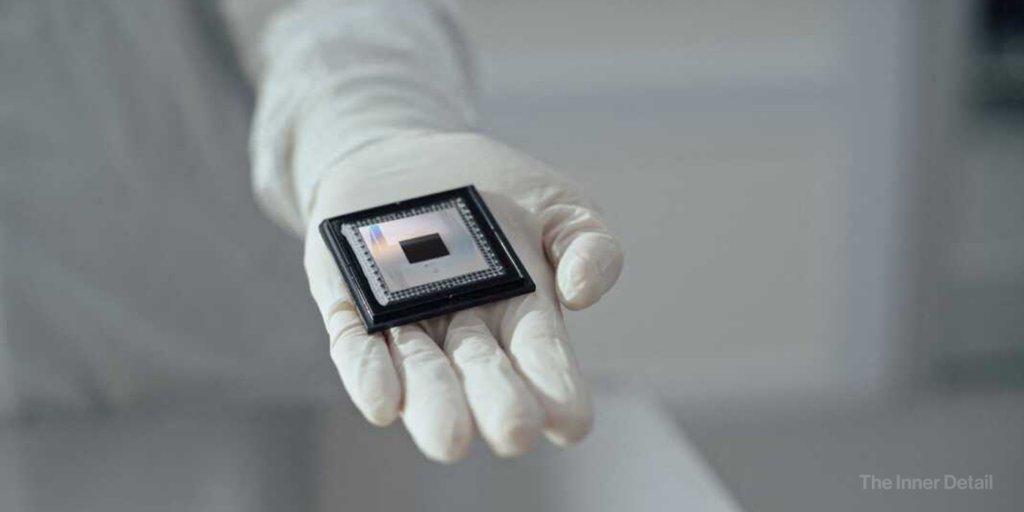
Imagine a form of matter so elusive, so fundamentally different, that it exists only when pushed far beyond its normal limits. What if a quantum computer could not only imagine it but actually bring it into being? This is precisely what an international team of scientists, leveraging Google’s powerful 58-qubit quantum AI chip named “Willow,” has achieved.
This groundbreaking discovery marks a significant leap, transforming quantum computers from mere computational tools into sophisticated laboratories for exploring the deepest mysteries of physics.
The research, a collaborative effort between the Technical University of Munich (TUM), Princeton University, and Google Quantum AI, unveiled a never-before-seen exotic phase of matter, as detailed in their publication in Nature on September 10, 2025.
What are Exotic Phases of Matter?
Most of us are familiar with matter in its conventional forms: solid, liquid, gas, or plasma. These are generally defined under equilibrium conditions, where a system remains stable over time—think of water existing as a liquid or ice. However, nature holds far stranger possibilities. There are “out-of-equilibrium” phases that emerge only when a system is actively driven or perturbed, moving it away from its stable state.
The new state discovered falls into a particularly rich category known as Floquet systems. These are quantum systems that are periodically driven in time, much like a rhythmic pulse. This rhythmic driving can create entirely new forms of order that are simply impossible under any equilibrium conditions. Unlike conventional phases, these non-equilibrium quantum phases are defined by their dynamic and time-evolving properties, a behavior that traditional equilibrium thermodynamics cannot capture. They reveal phenomena that are fundamentally beyond the reach of conventional matter.
Willow’s Breakthrough: Realizing the Impossible
Using Google’s 58 superconducting qubit quantum processor, “Willow,” the team successfully realized a Floquet topologically ordered state. This particular phase had been theoretically proposed for years but had never been directly observed in any experiment until now.
To achieve this, the researchers directly imaged the characteristic directed motions at the edge of the quantum system. They also developed a novel interferometric algorithm to precisely probe the system’s underlying topological properties. This innovative approach allowed them to witness the dynamical “transmutation” of exotic particles – a critical hallmark that had been theoretically predicted for these unusual quantum states.
Quantum Computers: More Than Just Calculators
This achievement underscores a profound shift in how we view quantum computers. As Melissa Will, a PhD student at the Physics Department of the TUM School of Natural Sciences and the study’s first author, explained, “Our results show that quantum processors are not just computational devices – they are powerful experimental platforms for discovering and probing entirely new states of matter”.
The reason quantum computers are so crucial for this type of research lies in the inherent complexity of these exotic states. “Highly entangled non-equilibrium phases are notoriously hard to simulate with classical computers,” Will noted. In fact, Google’s Willow chip has previously garnered attention for its mind-bending computational power, even sparking discussions about the multiverse theory. It once performed a computation in under five minutes that would likely take one of today’s fastest supercomputers 10 septillion years to complete, hinting at the possibility of parallel universes. Now, Willow is proving its mettle not just in raw computation, but in physical experimentation at the quantum level.
The Future Implications
This work represents the beginning of a new chapter in quantum simulation. By transforming quantum computers into dedicated laboratories, scientists can now explore the vast and largely uncharted landscape of out-of-equilibrium quantum matter.
The insights gleaned from these studies could have far-reaching implications, from deepening our understanding of fundamental physics to paving the way for the design of next-generation quantum technologies. This extraordinary feat by Google’s Willow chip is not just about creating a new state of matter; it’s about opening a new frontier in scientific exploration.
Key Takeaways
- Google’s “Willow” quantum chip has been used to create a new, exotic phase of matter.
- This phase is a Floquet topologically ordered state, previously only theorized.
- Quantum computers are evolving into experimental platforms for physics research.
- The discovery opens new avenues for exploring out-of-equilibrium quantum matter.
Join our community by subscribing to our Weekly Newsletter to stay updated on the latest AI updates and technologies, including the tips and how-to guides. (Also, follow us on Instagram (@inner_detail) for more updates in your feed).
(For more such interesting informational, technology and innovation stuffs, keep reading The Inner Detail).
