
While the world progresses rapidly, a significant portion of its population remains underserved, particularly in education. Globally, approximately 72 million children out of 2.2 billion are currently out of school, largely due to a critical lack of educational facilities. Sub-Saharan Africa, often referred to simply as Africa, bears a substantial part of this challenge, with inadequate infrastructure being a primary barrier to learning for countless children.
However, technology is now offering a promising solution to this persistent problem. When it comes to building infrastructure, 3D printing technology is making remarkable strides. This innovation has led to Madagascar becoming the first country globally to successfully 3D print a school, signaling a new era for educational development.
Madagascar’s Pioneering 3D-Printed School Initiative
This groundbreaking initiative is a collaborative effort between Studio Mortazavi, an architecture firm with bases in San Francisco and Lisbon, and Thinking Huts, a non-profit organization dedicated to expanding global access to education through innovative 3D printing solutions.
While 3D printing has been utilized for various building projects, this marks a historic milestone as the first instance of a dedicated school structure being entirely 3D printed.
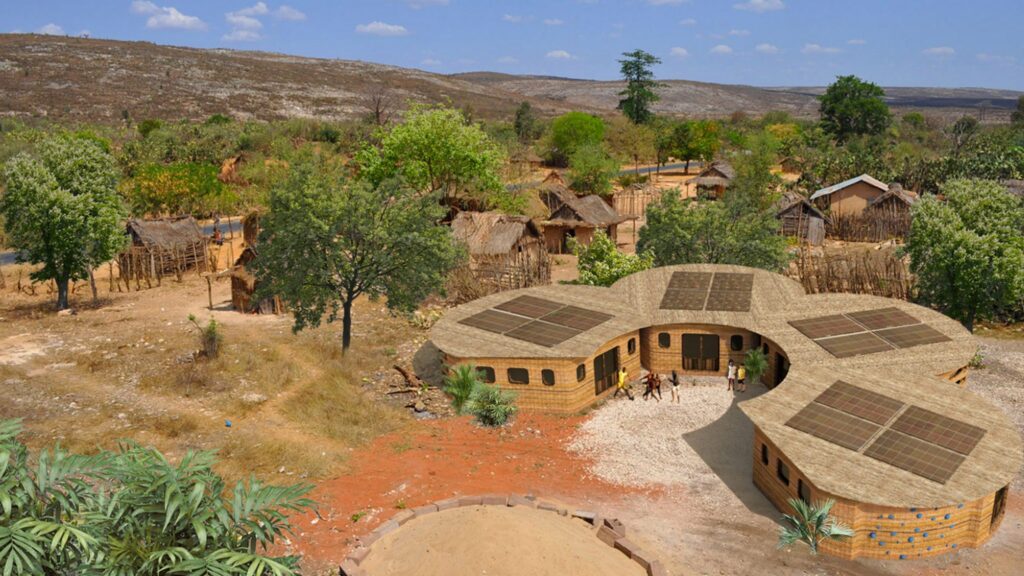
Thinking Huts founder Maggie Grout stated in an interview with Dezeen, “Based on our current information, we are constructing the world’s first 3D-printed school in Madagascar. While it’s possible another such school exists, we have not yet identified its location.”
Designed by Studio Mortazavi, this innovative school structure is composed of concrete aggregate, which can be produced from recycled materials to minimize CO2 emissions, alongside other locally sourced construction materials from Fianarantsoa, Madagascar. A significant advantage of this 3D-printed school is its remarkably short construction timeline; the entire process, from foundation laying to completion, took less than a week. This rapid deployment also makes it considerably more cost-effective compared to traditional construction methods.
The solar-powered school features a modular design, constructed from individual “pods.” This modularity offers exceptional versatility, allowing for the integration of additional pods in the future as needed. (A pod typically refers to a self-contained unit comprising one or more rooms, often with shared resources.) These versatile pods can be adapted for various educational purposes, including classrooms, science laboratories, dance studios, or libraries, depending on the specific requirements of the school.

Amir Mortazavi, founder of Studio Mortazavi, elaborated to Dezeen, “The inherent beauty of these pods lies in their ability to create an expandable campus, growing infinitely to meet the evolving needs of students and the educational institution.”
The initial pilot project involves constructing a single-story 3D-printed building on the university campus of Ecole de Management et d’Innovation Technologique (EMIT) in Fianarantsoa. This structure will span 230 square meters and is designed to accommodate up to 20 students, serving as a vital learning space.
Architectural Design and Interior Features of the 3D-Printed School
Each educational pod features two straight, narrow walls complemented by one concave and one convex wall, a design chosen for both its scalability and its harmonious integration with the surrounding environment. The design team explored various configurations, including circular, hexagonal, pentagonal, and octagonal shapes, ultimately opting for a hybrid approach that blends faceted geometry with organic forms.
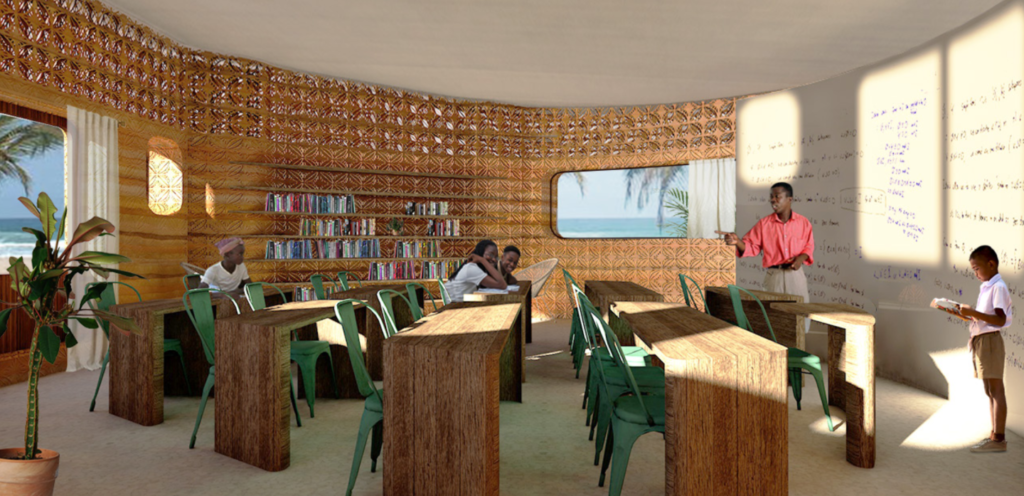
The exterior walls showcase intricate Malagasy relief patterns, which are directly 3D printed into the structure, eliminating the need for additional paint. This design aesthetic is consistently applied to the interior surfaces as well, creating a cohesive and culturally rich environment.
Mortazavi further noted, “Our considerations also extended to incorporating color directly into the aggregate used for printing, allowing the building to seamlessly blend with the natural hues of Madagascar’s landscape.”
Explore how college education is free in Norway, even for overseas students!
Beyond its aesthetic appeal, the facade incorporates a climbing wall and integrated pockets suitable for vertical farming, offering engaging and educational opportunities for children. Powering the school, from lighting systems to compostable toilets, is a robust array of solar panels installed on the roof. Additionally, the roof design includes fans and ventilation systems to ensure optimal temperature regulation and comfort within the classrooms.
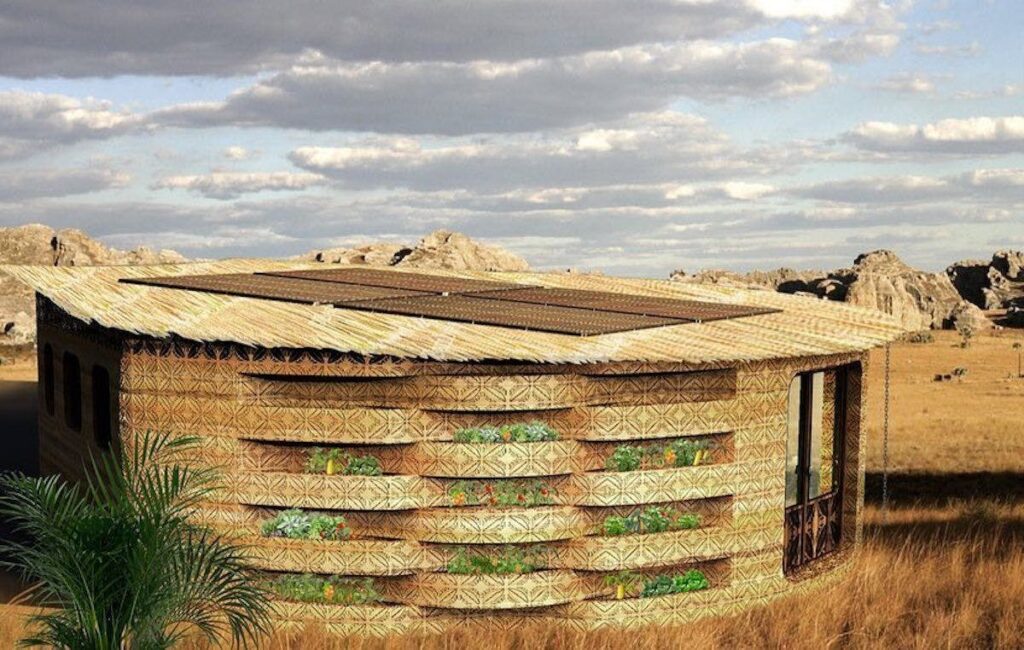
With a projected start date of July/August 2021, Studio Mortazavi and Thinking Huts are set to commence the 3D printing of the school, in collaboration with the Finnish 3D printing specialist company, Hyperion Robotics.
Read this: This Indian School accepts Plastic wastes as School fees
The widespread adoption of 3D-printed schools is poised to make a significant impact globally, especially in regions where traditional construction methods are impractical due to resource limitations, lack of skilled labor, or remote locations. This innovative approach promises to eliminate infrastructure as a fundamental barrier to education, ensuring that more children worldwide have access to learning environments.
Should this pilot project prove successful, the collaboration aims to expand its efforts, leading to the development of numerous additional 3D-printed schools across Madagascar in the future.
“If your plan is for one year, plant rice; if your plan is for ten years, plant trees; if your plan is for one hundred years, educate children.”
– Confucius (Renowned Chinese Philosopher)
Related Content on 3D Printing Innovations:
- The Future of Beverages: Exploring 3D and 2D Printed Drinks
- Space Manufacturing: Satellites That 3D Print Themselves and Launch
References:
- https://www.dezeen.com/2021/02/24/studio-mortazavi-worlds-first-3d-printed-school-madagascar/
- https://archinect.com/news/article/150248529/world-s-first-3d-printed-school-due-to-rise-in-madagascar
- https://www.weforum.org/videos/this-3d-printed-school-is-taking-shape-in-madagascar
Join our community by subscribing to our Weekly Newsletter to stay updated on the latest AI updates and technologies, including the tips and how-to guides. Also, follow us on Instagram (@inner_detail) for more updates in your feed. For more such interesting informational, technology and innovation stuffs, keep reading The Inner Detail.
