

Shanghai-based MiniMax has launched its M3 model, a high-performance AI specifically engineered for complex software engineering and automated coding workflows. This breakthrough architecture significantly improves processing speeds while outperforming industry giants like GPT-5.5 on key programming benchmarks.
Think of traditional AI models as skilled interns who can write a quick email or summarize a document but struggle when tasked with rebuilding an entire company’s database from scratch. While they are great at surface-level tasks, they often lose track of the “big picture” in large, interconnected codebases.
The arrival of M3 is akin to upgrading from a standard library search to a dedicated software architect who never forgets a single line of code. By prioritizing structural complexity and long-form data processing, this model represents a shift toward AI that functions more like a specialized engineer rather than a general-purpose chatbot.
Key Takeaways
- Massive Context Handling: M3 features a 1 million token context window, allowing for the ingestion and analysis of entire software repositories.
- Superior Efficiency: The model operates on just one-twentieth of the computational power required by its predecessors, slashing inference costs.
- Benchmark Performance: M3 has demonstrated the ability to outperform industry leaders like GPT-5.5 and Gemini 3.1 Pro on SWE-Bench Pro.
- Engineering Focus: Designed specifically for autonomous coding agents and high-end software development workflows.
Architectural Efficiency and Performance
The M3 model is built on a redesigned architecture that fundamentally changes how AI consumes computing resources. MiniMax reports that the model requires only one-twentieth of the computational power of its predecessors, leading to a dramatic reduction in inference costs—the financial cost of running the AI to produce a response.
Beyond cost efficiency, the model is built for scale. It possesses a massive context window capable of processing up to 1 million tokens of data at once. This capacity allows M3 to ingest entire software repositories, enabling it to navigate and optimize complex programming projects that would overwhelm less capable models.
In a surprising development for the competitive AI landscape, MiniMax claims that M3 has surpassed prominent international rivals in standardized tests.
According to the company, M3 outperformed OpenAI’s GPT-5.5 and Google’s Gemini 3.1 Pro on the SWE-Bench Pro, a rigorous benchmark designed to evaluate an AI’s ability to solve real-world software engineering problems.
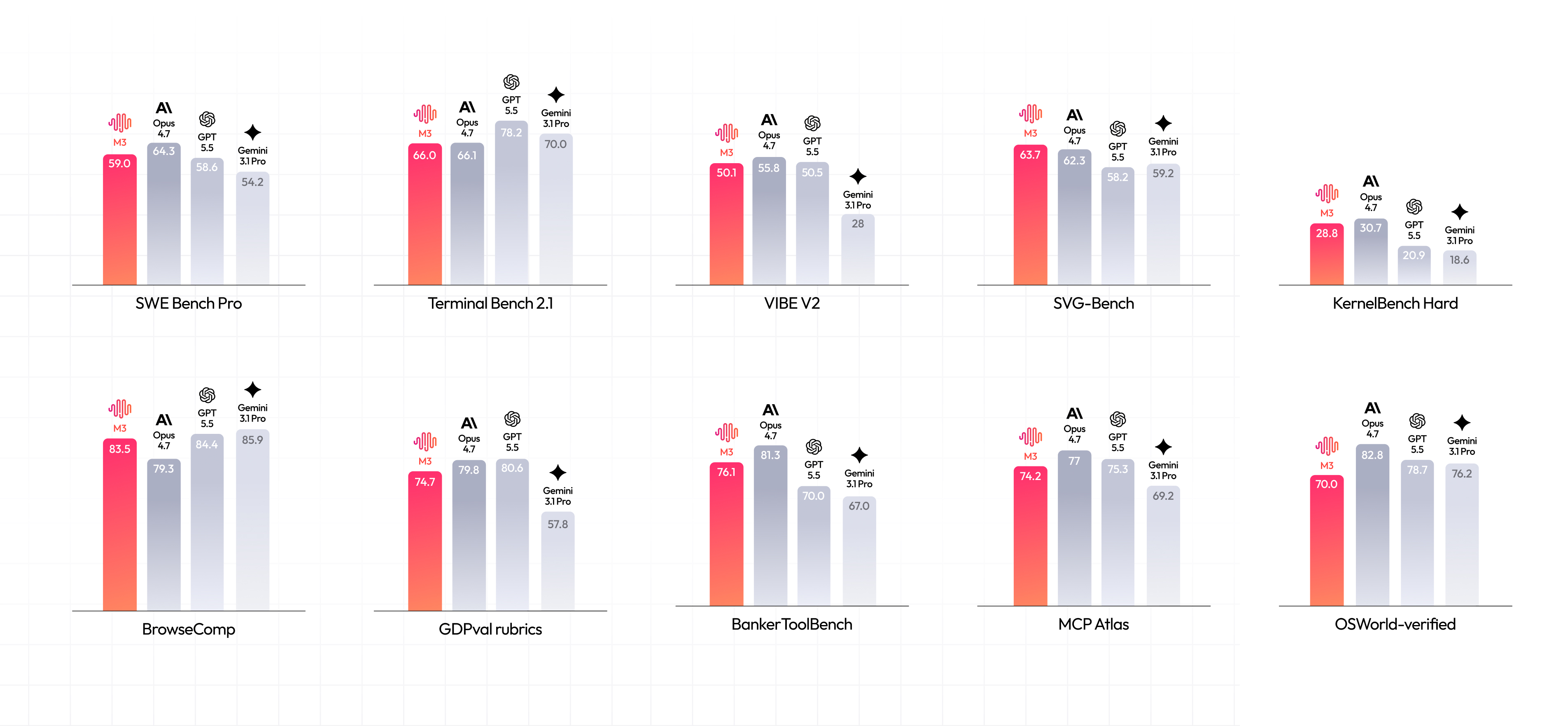
Key Capabilities of MiniMax M3
- Enhanced Long-Context Processing: Capable of handling 1 million tokens, allowing for deep analysis of extensive codebases.
- Computational Efficiency: Operates at 1/20th the computational requirement of previous models, significantly lowering operational costs.
- Specialized Engineering: Specifically optimized for coding agents and automated software workflows.
- Real-World Optimization: Demonstrated ability to successfully optimize software performance for high-end hardware, such as Nvidia’s Hopper chips.
What This Means for Developers
The emergence of M3 signals a maturation phase in generative AI. As developers move toward autonomous agents that can build, debug, and deploy software, the demand for models that can maintain logical consistency over long sequences becomes critical.
If MiniMax’s benchmarks hold up in broader industry testing, M3 could become a foundational tool for enterprise-level automation, allowing businesses to accelerate development cycles while keeping overhead costs manageable.
As MiniMax moves toward its planned public offering, the technical community will be watching closely to see how this model integrates into broader development ecosystems.
Whether it eventually displaces established Western models will depend on its availability and performance in diverse, multi-language coding environments.
Join our community by subscribing to our Weekly Newsletter to stay updated on the latest AI updates and technologies, including the tips and how-to guides. (Also, follow us on Instagram (@inner_detail) for more updates in your feed).
(For more such interesting informational, technology and innovation stuffs, keep reading The Inner Detail).
