

The tech landscape shifted monumentally at Google I/O 2026. Marking exactly a decade since Google pivoted to an “AI-first” company, CEO Sundar Pichai’s opening keynote revealed a company that has moved far beyond experimental AI and is now operating at a staggering, unprecedented scale.
We are officially entering what Google calls the “agentic Gemini era”—a phase where artificial intelligence transitions from answering queries to autonomously taking actions on our behalf.
The sheer momentum of this shift is best understood through the fundamental units of AI data processing: tokens. Two years ago, Google processed 9.7 trillion tokens a month. Last year, that number skyrocketed to 480 trillion. Fast forward to today, and Google’s ecosystem is processing over 3.2 quadrillion tokens every single month.
This massive scale is driven by over 8.5 million developers building with Google’s models, pushing roughly 19 billion tokens per minute through APIs, while more than 375 Google Cloud customers have each processed over a trillion tokens.
This momentum translates directly to consumer products. Google now boasts 13 products with over a billion users each, five of which have crossed the 3 billion user mark. Search’s AI Overviews alone see over 2.5 billion monthly active users, while the new AI Mode surpassed 1 billion monthly active users in just one year.
Meanwhile, the Gemini app more than doubled its user base from 400 million to over 900 million users since the last I/O, and the Nano Banana model has been used to generate over 50 billion images.
To support this massive ecosystem, Google announced an avalanche of new features, models, hardware, and pricing tiers. Here is everything newly announced at Google I/O 2026.
Key Takeaways
- Transition to the “agentic era” where Gemini performs autonomous actions like email management and fee hunting in the background.
- Introduction of 8th Generation TPUs (8t and 8i) to handle a massive scale of 3.2 quadrillion tokens monthly.
- Launch of Gemini 3.5 Flash and Gemini Omni, offering significant speed increases and multimodal “world model” capabilities.
- Release of Intelligent Eyewear powered by Android XR and the Antigravity 2.0 platform for agent orchestration.
- New “vibe-coding” features in Google AI Studio allowing for natural language app development.
TPU – 8th Gen chip
Supporting the agentic era requires astronomical investments in infrastructure. In 2022, Google’s annual capital expenditure was $31 billion; this year, the company expects that figure to reach between $180 billion and $190 billion.
A significant portion of this investment is dedicated to Google’s highly specialized custom silicon. At I/O, Google showcased its 8th generation of Tensor Processing Units (TPUs), utilizing a dual-chip approach for the very first time to separate training and inference workloads.
The TPU 8t is engineered exclusively for large-scale pretraining. It delivers nearly three times the raw computing power of the previous generation. By utilizing JAX and Pathways, Google is no longer restricted by the limits of a single data center; instead, training is seamlessly distributed across multiple sites. This allows Google to scale its training clusters across more than 1 million TPUs globally.
Conversely, the TPU 8i is explicitly designed for inference, ensuring that latency is kept to an absolute minimum when users prompt the models. Both the 8t and 8i are highly sustainable, delivering up to two times better performance-per-watt compared to previous iterations.
Gemini 3.5
The centerpiece of Google’s AI advancements is the new Gemini 3.5 Flash model, which combines frontier-level intelligence with lightning-fast execution. Gemini 3.5 Flash surpasses the older 3.1 Pro model across almost all benchmarks, showing particular dominance in coding and real-world economically valuable tasks.
When looking at output tokens per second, 3.5 Flash is four times faster than comparable frontier models. Internally, when running on Google’s specialized Antigravity platform, it reaches speeds up to 12 times faster.
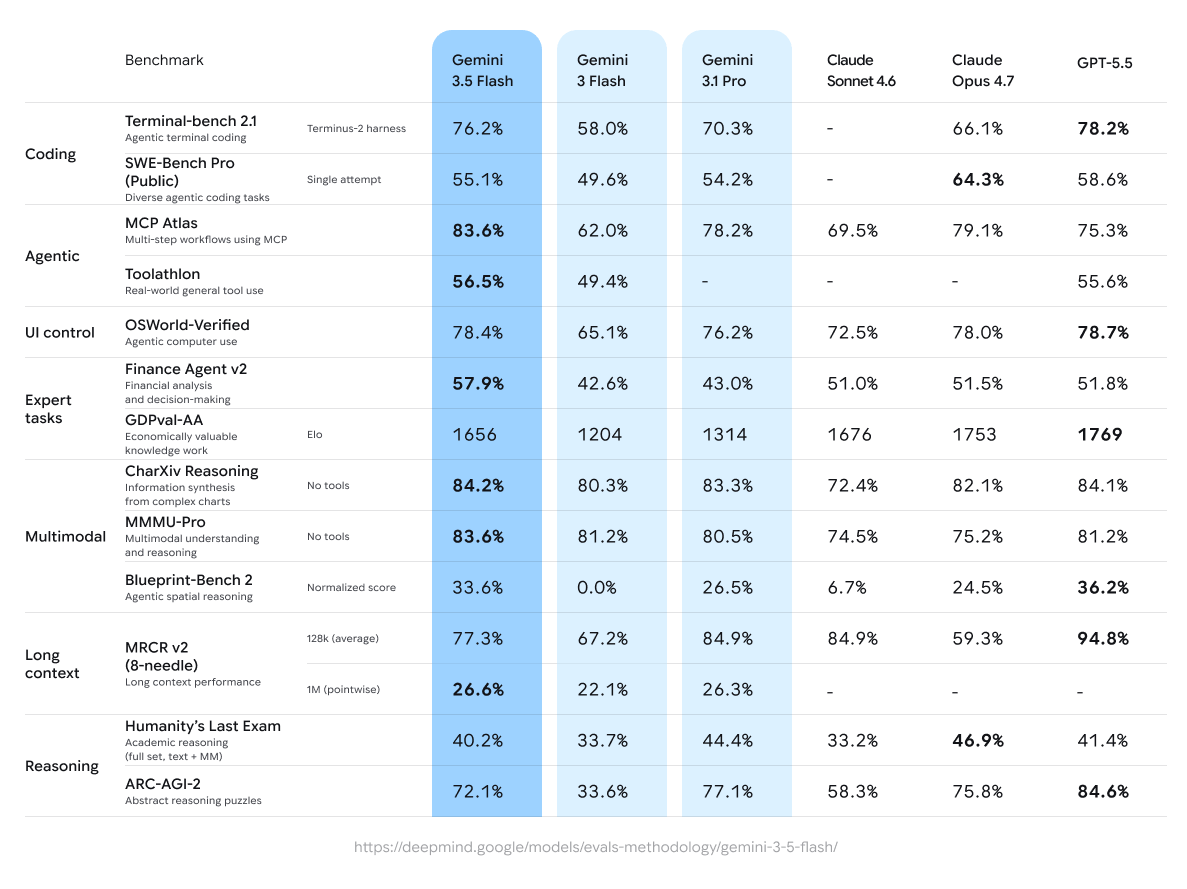
For consumers, Gemini 3.5 Flash is rolling out immediately as the default engine powering the Gemini app, Search’s AI Mode, and the Gemini API. Google estimates that top enterprise companies could save over $1 billion annually by shifting 80% of their workloads from other frontier models to 3.5 Flash.
Google Omni
Moving beyond text, Google unveiled Gemini Omni, an entirely new family of AI models that pushes closer to “world models” capable of simulating reality. The first release, Gemini Omni Flash, accepts multimodal input—including text, photos, video, and audio—and generates video outputs that are grounded in real-world knowledge.
Eventually, Google aims for Omni to be able to create anything from any type of input. Gemini Omni is available starting today in the Gemini app, Google Flow, and YouTube Shorts.
Google Spark and The Gemini App Redesign
Perhaps the most disruptive announcement for personal productivity is Gemini Spark. Spark is not just an assistant; it is a 24/7 personal agent that runs continuously on dedicated Google Cloud virtual machines. You do not need to keep your laptop open for Spark to work. It can write emails, create study guides, and hunt for hidden credit card fees seamlessly in the background.
Spark integrates directly with Workspace apps like Docs, Sheets, and Gmail, and will expand to third-party services via MCP over the summer. The Gemini user experience is also undergoing a transformation with a brand-new design language dubbed “Neural Expressive”. This visual overhaul features vibrant colors, fluid animations, and satisfying haptic feedback.
The interface now utilizes a pill-shaped prompt box on mobile, and the Gemini Live feature provides an inline experience without taking over your full screen. Responses will highlight crucial information in bold accompanied by interactive visualizations.
Subscription and Pricing Updates
To help users start their day, Google is launching the Daily Brief for AI Plus, Pro, and Ultra subscribers. This agent sifts through your inbox and calendar to synthesize an easily skimmable morning digest.
The Gemini app is transitioning to a “compute-used” model, where usage limits refresh every five hours and account for prompt complexity. Additionally, the premium Google AI Ultra plan has been reduced from $250-per-month to $200. Google also introduced a new $100-per-month entry tier for Ultra that offers five times higher usage limits than the standard AI Pro subscription.
Reimagining Search: Information Agents and Generative UI
Google Search is being heavily upgraded with Gemini 3.5 Flash. The traditional search bar is being replaced with an intelligent Search box that automatically expands and accepts images, files, videos, and active Chrome tabs as inputs.
Google is also introducing Information Agents. These agents work 24/7 in the background, scouring blogs, news sites, and real-time feeds to keep you updated on specific topics. Search is also gaining Generative UI capabilities, building dynamic layouts, simulations, and interactive graphs specifically tailored to your query.
Google Workspace
Interacting with data is becoming conversational. Google introduced Docs Live, allowing users to verbally “brain dump” thoughts while Gemini formats them into documents. A similar feature is coming to Google Keep.
Email is receiving Gmail Live, which allows you to conversationally query your inbox for specific information, like a hotel confirmation code, without scrolling. An AI Inbox feature is also rolling out to AI Plus and Pro users.
Google Pics
For visual creatives, Google introduced Google Pics, powered by the Nano Banana 2 model. Pics treats image elements as individual objects rather than static pixels. Users can click on a specific part of a photo and leave a written comment to describe the edit they want, rather than writing entirely new prompts.
Shopping and YouTube
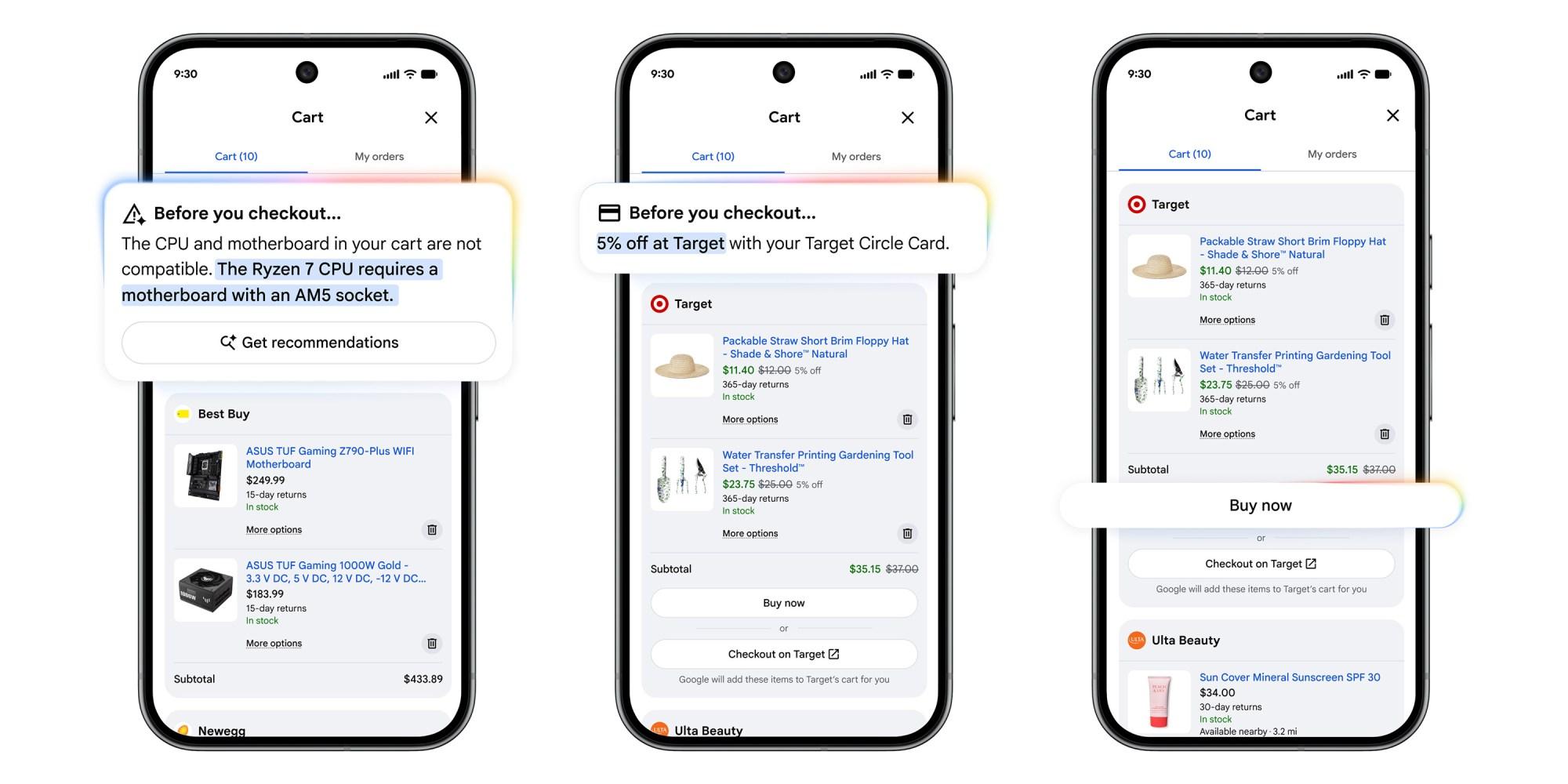
E-commerce is being upgraded with the Universal Cart. This Gemini-powered hub allows you to add products from disparate merchants—such as Nike, Target, and Shopify—into a single cart hosted across Google platforms.
- Once you add a product to your cart, Google finds deals, price drops, price history insights, and stock alerts.
- “Say you’re building your first custom PC and add a few parts from several retailers to your cart. Your cart will proactively flag any product incompatibilities and suggest alternatives.”
- “Since the cart was built on Google Wallet, it understands your payment method perks, loyalty information and merchant offers to help you choose.”
- Coming to Search and the Gemini app in the U.S. this summer, with YouTube and Gmail to follow.
Antigravity 2.0 and Vibe-Coding
Google’s internal development platform, Antigravity, is being released as a standalone desktop application. Antigravity 2.0 acts as the central command center for orchestrating cohorts of autonomous AI agents.
For Android developers, Google AI Studio is introducing the ability to “vibe-code” native Android apps using simple natural language prompts. The suite includes an embedded emulator and allows users to install their creations directly onto physical phones.
Android Halo
To help users track agent activity, Google announced Android Halo. Coming later this year, Android Halo provides subtle, at-a-glance visibility at the top of the phone screen, indicating the progress agents like Gemini Spark have made without interrupting the user’s current workflow.
- “This means you can see the agent’s progress right from the top of any screen you’re on, without having to stop what you’re doing.”
- Available later this year for Gemini Spark and other supported agents. More details are coming then.
Specialized AI Tools: Flow, Science, and Beam
Google Flow is launching a new agent that allows users to vibe-code creative tools within the platform. For researchers, Gemini for Science connects agentic platforms to over 30 major life science databases.
Telepresence is being updated with Google Beam (formerly Project Starline). Google showcased “Sophie,” an AI video agent that interacts naturally during calls. Google is also bringing group call support to Beam, with future integration for Zoom and Google Meet.
Hardware: Intelligent Eyewear and Android XR

Google officially branded its new XR form factor as “Intelligent Eyewear”. Launching this fall are the first audio-only smart glasses powered by Android XR, featuring designs by Warby Parker and Gentle Monster. Users will receive live translations and navigation directions via Gemini.
Google also demonstrated Project Aura, built in collaboration with Xreal. This latest prototype features a redesigned external compute puck and improved display widgets for Google Keep and Calendar.
Setting the Standard for AI Transparency
The SynthID invisible watermarking technology is expanding beyond the Gemini app and integrating directly into Google Search and Chrome. Users will now see C2PA Content Credentials revealing if an image was captured by a camera or AI-generated. OpenAI, Kakao, and Eleven Labs have also announced they will begin adopting SynthID.
Conclusion
Google I/O 2026 proved that the company is no longer just experimenting with AI; it is building the foundational layers of a truly autonomous ecosystem. From custom silicon to 24/7 Spark agents, Google’s agentic era is poised to fundamentally alter how we interact with technology.
Join our community by subscribing to our Weekly Newsletter to stay updated on the latest AI updates and technologies, including the tips and how-to guides.
(Also, follow us on Instagram (@tid_technology) for more updates in your feed and our WhatsApp Channel to get daily news straight to your Messaging App).
