
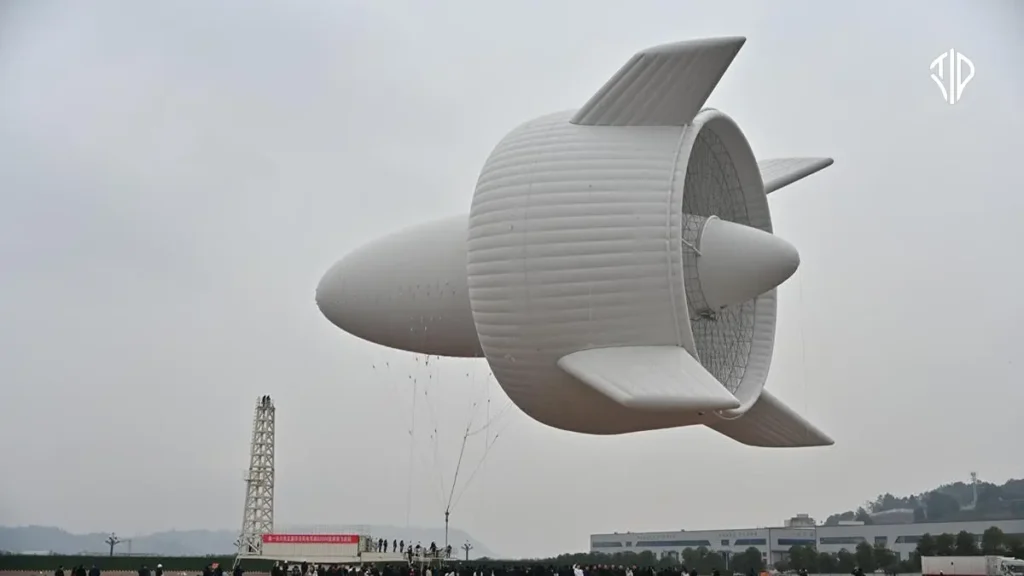
Imagine a future where clean energy isn’t just generated from towering structures rooted to the ground, but from magnificent airships gracefully harnessing the mighty winds of the upper atmosphere. This vision is rapidly becoming a reality, as China has recently achieved a significant milestone in renewable energy with the successful maiden flight of its groundbreaking S1500, the world’s largest megawatt-level flying “windmill.”
This innovative airborne wind-power system promises to unlock a vast, untapped energy resource, offering a fresh perspective on how we power our world.
The S1500: A Zeppelin in the Sky, Generating Power
Dubbed a “Zeppelin-like” structure, the S1500 is a marvel of modern engineering, a buoyant airborne turbine designed to float high above the earth. Measuring an impressive 197 feet long (60 meters), 131 feet wide (40 meters), and 131 feet tall (40 meters), it is by far the largest airborne wind-power generator ever constructed.
Developed by Beijing SAWES Energy Technology Co., Ltd., with crucial support from Tsinghua University and the Aerospace Information Research Institute (AIR) under the Chinese Academy of Sciences, this system recently completed its initial flight in Hami, Xinjiang, passing rigorous tests that included full desert assembly and repeated deployments in high winds. This achievement marks a pivotal moment for airborne wind power.
A Glimpse into its Advanced Design
The S1500’s ingenious design features a main airfoil and an annular wing that together form a giant duct. Nestled within this duct are 12 individual turbine-generator sets, each boasting a 100 kW rating.
These rotors efficiently capture the steady, powerful high-altitude winds, converting their kinetic energy into electricity. This power is then safely transmitted to the ground via a robust tether cable, connecting the floating generator to our terrestrial grids.
Making such a system feasible required overcoming immense engineering challenges. Researchers meticulously mastered the intricacies of aerostat stability—ensuring the massive airship remains stable despite atmospheric forces—along with the development of ultra-light generators and kilometer-scale high-voltage tethers capable of transmitting power from significant altitudes.
This success builds upon previous prototypes, including the S500 and S1000, which incrementally validated the concept of high-altitude energy harvesting.
The Unrivaled Advantages of Sky Power
One of the most compelling aspects of the S1500 is its distinct advantages over traditional, land-based wind turbines. Unlike its conventional counterparts, this airborne system eliminates the need for towering structures or deep foundations. This translates directly into substantial benefits:
- Reduced Material Use: A remarkable 40 percent less material is required for its construction.
- Lower Electricity Costs: It promises to cut electricity costs by an impressive 30 percent.
- Unprecedented Mobility: The entire unit can be assembled and moved within hours, making it incredibly versatile.
- Expanded Deployment: Its mobility makes it ideally suited for remote locations such as deserts, islands, and mining sites, or for temporary installations where traditional turbines are impractical.
Tapping into the Jet Stream: A Vast Untapped Resource
The true genius behind the S1500 lies in its ability to harness high-altitude winds, which exist between 1,640 and 32,810 feet (500 and 10,000 meters) above the ground. These winds are not only significantly stronger but also far steadier than those found at surface level.
This difference is critical, as the physics of wind power dictate an exponential increase in energy yield with wind speed. As Gong Zeqi, a researcher from AIR, explained, “When wind speed doubles, the energy it carries increases eightfold, triple the speed, and you have 27 times the energy.”
This principle demonstrates why high-altitude turbines like the S1500 have the potential to generate vastly more power than conventional systems, utilizing an abundant, widely available, and carbon-free resource.
Beyond Energy: A Lifeline in Disasters
The utility of the S1500 extends beyond everyday power generation. SAWES envisions this platform as a critical tool for rapid disaster response. In the aftermath of earthquakes or floods, when conventional infrastructure is often compromised, the system can be quickly deployed to supply essential electricity.
As Weng Hanke, chief technology officer of SAWES, noted, “The airborne platform can be launched quickly after an earthquake or flood to keep lights, radios and life-saving equipment running.” This capability underscores its potential as a crucial component of emergency preparedness and humanitarian aid.
A National Vision for a Sustainable Future
China has long recognized the immense potential of airborne wind power, integrating its research and development into national strategic plans. An action plan from the National Development and Reform Commission, spanning 2016 to 2030, specifically outlines priorities for large-scale high-altitude wind-power generators.
The S1500’s successful flight represents the culmination of decades of dedicated research and signals China’s readiness to lead the charge in harnessing one of the planet’s last major untapped sources of renewable energy. As the world strives for a cleaner energy future, airborne turbines could soon play a pivotal role in the global energy transition, providing power from the skies above.
Key Takeaways
- China’s S1500, the world’s largest megawatt-level flying “windmill,” has successfully completed its maiden flight.
- The S1500 is a Zeppelin-like structure measuring 197 feet long, featuring 12 individual 100 kW turbine-generator sets to harness high-altitude winds.
- It offers significant advantages over traditional wind turbines, including 40% less material use, 30% lower electricity costs, and unprecedented mobility for deployment in remote or disaster-stricken areas.
- High-altitude winds are much stronger and steadier, exponentially increasing energy yield (e.g., doubling wind speed results in 8x energy), making this a vast untapped energy resource.
- This innovation aligns with China’s national strategic plans for large-scale high-altitude wind power, signaling a pivotal step towards a cleaner global energy future.
Join our community by subscribing to our Weekly Newsletter to stay updated on the latest AI updates and technologies, including the tips and how-to guides. (Also, follow us on Instagram (@inner_detail) for more updates in your feed).
(For more such interesting informational, technology and innovation stuffs, keep reading The Inner Detail).
