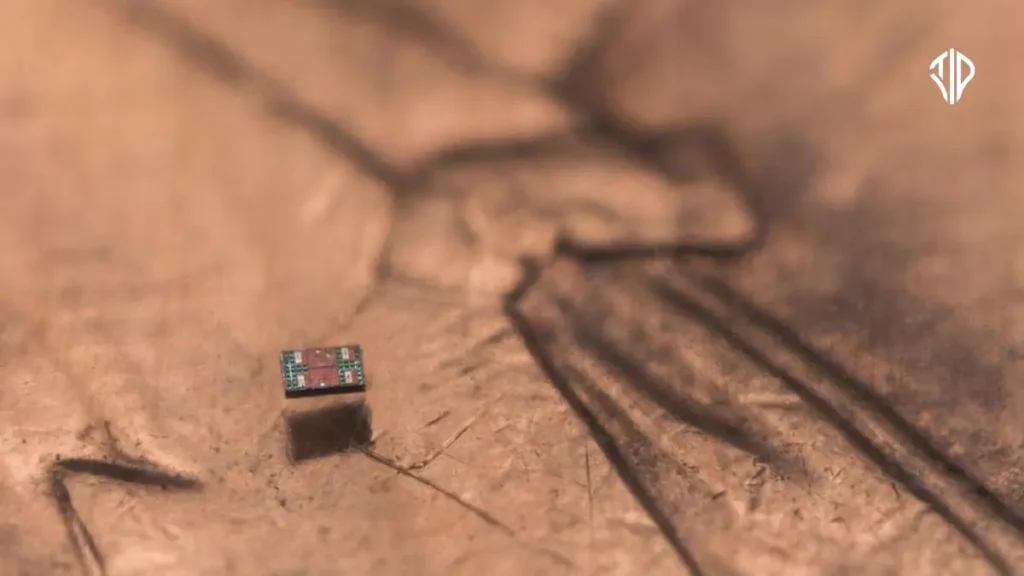
In the realm of robotics, bigger has often meant better—more gears, larger batteries, and stronger arms. But a groundbreaking collaboration between the University of Pennsylvania and the University of Michigan has flipped this script entirely. Researchers have unveiled the world’s smallest fully programmable, autonomous robots.
These machines are not just small; they are microscopic. Measuring just 200 by 300 by 50 micrometers, they are smaller than a single grain of salt. Yet, despite their size, they possess an onboard computer, can sense their environment, and operate independently without a single wire or remote control.
A One-Penny Engineering Marvel
For decades, the field of robotics struggled to shrink autonomous machines below the millimeter scale. While electronics (like chips) got smaller, robots remained bulky because they needed batteries and motors. This new device shatters that barrier, being 10,000 times smaller than previous autonomous robots.

Perhaps the most shocking feature of these high-tech specks is their price tag. Because they are built using standard semiconductor fabrication techniques, the researchers estimate they cost just one penny each to manufacture. This low cost could allow scientists to deploy them in swarms of hundreds or thousands to perform complex tasks.
Swimming Through “Tar” Without Moving Parts
Building a robot the size of a microorganism requires rethinking physics. At this microscopic scale, gravity matters less, and forces like viscosity dominate. As lead researcher Marc Miskin explains, “If you’re small enough, pushing on water is like pushing through tar”. Traditional mechanical limbs or gears would simply snap under the resistance.
To solve this, the team invented a new propulsion system inspired by chemistry rather than mechanics. The robots do not have moving parts. Instead, they generate an electrical field that nudges ions in the surrounding fluid. These ions push against water molecules, propelling the robot forward. This allows the robot to “swim” at speeds of up to one body length per second without any physical wear and tear.
A Computer on a Speck of Dust
What makes these robots truly “autonomous” rather than just remote-controlled drones is their brain. The University of Michigan team, led by David Blaauw, integrated a complete computer—including a processor, memory, and sensors—onto the robot’s tiny frame.
The engineering challenge was immense because the robot is powered entirely by light via microscopic solar panels. These panels generate only 75 nanowatts of power—roughly 100,000 times less than a smartwatch requires. To make it work, the team developed ultra-low-power circuits and a specialized code that condensed complex instructions into single data packets, allowing the robot to “think” on a stringent energy diet.
Talking via “The Waggle Dance”
Since the robots are too small for Wi-Fi or Bluetooth antennas, they communicate in a uniquely biological way. The robots sense their environment—currently, they can detect temperature changes with high precision. To report this data back to researchers, the robots perform a “waggle dance”.
They encode the information (like a temperature reading) into specific pulses of movement. A microscope with a camera tracks these wiggles and decodes the message. It is a method strikingly similar to how honeybees communicate the location of flowers to their hive.
The Future: Medicine and Micro-Factories
While this current version is a prototype, it represents a massive leap forward. The robots are durable enough to survive being sucked up by a micropipette and injected into different environments.
The potential applications are vast. In the future, these robots could be deployed inside the human body to monitor cell health, repair tissues, or deliver medicine to precise locations. Outside of medicine, they could be used in microscale manufacturing to assemble devices too small for human hands to touch. As Professor Miskin notes, this is just “the first chapter” of a future where intelligence pervades the microscopic world.
Join our community by subscribing to our Weekly Newsletter to stay updated on the latest AI updates and technologies, including the tips and how-to guides.
(Also, follow us on Instagram (@tid_technology) for more updates in your feed and our WhatsApp Channel to get daily news straight to your Messaging App).