
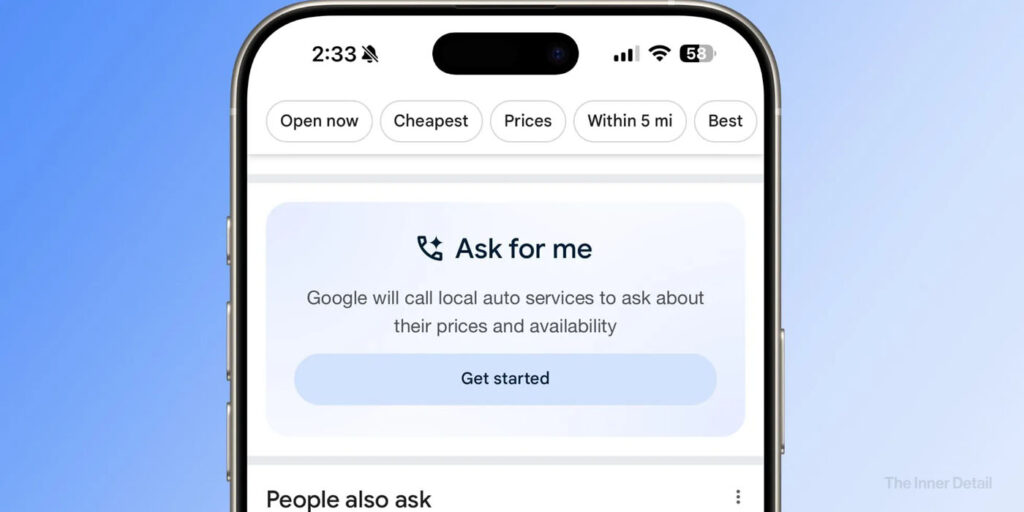
Google launches its new Agentic-AI feature “Let Google Call” (which was earlier “Ask for me“) to users, where Google itself will call and inquire what you want to know from businesses on behalf of you. Indeed, it will inquire with multiple businesses.
We all appreciate the convenience of modern shopping, but let’s be honest: finding the perfect item often becomes a chore involving endless scrolling, tracking prices, and jumping between tabs. Even worse is needing a product right now—requiring multiple phone calls to nearby stores or waiting on hold just to confirm if the item is in stock.
Google is addressing this frustration with a major AI shopping update, leveraging agentic technology to do the “hard parts” of shopping for you. This new functionality allows Google’s AI to actively call businesses on your behalf, revolutionizing how you gather information and verify inventory, and changing the definition of convenience.
The Rise of Agentic AI
Google’s latest advancements in AI and agentic technology are designed to simplify your shopping experience. Agentic AI refers to systems capable of autonomously performing tasks to achieve a user’s goal, and in this context, it means Google can take on the administrative burden of searching for products.
This feature is rolling out in Google Search, especially when you are looking for products “near me”. The feature relies on Google’s advanced AI calling infrastructure, which is powered by Duplex technology, significantly upgraded by a large Gemini model. This technology helps Google identify the best businesses to contact, suggests useful questions to ask based on the product you seek, and most importantly, summarizes the conversations into key takeaways for you.
For user comfort and transparency, every call the AI makes explicitly states that an Artificial Intelligence is handling the conversation. Businesses, meanwhile, are not forced to receive these calls; they can easily opt out through their Google Business Profile settings.
What this Business-Calling AI-Agent can do?
Google’s automated system of business-calls on behalf of users handles several other routine customer actions:
- Booking Appointments: Customers can delegate Google to book appointments. This includes specifying details such as the preferred time, the type of service needed, and the party size. After confirming the specifics with the customer, Google calls the business to finalize the booking. If available, Google might use an online booking partner or place the automated call directly to the business.
- Checking Restaurant Wait Times: For restaurants, customers can use Google to check how long the wait is for a table. Google may call the business to obtain this information before relaying it to the customer.
- Confirming Service Details: The AI feature extends beyond just physical products to confirm the pricing and availability of services offered by nearby local businesses.
In addition to handling customer requests, Google might also call or text a business to confirm the accuracy of details listed in its Business Profile, such as current operating hours and in-store inventory.
How ‘Let Google Call’ Finds Inventory in a Flash
If you’ve decided on a specific product and need it quickly or want to buy it locally, you can now skip the frustrating phone tag and ask Google to call stores on your behalf. When you search for certain products “near me,” you will see the option to “Let Google Call”.
This system efficiently handles the task of contacting multiple shops for you:
- Initiation: You tap “get started” when you see the “Let Google Call” option.
- Detail Collection: Google prompts you with a few questions tailored to what you are shopping for. For instance, if you’re looking for a specific electronic device, the AI will confirm the model, color, or other necessary details.
- Automated Contact: The AI then gets to work, making calls to nearby stores to see if they have what you’re looking for. Beyond just stock, the AI can gather specifics on how much the item costs and if there are any special promotions currently running.
- Reporting: Once the information is collected, Google will send you an email or text message containing the answers. This summary is also supplemented with local inventory information pulled from the vast Shopping Graph—which includes over 50 billion product listings.
This agentic calling capability is starting to roll out for categories such as toys, health and beauty, and electronics in the U.S.. Similarly, related AI calling features are currently being tested in an experimental phase for services like finding pricing and availability at nail salons and auto shops.
Business Interaction and Data Management
The system is designed to provide seamless communication while respecting the needs of businesses, especially concerning inventory management:
- Reporting Customer Information: When a customer uses Google to confirm pricing or availability and the business shares that information, the customer receives an email or an SMS text message that includes the business’s product details or a service quote.
- Inventory Exemption (The Merchant Center Rule): Businesses that actively share their in-store product details through the Google Merchant Center will not receive calls from Google’s automated system regarding inventory. Google utilizes the already shared Merchant Center data instead. This serves as an effective way for businesses to avoid automated inventory inquiries while ensuring their data remains current.
- Commitment to Minimizing Disruption: Google is committed to minimizing disruption to businesses. This includes limiting the number of calls made for the same information and strictly avoiding calls during late night or early morning hours.
Geographical Limitations and Operational Constraints
The availability and operation of this feature are currently restricted geographically and are subject to quality assurance measures:
- U.S. Availability (with Exclusions): Automated calls for appointment bookings, checking restaurant wait times, and confirming product/service details are currently only available in the United States. However, the feature is explicitly unavailable in five specific states: Indiana, Louisiana, Minnesota, Montana, and Nebraska.
- Quality and Monitoring: For quality assurance purposes, all automated calls placed by Google are monitored and recorded.
- Call Triggers: Google will only call a business for a limited set of reasons, triggered by customer requests or system needs. These triggers include:
- A customer wanting to book an appointment.
- A customer wanting to check the restaurant wait time.
- A customer wanting to confirm the price and availability of products or services.
- Google needing to check the business hours.
- Google needing to check the status of in-demand inventory.
The Future of Admin Tasks: Freeing Up Your Day
The introduction of agentic AI calling signifies a major shift in how consumers interact with local businesses. This tool fundamentally replaces administrative labor by removing the need for manual, repetitive, and time-consuming tasks like calling stores or waiting on hold.
By allowing the AI to gather necessary information, such as pricing, service details, and availability, and relaying it back efficiently, this feature is essentially performing administrative research for the user. This not only allows the AI to handle the “heavy lifting”, but it effectively frees up time in your day.
By potentially eliminating wait times and improving access to accurate, real-time information, AI-powered calling services like this are poised to revolutionize both customer service and routine business communications. It provides a valuable resource for users who simply prefer not to make phone calls, ensuring they get the information they need quickly and easily.
Key Takeaways
- Google is rolling out AI-powered calling to automate shopping tasks.
- The AI can call businesses to check inventory, book appointments, and confirm service details.
- This feature is currently available in the U.S. (with some state exclusions).
- Businesses can opt out of receiving AI calls through their Google Business Profile.
- The goal is to free up consumers’ time by handling administrative tasks.
Join our community by subscribing to our Weekly Newsletter to stay updated on the latest AI updates and technologies, including the tips and how-to guides.
(Also, follow us on Instagram (@inner_detail) for more updates in your feed and our WhatsApp Channel to get daily news straight to your Messaging App).
