
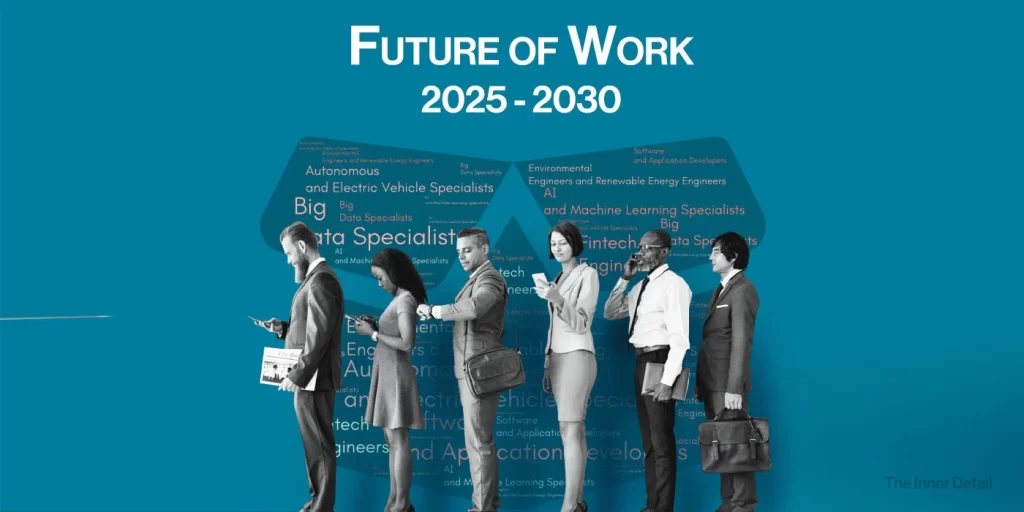
The world of work is in constant flux, a dynamic ecosystem shaped by technological advancements, shifting economic landscapes, and evolving societal needs. Understanding these transformations is crucial for professionals, students, and policymakers alike to prepare for what lies ahead.
The current global labor market is undergoing unprecedented change, largely driven by the rapid acceleration of digital transformation and the pervasive influence of artificial intelligence. From the rise of remote work to the increasing demand for specialized tech skills, industries worldwide are recalibrating their needs, creating both new opportunities and significant challenges for the workforce. This era demands adaptability and a forward-looking perspective to thrive amidst the disruption.
Let’s delve into the core insights from the “Future of Jobs Report 2025” by WEF to understand the jobs that are set to define the coming years.
Understanding the Forces Reshaping the Job Market
The World Economic Forum’s “Future of Jobs Report 2025” provides a comprehensive analysis of the interconnected trends shaping the global labor market through 2030. Derived from an extensive survey of over 1,000 global employers, representing more than 14 million workers across 22 industry clusters and 55 economies, the report highlights several key drivers of transformation.
- Technological Change: Broadening digital access is expected to be the most transformative trend, with 60% of employers anticipating it will reshape their business by 2030. Advancements in AI and information processing (86%), robotics and autonomous systems (58%), and energy generation, storage, and distribution (41%) are also poised for significant impact. Generative AI, in particular, has seen an almost eightfold increase in investment since November 2022 (launch of ChatGPT), rapidly reducing barriers to usage with its natural language processing capabilities.
- Economic Uncertainty: Rising cost of living and inflation are major concerns, with half of employers expecting them to transform their businesses by 2030. Slower economic growth is also anticipated to displace 1.6 million jobs globally.
- Green Transition: Climate-change mitigation and adaptation are critical drivers, with 47% and 41% of employers, respectively, expecting them to transform their businesses. This is fueling demand for roles in renewable energy and environmental engineering.
- Demographic Shifts: Aging and declining working-age populations in higher-income economies, coupled with expanding working-age populations in lower-income economies, are creating divergent labor market pressures. These shifts increase demand for healthcare and education professions.
- Geoeconomic Fragmentation: Geopolitical tensions and increased restrictions on trade and investment are expected to drive business model transformation in one-third of surveyed organizations, leading to demand for security-related roles.
Overall, these structural labor market transformations are projected to result in a combined churn of 22% of today’s total jobs by 2030. While approximately 170 million new jobs are expected to be created, 92 million existing jobs are also projected to be displaced, leading to a net growth of 78 million jobs globally.
Fastest Growing Jobs in the Next 5 Years
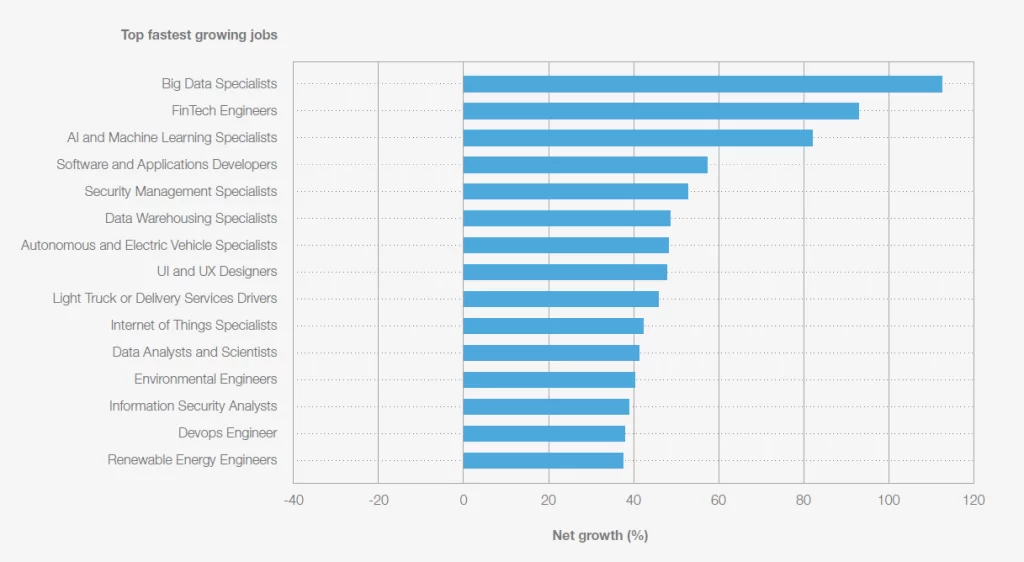
The report identifies several job roles that are poised for significant growth, both in absolute numbers and in percentage terms, driven primarily by technological advancements and the green transition.
In terms of percentage growth, technology-related and green transition roles dominate the landscape:
- Big Data Specialists: As data continues to explode, the demand for professionals who can manage and analyze it remains high.
- Fintech Engineers: The evolving financial technology sector requires specialized engineering talent.
- AI and Machine Learning Specialists: These roles are at the forefront of the technological revolution, driving innovation across industries.
- Software and Application Developers: The continuous need for new applications and software solutions ensures sustained demand for developers.
- Autonomous and Electric Vehicle Specialists: The automotive industry’s shift towards electric and autonomous vehicles creates new specialized roles.
- Environmental Engineers and Renewable Energy Engineers: These roles are crucial for addressing climate change and transitioning to sustainable energy sources.
Largest Growing Jobs in the Next 5 Years
In terms of absolute growth, frontline roles critical to many economies are expected to see the largest increases:
- Farmworkers, Labourers, and Other Agricultural Workers: Topping the list, an estimated 35 million more jobs are expected in this sector by 2030, driven by green transition trends.
- Delivery Drivers (Light Truck or Delivery Services Drivers): The increasing demand for logistics and e-commerce continues to fuel growth in this area.
- Construction Workers (Building Framers, Finishers, and Related Trades Workers; Construction Laborers): Infrastructure development and evolving construction methods contribute to their growth.
- Salespersons (Shop Salespersons): Despite automation in some retail aspects, the need for direct sales roles remains significant. Salesforce CEO Marc Benioff also said that the company plans to not recruit any software engineers in 2025 but only salespersons.
- Food Processing and Related Trades Workers: Growth in the food industry drives demand for these roles.
- Care Economy Jobs: Roles like Nursing Professionals, Social Work and Counselling Professionals, and Personal Care Aides are expected to grow significantly due to aging populations and increased focus on well-being.
- Education Roles: Tertiary and Secondary Education Teachers are also projected to see substantial growth.
Fastest Declining Jobs in the Next 5 Years
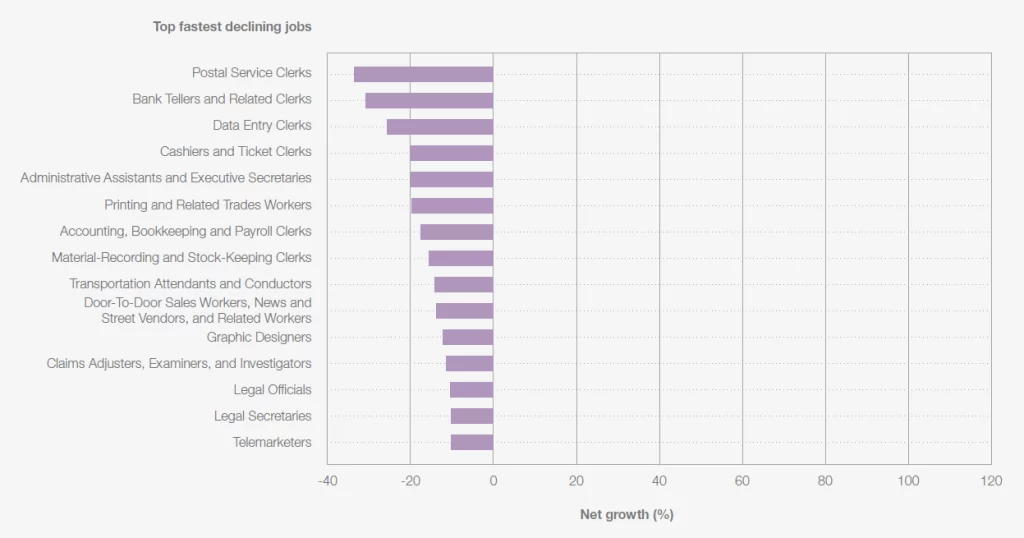
While new opportunities emerge, some job roles are expected to experience significant declines due to automation and evolving business processes.
- Clerical and Secretarial Workers: This category, including Cashiers and Ticket Clerks, and Administrative Assistants and Executive Secretaries, is projected to see the largest decline in absolute numbers.
- Postal Service Clerks: Automation in mail sorting and delivery, coupled with the decline in traditional mail, contributes to this reduction.
- Bank Tellers: The shift towards digital banking and automated services is reducing the need for traditional bank teller roles.
- Data Entry Clerks: Advancements in data capture and automation technologies are making these roles increasingly redundant.
- Accounting, Bookkeeping, and Payroll Clerks: While complex accounting roles will remain, routine tasks are susceptible to automation.
- Graphic Designers: While creative roles persist, some routine design tasks may be impacted by AI tools.
- Material-Recording and Stock-Keeping Clerks: Automation in inventory management and supply chain logistics is affecting these positions.
It’s important to note that these declines are often driven by technologies like AI and information processing, robotics, and automation, which streamline processes and reduce the need for manual or repetitive tasks.
The Human Element: Adaptability and Collaboration
Despite the significant impact of technology, the report emphasizes that human-centric skills will become increasingly vital. Employers are prioritizing skills such as analytical thinking, creative thinking, resilience, flexibility, agility, and curiosity and lifelong learning. These “human” skills are essential for navigating uncertainty, fostering innovation, and collaborating effectively with AI tools. The future workforce will not only need to understand technology but also possess the uniquely human abilities that complement and enhance AI capabilities.
The report also indicates a slowing in the measure of “skill instability” compared to previous editions, suggesting that efforts in training, reskilling, and upskilling are making a positive impact. A significant portion of the global workforce will require training by 2030, highlighting the continuous need for investment in talent development.
Preparing for the Future: Skills to Learn
The evolving job market necessitates a proactive approach to skill development. As we navigate the coming years, continuous learning and adaptation will be paramount for career resilience and growth. The shifts outlined in the “Future of Jobs Report 2025” underscore the importance of aligning individual skill sets with emerging industry demands.
To truly thrive in this transforming landscape, it’s essential to understand not just which jobs are growing and declining, but what skills underpin success in the jobs of tomorrow.
We’ve touched upon some key areas, but for a detailed roadmap on the specific competencies that students and freshers should acquire right now, I highly recommend you read my other blog article: “Skills in Demand: What Skills should Students & Freshers learn now?”. It provides an in-depth look at the most crucial skills and practical advice on how to develop them to be job-ready for the next couple of years.
The “Future of Jobs Report 2025” paints a vivid picture of a labor market in transition—one characterized by significant technological acceleration, environmental consciousness, and economic fluidity. While the displacement of certain roles is inevitable, the net creation of millions of new jobs offers immense opportunities. Success in this evolving landscape will hinge on adaptability, a commitment to lifelong learning, and the ability to combine human ingenuity with technological advancements. By understanding these trends and strategically investing in skills, individuals and organizations can confidently step into the future of work.
Key Takeaways
- Technological change, economic uncertainty, and the green transition are key forces reshaping the job market.
- Demand for technology-related and green transition roles is growing rapidly.
- Human-centric skills like analytical thinking and adaptability are increasingly vital.
- Continuous learning and upskilling are essential for career resilience.
Join our community by subscribing to our Weekly Newsletter to stay updated on the latest AI updates and technologies, including the tips and how-to guides. (Also, follow us on Instagram (@inner_detail) for more updates in your feed).
(For more such interesting informational, technology and innovation stuffs, keep reading The Inner Detail).
