
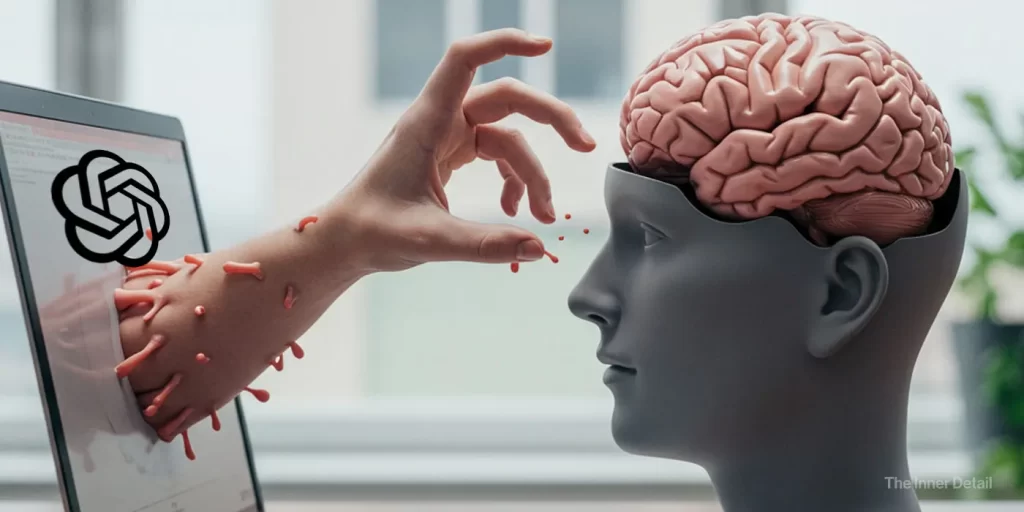
“ChatGPT can rot your brain,” screamed some recent reports, citing research from MIT scientists. It’s enough to make anyone pause before typing another prompt into their AI assistant. While such sensationalized titles grab attention, it’s crucial to understand what the research truly suggests and, more importantly, what it means for how we interact with powerful AI tools like ChatGPT. Rest assured, your brain isn’t literally at risk of decaying, but the findings do highlight important considerations for our cognitive well-being in the age of artificial intelligence.
Understanding the MIT Research: It’s About Our Habits, Not Hardware Damage
The core of the research, conducted by scholars from MIT and other prestigious institutions, doesn’t claim that AI physically harms brain tissue. Instead, it delves into the cognitive impact of over-reliance on large language models (LLMs) such as ChatGPT. The concern isn’t about your brain cells “rotting,” but rather about the potential for changes in how we think, learn, and problem-solve when we outsource complex mental tasks to AI.
Here’s a simpler breakdown of what the scientists are concerned about:
- Cognitive Offloading: Imagine constantly using a calculator for every single arithmetic problem, no matter how simple. Over time, your mental math skills might diminish because you’re offloading the effort to a tool. Similarly, when we rely on AI to generate ideas, summarize complex texts, or even solve logical problems for us, we might be offloading cognitive effort that our brains would otherwise perform. This repeated offloading, the researchers suggest, could lead to a reduction in our own cognitive muscle.
- Deskilling: Just as a pilot might lose manual flying skills if they always use autopilot, our intellectual skills could become “deskilled” if we consistently let AI do the heavy lifting. This could affect our ability to critically evaluate information, synthesize diverse ideas, or formulate original thoughts from scratch.
- Reduced Critical Thinking: If AI provides answers quickly and seemingly perfectly, there’s a risk we might stop questioning, verifying, or delving deeper. This passive acceptance could dull our inherent capacity for critical analysis and independent reasoning, which are vital for navigating a complex world.
- Impact on Creativity and Originality: While AI can generate novel combinations of existing information, true human creativity often stems from struggle, contemplation, and the unique synthesis of disparate experiences. If we default to AI for creative sparks, we might bypass the very mental processes that foster genuine innovation and originality within ourselves.
In essence, the concern isn’t that ChatGPT is a toxin for your brain, but that how we use it could subtly reshape our cognitive habits, potentially leading us to rely less on our innate intellectual capacities.
Leveraging AI Wisely: What You Should Do Instead
The good news is that AI is a tool, and like any powerful tool, its impact depends entirely on how we wield it. Rather than fearing AI, we can learn to integrate it into our lives in a way that augments our intelligence, creativity, and productivity, rather than diminishing them. Here are some dos and don’ts to consider:
Do’s for Smart AI Engagement
- Use AI as a Brainstorming Partner, Not a Brain Replacement: When starting a new project or idea, use ChatGPT to spark initial thoughts, generate diverse angles, or explore different approaches. Treat its output as a starting point, then build upon it with your own unique insights and critical evaluation.
- Verify and Validate: Always fact-check any information provided by AI. Even the most advanced models can “hallucinate” or provide inaccurate data. Your critical thinking skills are irreplaceable for ensuring accuracy.
- Demand Explanations: If you ask AI for a solution or a summary, also ask it to explain its reasoning or cite its sources. This forces the AI to reveal its process, which can be a valuable learning opportunity for you.
- Practice Active Learning: If AI summarizes a complex topic for you, don’t just read it. Challenge yourself to explain it in your own words, find supporting evidence, or debate its points. Use AI as a tutor, not a substitute for active engagement with the material.
- Refine Your Prompts: The better you become at prompting AI, the more you engage your own cognitive abilities in structuring queries, defining needs, and iterating on responses. This process itself is a valuable intellectual exercise.
- Focus on Augmentation, Not Automation: Instead of having AI automate an entire task, look for ways it can augment your contribution. Perhaps it handles the tedious data sorting while you focus on the high-level analysis, or it generates first drafts that you then infuse with your unique voice and perspective.
Don’ts for Healthy Cognitive Habits
- Don’t Outsource Critical Thinking Entirely: Avoid the temptation to let AI do all your analysis, problem-solving, or decision-making. Your brain thrives on these challenges; denying it that exercise can lead to atrophy of those skills.
- Don’t Blindly Accept AI Output: Never assume that what an AI generates is perfect, accurate, or even logical. Always apply your own judgment and scrutiny.
- Don’t Let AI Steal Your Struggle: Some of our most profound learning and creative breakthroughs happen when we grapple with difficult problems. If you consistently use AI to bypass this struggle, you might miss out on deeper understanding and genuine innovation.
- Don’t Neglect Traditional Research: While AI can be a quick search tool, don’t abandon the discipline of in-depth research, reading books, academic papers, and diverse sources. These methods often provide context, nuance, and deeper understanding that AI summaries might miss.
- Don’t Rely on AI for Original Content Without Your Mark: If you’re creating something truly original – a story, an essay, a unique business proposal – use AI for assistance, but ensure the final product distinctly bears your intellectual stamp, your voice, and your unique perspective.
The advent of AI tools like ChatGPT presents an unprecedented opportunity to enhance human potential. The key lies not in fearing their power, but in understanding their true capabilities and, more importantly, our own. By using AI as a smart assistant that amplifies our intellect rather than replaces it, we can navigate this exciting new era with our minds sharper and more capable than ever before. Your brain isn’t at risk of “rotting”; it’s ready to evolve. The choice, as always, is yours.
Key Takeaways
- AI’s impact on our brains is about cognitive habits, not hardware damage.
- Over-reliance on AI can lead to cognitive offloading and deskilling.
- Use AI as a brainstorming partner and for augmentation, not replacement.
- Always verify AI output and demand explanations.
Join our community by subscribing to our Weekly Newsletter to stay updated on the latest AI updates and technologies, including the tips and how-to guides. (Also, follow us on Instagram (@inner_detail) for more updates in your feed).
(For more such interesting informational, technology and innovation stuffs, keep reading The Inner Detail).

Thanks for the article. Here’s more on the topic https://orenbash.ru/