
As human intelligence evolves, technology similarly advances to simplify processes and assist us. Artificial Intelligence (AI) stands as a prime example, having profoundly impacted and continuing to shape our world. While often confused with robotics, AI is distinct; it’s the underlying technology integrated into robotics. Essentially, AI is a branch of computer science that enables machines to simulate human cognitive functions.
Defining Artificial Intelligence: What Does AI Truly Mean?
Artificial intelligence (AI) is an innovative technology where machines and computer systems are designed to simulate or possess human-like intelligence, enabling them to perform tasks automatically and achieve goals with capabilities akin to natural intelligence.
Colloquially, artificial intelligence refers to machines that emulate the cognitive functions associated with the human mind, including essential processes like learning, reasoning, and problem-solving.
This advanced technology allows systems to analyze their environment, process information using predefined algorithms or vast datasets, and then determine the optimal path to achieve specific objectives. These objectives can either be explicitly programmed or learned autonomously by the machine through past interactions, a process known as reinforcement learning.
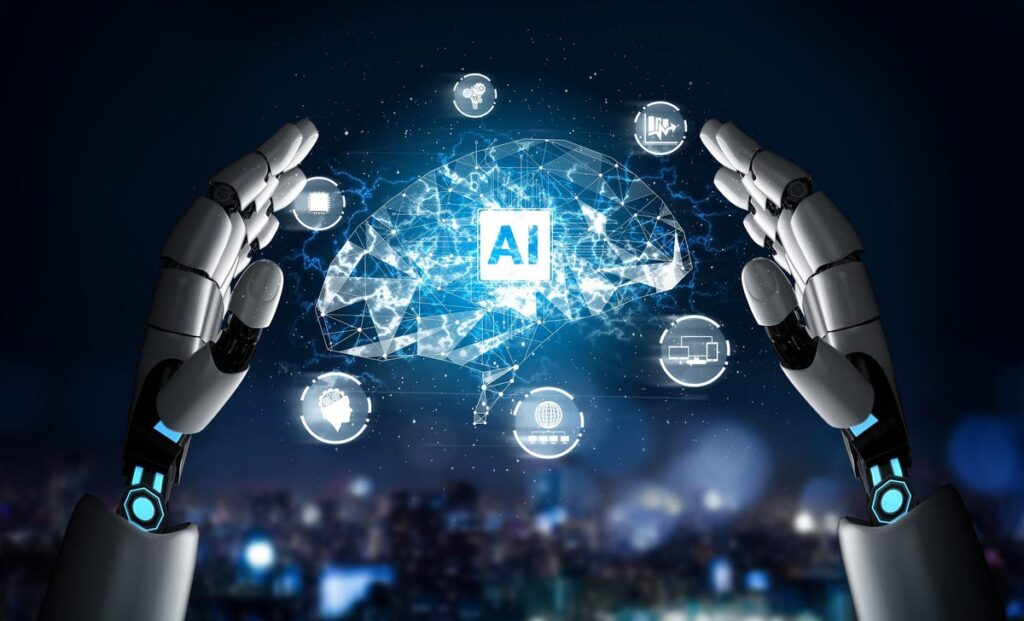
Among the various approaches to AI, one of the most compelling is the artificial neural network (ANN), which draws inspiration from the human brain. This approach utilizes artificial neurons that learn by adjusting the strength of their internal connections based on desired outputs, effectively “reinforcing” pathways found to be useful for accurate processing.
Did You Know?
The term 'Artificial Intelligence' was first coined in 1956 to distinguish the field from 'cybernetics'.
How Artificial Intelligence Works: A Deeper Look
As previously mentioned, AI technology is designed to analyze situations and autonomously execute tasks with intelligence. To illustrate this, let’s consider the example of a chess game.
1. Data Analysis:
- Initially, the AI system receives fundamental instructions, including the rules of chess, the movement of each piece, and the ultimate objective of checkmating the opponent.
- It is then fed extensive data enabling it to strategize for checkmate, simultaneously evaluating the safety and security of its own pieces.
- Should a piece be attacked, the AI prioritizes its defense before continuing with offensive maneuvers.
2. Interpretation and Simulation:
Throughout the game, the AI system dynamically interprets and simulates potential next moves from the opponent, much like a human player. It leverages its data to anticipate any threats to its pieces and skillfully manipulates the game state to prevent losses.
3. Manipulation and Decision-Making:
By correlating the analyzed data and simulated scenarios, the AI makes informed decisions to move specific pieces with the ultimate goal of outmaneuvering and defeating the opponent.
Similarly, the system constantly processes new information about the game state, meticulously inspecting every move to advance towards its primary objective: winning the game.
Deep Blue made history as the first AI-powered computer chess system to defeat a reigning World Champion, Garry Kasparov, on May 11, 1997.
In achieving these feats, AI systems are designed to prioritize the simplest possible solutions, unless a complex approach offers significant advantages (as seen in situations like overfitting). However, certain problems can lead to a ‘combinatorial explosion,’ a scenario where solving them requires an exponential increase in computational time as complexity grows.
Ultimately, a deep understanding of artificial intelligence reveals its capacity to enable machines in critical areas such as reasoning, complex problem-solving, recognition, strategic planning, continuous learning, effective decision-making, natural language processing, perception, and skillful manipulation.
Key Applications of Artificial Intelligence Across Industries
Artificial intelligence has become ubiquitous due to its highly productive and effective methodologies, significantly assisting humans across diverse sectors. From the facial recognition on your smartphone to critical operations in hospitals, AI’s achievements continue to drive its increasing demand. Below, we explore a few major applications.
- AI profoundly impacts healthcare by assisting medical professionals. For instance, AI systems can analyze vast amounts of medical data to recommend appropriate diagnostics like ECGs or CT scans. According to Bloomberg Technology, AI has also aided in effectively diagnosing cancer patients and suggesting optimal treatments from a database of over 800 medicines and vaccines, thereby streamlining doctors’ workloads.
- One of AI’s most significant contributions is to the automotive sector, particularly with ‘self-driving’ vehicles. Here, AI is integrated into every critical component that traditionally responds to a driver’s input, including braking, steering, collision avoidance, navigation, and mapping. These sophisticated AI-powered systems collectively enable the development of complex self-driving cars.
- Furthermore, AI facilitates advanced stock analysis by interpreting and examining financial data, leading to more efficient marketing strategies and financial trading. It is also widely deployed in banking institutions to detect and prevent unauthorized debit card usage.
Read more: 3rd Generation of Artificial Intelligence – Neuromorphic Computing
The widespread adoption of AI is evident across nearly all industries. Jack Ma once provocatively suggested that AI CEOs could emerge within 30 years. AI’s rapidly expanding influence consistently raises discussions about its potential to automate and transform human workforces within the next one or two decades.
Potential Disadvantages and Ethical Concerns of AI
Every innovation has its dual nature, and for AI, the primary concerns revolve around digital warfare and potential human obsolescence.
“From my perspective, the most perilous applications for AI would involve criminals or major terrorist organizations utilizing it to disrupt critical systems or inflict direct harm. This could manifest through digital warfare, or potentially a dangerous combination of robotics, drones, and AI, among other advanced technologies.”
– Irakli Beridze (Head, Artificial Intelligence and Robotics, UNICRI, United Nations)
“The complete development of artificial intelligence could signify the conclusion of the human era. Once AI is fully realized, it will autonomously advance and continually redesign itself at an accelerating pace. Humans, constrained by the slow process of biological evolution, would be unable to compete and ultimately superseded.”
– Stephen Hawking
Join our community by subscribing to our Weekly Newsletter to stay updated on the latest AI updates and technologies, including the tips and how-to guides. (Also, follow us on Instagram (@inner_detail) for more updates in your feed).
(For more such interesting informational, technology and innovation stuffs, keep reading The Inner Detail).

Pingback: Educational Trends enhancing the Student’s Future – The Inner Detail