While water covers approximately 70% of Earth’s surface, making up two-thirds of the planet, only a tiny fraction—3%—is fresh water. Alarmingly, merely 0.5% of this fresh water is readily accessible for human use, with the remaining 2.5% trapped within glaciers and icebergs. Despite this critical scarcity, and the fact that 2.2 billion people worldwide lack access to clean drinking water, instances of potable water wastage persist.
The vast majority of the world’s water is saline, rendering it undrinkable. Conventional desalination processes, which convert saltwater into potable water, are typically energy-intensive and costly, limiting their widespread adoption. However, a significant innovation from MIT researchers has emerged: a compact, suitcase-sized device designed to transform seawater into safe drinking water, using considerably less energy than traditional water filters.
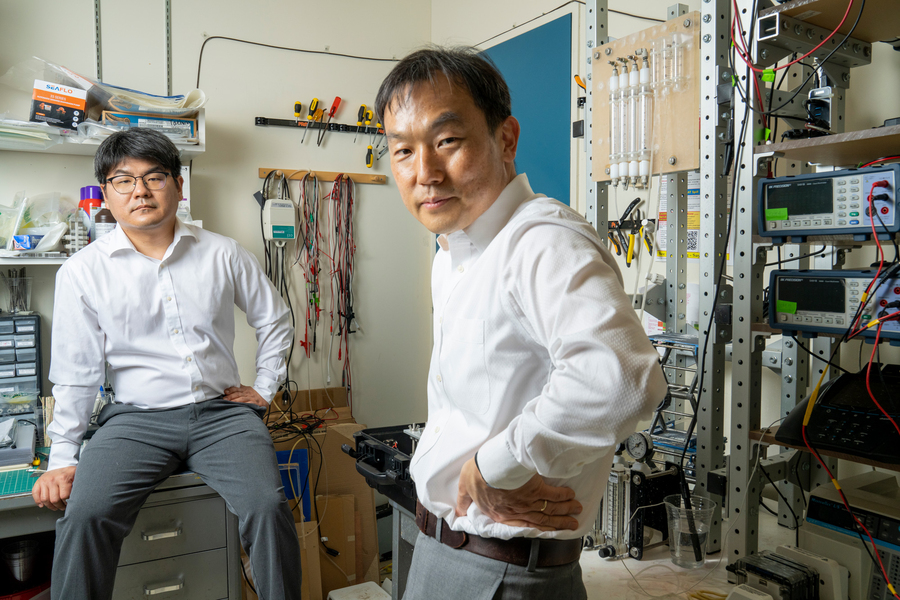
Jongyoon Han, a distinguished professor of Electrical Engineering and Computer Science and of Biological Engineering, alongside his dedicated team, spearheaded the development of this portable desalination unit. Sized like a suitcase and weighing less than 10 kilograms, it’s remarkably easy to transport. This innovative device efficiently removes unwanted particles and salts, producing drinking water that meets stringent World Health Organization (WHO) standards.
What truly sets this device apart from conventional water filters is its unique electrification-based separation method. By applying electrical power to seawater, it automatically generates drinking water that surpasses the World Health Organization’s quality benchmarks. This advanced purification is achieved with just the push of a button. Han notes that the device’s operational power requirement is even lower than that of a typical cell phone charger, and it can be conveniently powered by a portable solar panel affixed to its back.
How Does This Portable Desalination Technology Function?
Many commercially available water filters rely on high-pressure pumps to force water through membranes, demanding significant space and power for effective operation. This traditional approach also presents challenges for miniaturization without compromising energy efficiency.
In contrast, the groundbreaking method developed by MIT scientists, known as ‘Ion Concentration Polarization (ICP)’, utilizes an electrical field. This field is applied to membranes positioned above and below a water channel. As water flows through, the electrified membranes effectively repel both positively and negatively charged particles—including salt molecules, bacteria, viruses, and other undesirable contaminants. These charged particles are then directed into a separate stream of water for discharge, leaving behind clean, fresh water ready for consumption.
Jongyoon Han on the Decade-Long Journey to Portable Desalination Innovation
Senior author Jongyoon Han reflects, “This is really the culmination of a 10-year journey that I and my group have been on. We worked for years on the physics behind individual desalination processes, but pushing all those advances into a box, building a system, and demonstrating it in the ocean, that was a really meaningful and rewarding experience for me.”
Recognizing that ICP alone might not eliminate all dissolved salts, a second process, electrodialysis, was integrated to remove any remaining salt ions, ensuring comprehensive purification.
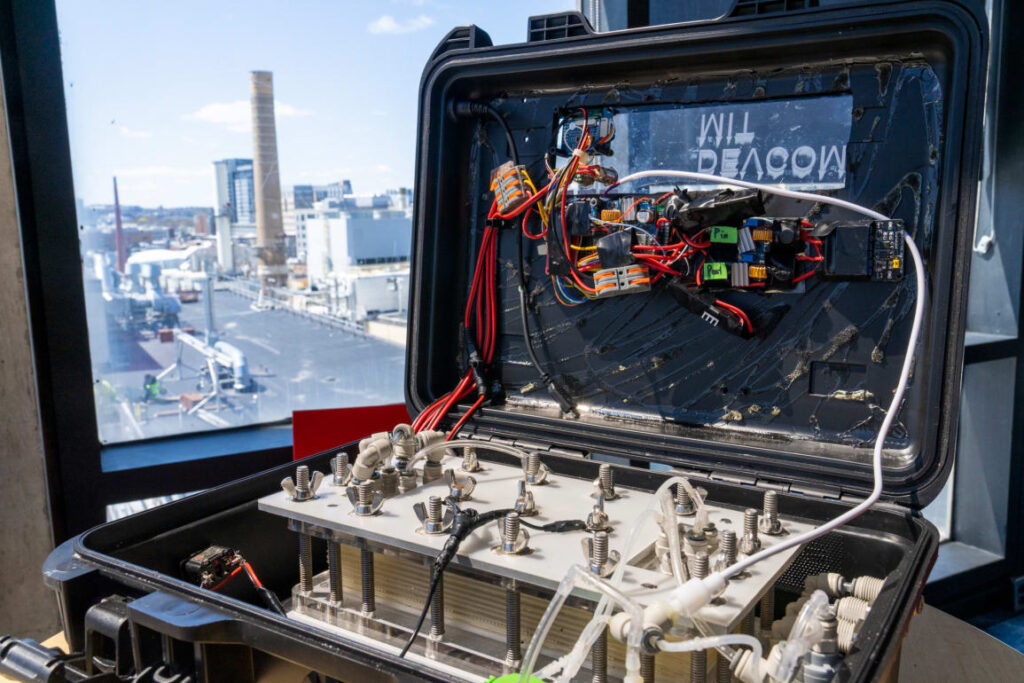
To further enhance efficiency and scalability, researchers meticulously developed a two-stage ICP process. Water flows sequentially through six modules in the initial stage, followed by three modules in the second stage, and then undergoes a single electrodialysis treatment. This optimized sequence significantly minimizes energy consumption while incorporating a crucial self-cleaning mechanism.
Junghyo Yoon on the Self-Cleaning Capabilities of the Desalination Unit
Junghyo Yoon explains this innovative feature: “While it is true that some charged particles could be captured on the ion exchange membrane, if they get trapped, we just reverse the polarity of the electric field and the charged particles can be easily removed.”
Field Testing the Portable Seawater-to-Drinking Water Converter
With the research complete, the device was ready for real-world application. Researchers conducted field tests at Boston’s Carson Beach to demonstrate its capabilities.
Junghyo Yoon, a research scientist in RLE, and Sungku Kang, a postdoctoral researcher at Northeastern University, positioned the suitcase-sized unit near the shoreline, extending its feed tube into the ocean. Within approximately thirty minutes, the device successfully produced clear, drinkable water directly into a waiting cup.
Explore More Related Content
Jongyoon Han Reflects on the Device’s Initial Success
Han remarked on the trial’s immediate success: “It was successful even in its first run, which was quite exciting and surprising. But I think the main reason we were successful is the accumulation of all these little advances that we made along the way.”
The prototype demonstrated impressive performance, yielding drinking water at a rate of 0.3 liters per hour while consuming only 20 watt-hours per liter.
Yoon noted the team’s ongoing efforts, stating, “Right now, we are pushing our research to scale up that production rate.”
Once fully scaled, this innovative device holds immense potential to serve as a vital resource in remote locations, including isolated island communities, aboard seafaring cargo vessels, and potentially even alleviate water scarcity challenges for coastal cities worldwide.
Join our community by subscribing to our Weekly Newsletter to stay updated on the latest AI updates and technologies, including the tips and how-to guides. (Also, follow us on Instagram (@inner_detail) for more updates in your feed).
(For more such interesting informational, technology and innovation stuffs, keep reading The Inner Detail).