
Augmented Reality (AR) and Virtual Reality (VR), two of today’s most talked-about technologies, are converging into the sensational concept known as the ‘Metaverse’. This term has seen significant online discussion, especially since Facebook rebranded to ‘Meta’ on October 28, 2021. While recent developments and popular platforms like Fortnite and Roblox have amplified its presence, the concept of the Metaverse itself is actually decades old.
Understanding the Metaverse: A Comprehensive Overview
The Metaverse represents a sophisticated integration of various technologies, primarily Virtual Reality (VR) and Augmented Reality (AR). In this expansive digital universe, users interact as online avatars, immersing themselves in virtual environments. Imagine donning a VR headset and stepping into a fantastical realm where you can meet and connect with others in a shared virtual space. This transformative concept is rapidly expanding into diverse applications, including professional work environments, fitness and exercise, shopping experiences, and entertainment.

Etymologically, the term ‘Metaverse’ derives its meaning from its components. The prefix ‘meta’ signifies ‘beyond,’ ‘more comprehensive,’ or even ‘transformative,’ while the suffix ‘verse’ is extracted from ‘universe,’ indicating a distinct realm or area. Together, ‘Metaverse’ thus describes a digital world that exists beyond, atop, or as an extension of our physical reality.
While major players like Meta (formerly Facebook) anticipate significant Metaverse developments in the coming years, various companies have already embraced elements of these technologies. Popular examples include gaming platforms like Fortnite, Minecraft, and Roblox. Interestingly, the foundational concept of the Metaverse was first introduced in 1992 by author Neal Stephenson, who coined the term in his dystopian science fiction novel, Snow Crash. In Stephenson’s vision, virtual and augmented realities converge, allowing people to navigate a vast digital street as avatars. The novel even distinguished between public terminal users, depicted as blurry black and white avatars, and those with private terminals, rendered in full color and detail. Since its literary inception, the term ‘Metaverse’ has evolved to encompass all instances of persistent, immersive virtual experiences.
Meta’s Vision for the Metaverse
Mark Zuckerberg, CEO of the recently rebranded Meta (formerly Facebook), has made substantial investments in virtual reality technology, notably through the acquisition of Oculus and the subsequent release of Oculus Quest VR headsets. Meta’s overarching vision is to construct an interconnected virtual world where digital avatars can interact for work, travel, and entertainment, primarily facilitated by VR headsets. Zuckerberg anticipates that the core functionalities of the Metaverse will become mainstream within five to ten years, though foundational aspects are already observable today.
Zuckerberg expresses strong optimism regarding the Metaverse, believing it possesses the potential to fundamentally transform our interaction with the internet.
Following the company’s rebranding, the Meta CEO stated, “The next platform and medium will be an even more immersive and embodied internet where you’re in the experience, not just looking at it, and we call this the Metaverse.”
Microsoft’s Expansion into the Virtual Metaverse

Microsoft, the prominent software corporation, is actively leveraging holograms and advancing mixed reality (MR) and extended reality (XR) applications through its innovative Microsoft Mesh platform. This platform seamlessly integrates real-world environments with Augmented Reality (AR) and Virtual Reality (VR). Recently, Microsoft unveiled its strategy to introduce mixed-reality features, including holograms and virtual avatars, into Microsoft Teams by 2022. Additionally, plans for the upcoming year include developing explorable 3D virtual connected spaces for both retail and professional workplaces. The U.S. Army is also collaborating with Microsoft, utilizing an augmented reality Hololens 2 headset to enhance soldier training, rehearsal, and combat readiness. Furthermore, Microsoft’s Xbox Live platform already facilitates connections among millions of global video game players, demonstrating its existing footprint in large-scale virtual interactions.
Epic Games: A Pioneer in Immersive Virtual Worlds
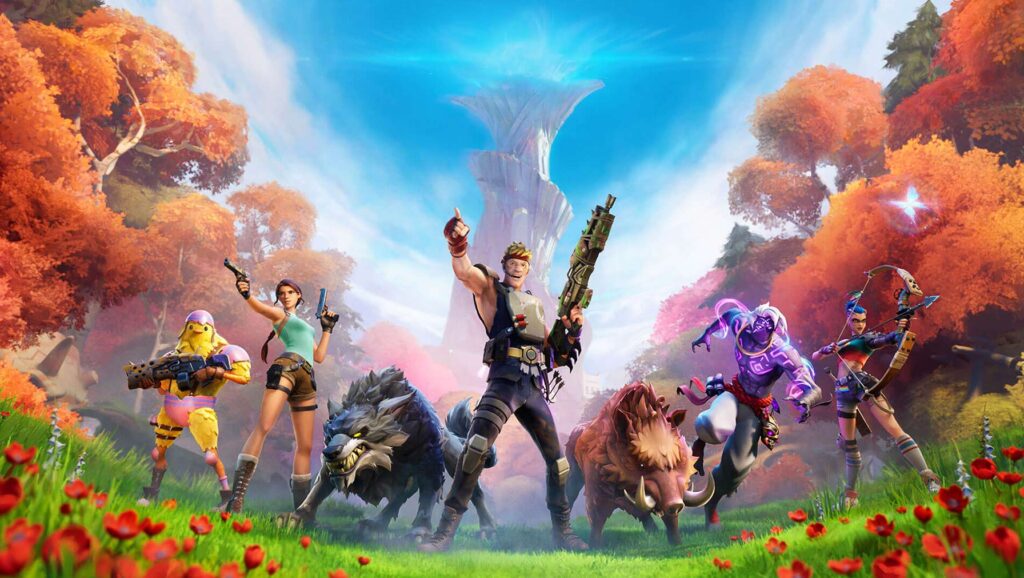
While major tech giants vie for dominance in constructing and governing the future Metaverse, Epic Games, the developer of the hugely popular Fortnite, has already captivated online gamers within its expansive virtual world. Launched in 2017, Fortnite boasts over 350 million registered players, offering a dynamic survival game experience. It integrates massive in-game events, such as a rocket launch that transformed the virtual sky or a black hole that consumed the entire game world, providing players with immersive occurrences rarely possible in physical reality.
Minecraft: A Creative Digital Universe

Microsoft-owned Minecraft stands as another highly popular virtual universe, particularly cherished by younger audiences. This platform functions as the digital equivalent of LEGOs, empowering players to design their own digital avatars and construct virtually anything they envision. By August, Minecraft had amassed over 140 million monthly active users. Its popularity significantly surged during the pandemic, as children increasingly relied on virtual connections for social interaction and play.
The Metaverse: A Digital Escape or a Potential Ensnarement?
The Metaverse presents itself as a fantastical digital realm, offering users the astonishing ability to experience alternate realities shaped to their desires. This immersive escape from the complexities and chaos of the physical world has been widely considered a significant draw. One blogger, reflecting on their Fortnite gaming experience, shared, “Over the last 18 months as we drifted in and out of lockdowns, Fortnite was the one game that made me feel connected to friends and family. After a long day of being on video calls, it was a great escape where we could meet up, hang out, and chat — while picking off other players along the way.”
However, if individuals become overly reliant on this appealing yet ultimately void digital fantasy world, it could potentially lead to a concerning detachment from real-world experiences and an inability to accept physical reality. In severe cases, this scenario might necessitate psychological intervention to re-engage with the physical world, a prospect that is undeniably disheartening.
As a wise suggestion in Tamil states, “அளவுக்கு மீறினால் அமிர்தமும் நஞ்சு,” which translates to the profound truth: “Too much of anything, even nectar, becomes poison.”
Join our community by subscribing to our Weekly Newsletter to stay updated on the latest AI updates and technologies, including tips and how-to guides. Also, follow us on Instagram (@inner_detail) for more updates directly in your feed.
For more interesting informational, technology, and innovation content, keep reading The Inner Detail.
