
Mastering AI skills is becoming increasingly important for career advancement, with AI poised to add significant value to the global economy. Whether you are a complete beginner or a professional looking to specialize, numerous online resources offer comprehensive training in AI. This article explores ten notable AI learning opportunities, ranging from introductory courses to advanced specializations and development kits, along with the comparison of the ten courses at the last.
10 Best Free AI Courses
1. Google’s AI Basics – Learn Essential AI Skills
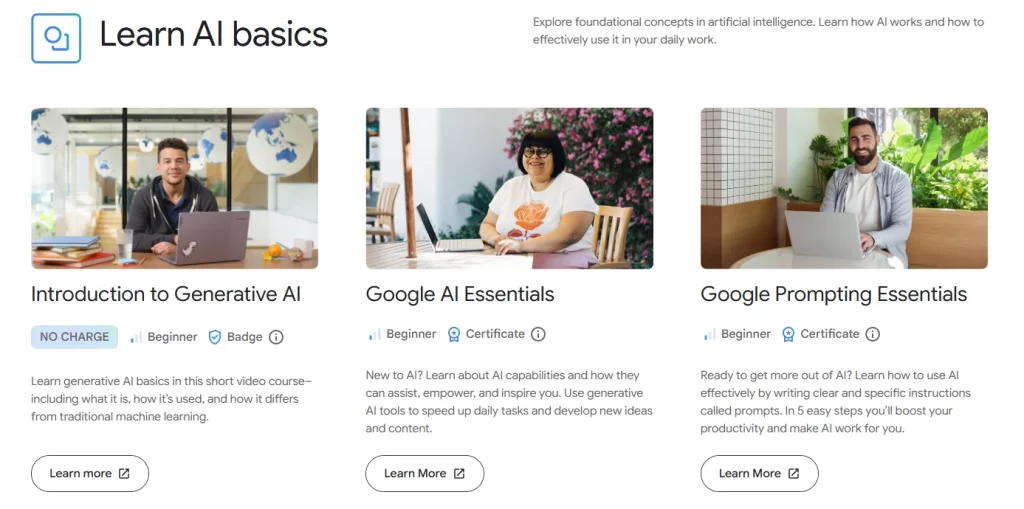
This refers to a collection of learning resources offered by Google to help individuals learn essential AI skills. Google provides various programs, trainings, and tools designed to address the needs of workers everywhere, helping them succeed in an AI-driven world.
- Who should take this resource collection? These resources are for anyone looking to learn foundational concepts in artificial intelligence. They cater to those who are new to AI and want to understand how AI works and how to use it effectively in their daily work.
- What you’ll get from this resource collection? The collection includes resources like “Introduction to Generative AI”, a short video course explaining what generative AI is and how it’s used. “Google AI Essentials” helps beginners understand AI capabilities and use generative AI tools for daily tasks. “Google Prompting Essentials” teaches how to use AI effectively by writing clear and specific prompts. Google offers resources on platforms like Grow with Google and Google Cloud Skills Boost, including no-charge workshops, training programs, courses, and hands-on labs. Some resources offer a completion badge or an industry-recognized certificate. These resources aim to help learners understand how AI works, use it in their daily work, and leverage generative AI tools.
- Who provides this resource collection? These resources are provided by Google through initiatives like Grow with Google and platforms like Google Cloud Skills Boost. The content is designed and built by subject-matter experts and AI practitioners at Google.
2. Fundamentals of Artificial Intelligence – SWAYAM
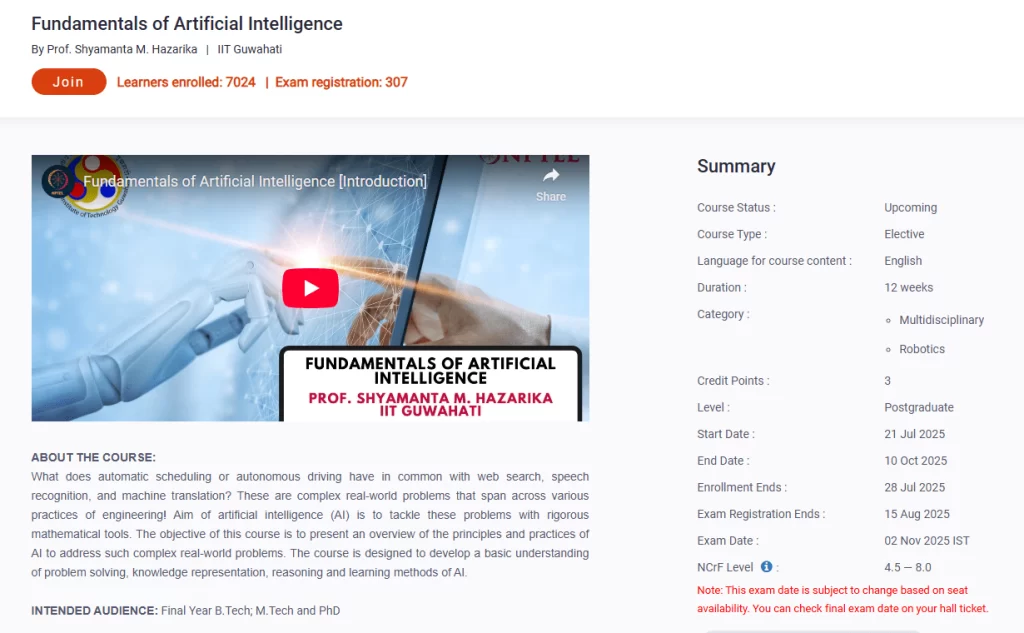
This is a course offered through the SWAYAM platform.
- Who should take this course? The course is intended for Final Year B.Tech, M.Tech, and PhD students. Prerequisites include a basic course in Probability and Linear Algebra.
- What you’ll get from this course? The objective is to present an overview of the principles and practices of AI to address complex real-world problems such as automatic scheduling, autonomous driving, web search, speech recognition, and machine translation. The course is designed to develop a basic understanding of problem solving, knowledge representation, reasoning, and learning methods of AI. The course layout covers topics like AI and Problem Solving by Search, Knowledge Representation and Reasoning, Reasoning under Uncertainty, Planning, Decision Making, and Machine Learning over 12 weeks. It is an elective, postgraduate level course worth 3 credit points.
- Who is teaching? The instructor is Prof. Shyamanta M. Hazarika from IIT Guwahati. Prof. Hazarika is a Professor of Mechanical Engineering and leads the Biomimetic Robotics and Artificial Intelligence Lab, with research interests including Artificial Intelligence and Knowledge Representation and Reasoning.
3. AI for Everyone
This course, often associated with Andrew Ng and DeepLearning.ai, is tailored for a broad audience.
- Who should take this course? It is designed for everyone, even if you don’t have a tech background, and complete beginners desiring a broad, non-technical overview of the field. It’s for non-technical people curious enough to implement AI in the real world.
- What you’ll get from this course? The course demystifies AI, showing how it works and how it can be used in various fields. It provides an overview of AI concepts and terminologies. You will learn about real-life applications of AI across industries, how to implement AI strategies in businesses, and gain insight into societal impacts and ethical concerns. The course discusses what machine learning can and cannot do with simple non-technical explanations. It gives an overview of the workflow for machine learning projects and how AI can be used in a company. By the end, you’ll learn to identify opportunities where AI can be implemented to solve problems in your organization. It is described as the best introductory course for developing AI literacy.
- Who is teaching? The course is by Andrew Ng, described as an AI legend. Andrew Ng is a prominent figure in AI, having co-founded Coursera and Google Brain, built the AI team at Baidu, and is a professor at Stanford University. The course is also listed as provided by Deeplearning.ai.
4. Deep Learning Specialization
This specialization by DeepLearning.ai is a comprehensive dive into deep learning.
- Who should take this course? This is for students with some experience who want to dive into the deep learning branch of AI. It is meant to follow up on Andrew Ng’s Machine Learning Specialization. You need prerequisites like Python, Linear Algebra, and Machine Learning experience.
- What you’ll get from this course? It’s a five-course series that gives you practical knowledge about how AI brains (neural networks) actually work. You learn how to build and train neural networks from scratch, fine-tune AI models, reduce errors, and optimize performance. The specialization covers topics like Convolutional Neural Networks (CNNs) used in self-driving cars and Sequence Models for natural language processing (NLP). It includes modules on structuring machine learning projects. Over five months, you’ll learn both the mathematical workings and how to build deep neural networks through guided coding sessions. You will learn about computer vision and natural language processing. Upon completion, you receive a course completion certificate from Deep learning AI.
- Who is teaching? The course is taught by Andrew Ng, Younes Bensouda Mourri, and Kian Katanforoosh. Younes Bensouda Mourri teaches AI at Stanford and is co-creator of graduate-level AI courses. Kian Katanforoosh is a Stanford Computer Science lecturer and co-creator of Stanford’s Deep Learning course.
5. Generative AI and Large Language Models
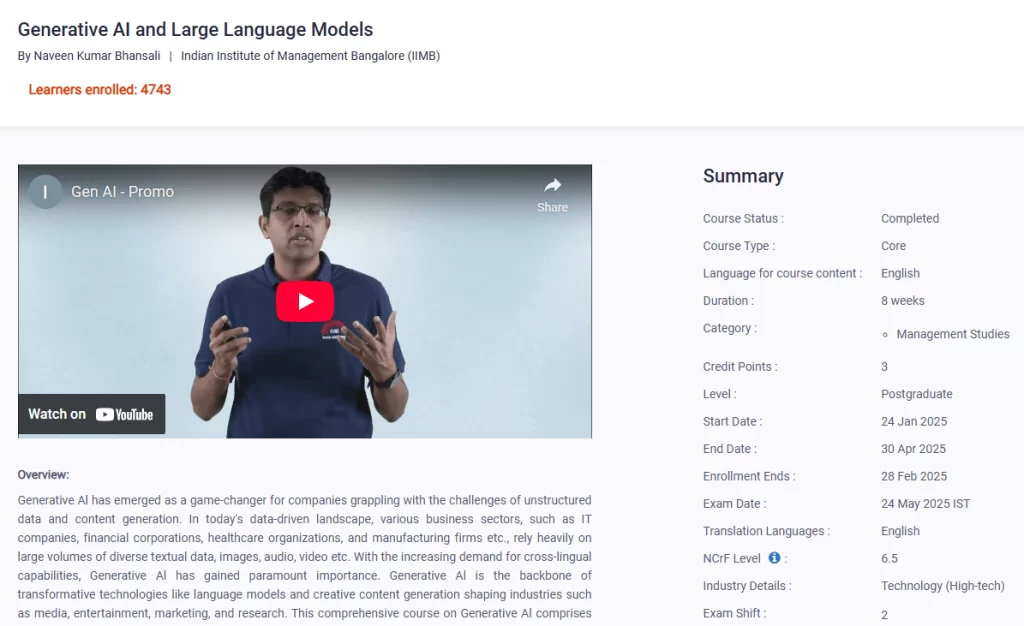
- Who should take this course? This is a Postgraduate level course suitable for individuals and professionals across diverse business sectors like IT, finance, healthcare, manufacturing, media, entertainment, marketing, and research. It’s particularly relevant for those dealing with unstructured data, content generation challenges, and the need for cross-lingual capabilities. It’s for learners seeking profound insights and mastery of Generative AI algorithms and deep learning concepts.
- What you’ll get from this course? This 8-week course offers a deep understanding of Generative AI’s Fundamental Concepts, Applications, and Deep Learning components. You’ll cover topics including Transformers, Prompt Engineering, RAG, Generative Image Models, LangChain, Training/Deployment strategies, and Responsible AI. While learning is free, a certificate requires registering for and passing a proctored exam. Eligibility requires 40% in internal assessments and 40% in the final exam. Certificates range from Successfully Completed to Bronze, Silver, or Gold based on your overall score. The course provides 3 Credit Points.
- Who is teaching? The course is taught by Naveen Kumar Bhansali. He is an adjunct faculty at the Indian Institute of Management Bangalore (IIMB) and the Co-founder and CTO of BlitzAI.
6. AI Courses in Swayam
SWAYAM is an online learning platform where courses are published by IIMs and IITs of India. Anyone around the globe can join the courses in the platform and leverage the content for free. The SWAYAM portal offers a vast array of Artificial Intelligence (AI) courses from premier Indian institutions, providing accessible and high-quality education.
- Who should take these courses? These courses cater to diverse learners: undergraduate/postgraduate students (engineering, science, arts), professionals seeking to upskill in IT, finance, healthcare, and research, and anyone curious about AI. Many introductory courses require no prior AI or coding experience.
- What you’ll get from these courses? You’ll gain deep understanding of AI principles, algorithms, and applications. Topics include fundamental AI, Machine Learning, Deep Learning (neural networks, CNN, RNN), and specialized applications like Generative AI (Transformers, Prompt Engineering). Practical skills in AI tools and Python are often included. Learning is free, but certification, which can offer credit points, requires passing a proctored exam.
- Who is teaching? Courses are taught by renowned faculty from leading Indian institutions like IITs and IIMs, ensuring expert-led instruction.
7. OpenAI’s Guide to AI Agents
This item is not a course, but a detailed 32-page guide titled “A practical guide to building agents” released by OpenAI. It offers insights and best practices for designing, developing, and deploying AI agents.
- Who should read this guide? This guide is for product and engineering teams looking to venture into building intelligent systems. It is particularly relevant for those interested in leveraging large language models (LLMs) for complex task automation.
- What you’ll get from this guide? The guide defines AI agents as systems that can independently accomplish tasks on a user’s behalf, distinguishing them from simple LLM integrations. It emphasizes that agents leverage an LLM to manage workflows, make decisions, correct actions, and interact with external systems. The guide outlines suitable use cases for AI agents, such as complex decision-making, workflows with difficult-to-maintain rules, and situations relying heavily on unstructured data. It details the core components of AI agents: the Model (LLM), Tools (external functions/APIs), and Instructions (guidelines). The guide explores orchestration patterns like single-agent and multi-agent systems (Manager and Decentralized patterns). A critical component discussed are Guardrails, layered defense mechanisms to ensure agents operate safely and predictably, including relevance, safety, and PII filters, moderation, tool safeguards, rules, and output validation.
- Who published this guide? The guide is published by OpenAI.
8. Harvard: Machine Learning and AI with Python
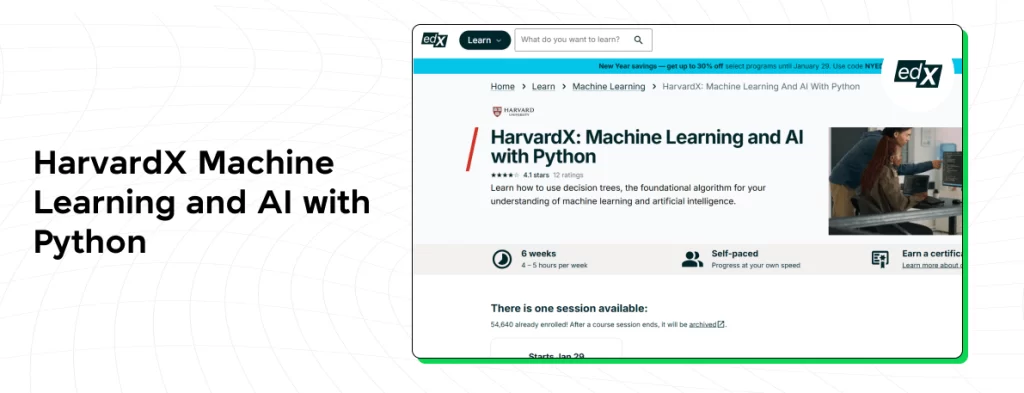
This course, offered through HarvardX (likely on edX as indicated by the link in one source), provides an introduction to Machine Learning and AI using Python. It is also mentioned as part of a larger “Computer Science for Artificial Intelligence Professional Certificate” on edX.
- Who should take this course? This course is for those interested in Python-based machine learning. It is described as suitable for intermediate to advanced learners. Prerequisites include a strong foundation in calculus, linear algebra, and Python programming. The related certificate is suggested for AI learners who want a solid computer science foundation or enjoy challenging problems.
- What you’ll get from this course? The course walks you through Python-based machine learning, exploring algorithms, data visualization, and AI frameworks. It is described as a mix of academic rigor and hands-on experience that prepares you for real-world challenges. Course content includes basics of machine learning algorithms like regression and classification, advanced topics such as natural language processing (NLP), computer vision, and deep learning [5 – This content is listed under GUVI, but sounds relevant to ML/AI course – reconsider using], Correction: Content listed in source for this specific course includes: Supervised and unsupervised learning models, Key algorithms like decision trees and clustering techniques, Data preprocessing, feature engineering, and evaluation, and Real-world applications in healthcare, finance, and more. The related HarvardX certificate course “Introduction to Artificial Intelligence with Python” covers Search, Knowledge Representation, Reasoning under Uncertainty, Optimization, Learning, Neural Networks, and Language. It involves building various AI programs, such as playing games, building crossword puzzles, identifying traffic signs, parsing sentences, and predicting masked words.
- Who is teaching? Based on the related HarvardX certificate program, the instructors include David J. Malan, a computer scientist and professor at Harvard, and Brian Yu, a software developer and educator who also teaches at Harvard.
9. MIT Introduction to Deep Learning
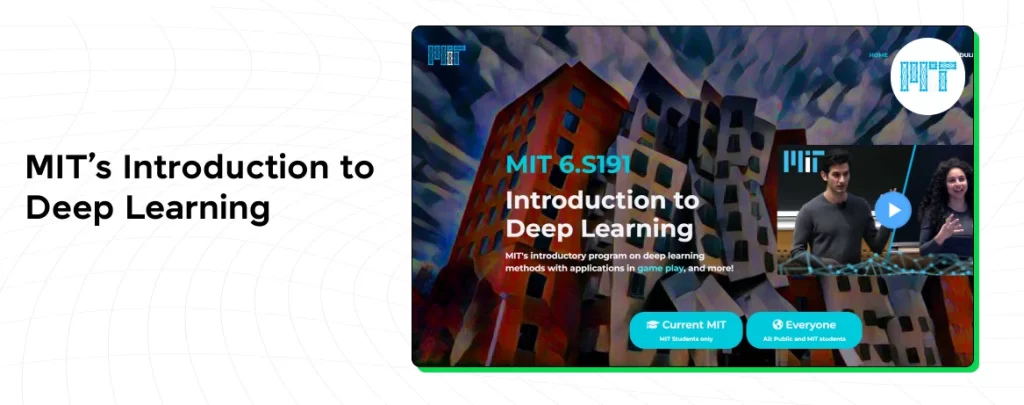
This course is offered by MIT.
- Who should take this course? This course is for those who want to dive into the world of deep learning. It is described as a beginner-level course. Prerequisites include high school math and basic programming knowledge.
- What you’ll get from this course? The course makes advanced topics, such as reinforcement learning and neural networks, approachable. It provides real-world case studies and expert insights. Course content includes mathematical foundations and optimization techniques, Convolutional Neural Networks (CNNs) and Recurrent Neural Networks (RNNs), Reinforcement learning for complex systems, and Applications in robotics, autonomous vehicles, and NLP.
10. Agent Development Kit (ADK)
This item is not a course, but Google’s Agent Development Kit (ADK), described as a brand-new framework set to revolutionize how developers build and deploy intelligent systems. It is primarily a Python library, with a Java version also available.
- Who should use this kit? The ADK is for developers eager to craft intelligent agents. It simplifies AI agent creation for developers. It is for those who want to build AI-Agents.
- What you’ll get from this kit? The ADK promises to demystify AI agent creation, making it more akin to traditional software development. It is a flexible and modular solution designed to streamline the entire lifecycle of AI agent development and deployment. It abstracts complexities, allowing developers to focus on agent logic and behavior. The kit provides classes and functions that simplify complex aspects like integrating with LLMs, managing conversation history (sessions), defining tools, and orchestrating multi-agent workflows. It is model-agnostic and deployment-agnostic, built for compatibility with Google’s AI or other models. Developers can define flexible workflows, support multi-agent architectures, and equip agents with a rich tool ecosystem. ADK is deployment-ready, offering options for local, cloud, or custom infrastructure, with built-in features for evaluation and safety. The kit allows developers to set up their environment, define their agent, equip it with tools (Python functions that the LLM can call), and run and interact with the agent using a Runner and SessionService.
- Who provides this kit? The Agent Development Kit is provided by Google. We’ve made an article on how to use ADK in your system.
Whether you are just starting to explore the possibilities of AI or aiming to build sophisticated intelligent systems, these resources offer valuable pathways to acquiring the necessary skills in 2025.
10 Best AI Courses Comparison
| Course / Guide | Provider / Source | Focus / Description | Level |
|---|---|---|---|
| Google’s AI Basics – Learn Essential AI Skills | Various programs, trainings, and tools to help individuals learn essential AI skills, from foundational concepts to more advanced applications. | Beginner | |
| Fundamentals of Artificial Intelligence | SWAYAM / IIT Guwahati | Presents an overview of AI principles and practices to address complex real-world problems. | Postgraduate |
| AI for Everyone | Coursera / DeepLearning.AI by Andrew Ng | Tailored for everyone, including those without a tech background, demystifying AI and showing how it works and can be used in various fields. | Beginner |
| Deep Learning Specialization | Coursera / DeepLearning.AI | Focuses on building and training neural networks, fine-tuning models, structuring ML projects, convolutional neural networks (CNNs), and sequence models (NLP). | Intermediate |
| Generative AI and Large Language Models | SWAYAM | Deep understanding of Generative AI’s Fundamental Concepts, Applications, and Deep Learning components | Advanced |
| Swayam AI Courses | SWAYAM | Refers to various courses available about AI on the SWAYAM platform. | Beginner to Advanced |
| OpenAI’s guide to AI Agents | OpenAI | Defines agents, outlines use cases, details core components (Model, Tools, Instructions), explores orchestration patterns (Single vs. Multi-agent), and emphasizes guardrails. | Not specified (Intended for product/engineering teams) |
| Harvard: Machine Learning and AI with Python | edX / HarvardX | Focuses on Python-based machine learning, exploring algorithms, data visualization, AI frameworks, supervised/unsupervised learning, decision trees, clustering, preprocessing, and real-world applications. | Advanced |
| MIT Introduction to Deep Learning | MIT OpenCourseWare | Dives into deep learning topics such as reinforcement learning and neural networks. | Beginner to Advanced (complete package) |
| Agent Development Kit (ADK) – Google | A Python/Java library and framework designed to simplify the creation and deployment of AI agents. | Developers (Advanced level implied due to programming) |
Key Takeaways
- Numerous AI learning resources are available online, catering to various skill levels.
- Google and DeepLearning.ai offer comprehensive AI training programs.
- SWAYAM provides AI courses taught by faculty from premier Indian institutions.
- OpenAI and Google offer practical guides and development kits for building AI agents.
Join our community by subscribing to our Weekly Newsletter to stay updated on the latest AI updates and technologies, including the tips and how-to guides. (Also, follow us on Instagram (@inner_detail) for more updates in your feed).
(For more such interesting informational, technology and innovation stuffs, keep reading The Inner Detail).






Pingback: Nvidia CEO shares Tips for students on When & How to Use AI - The Inner Detail