
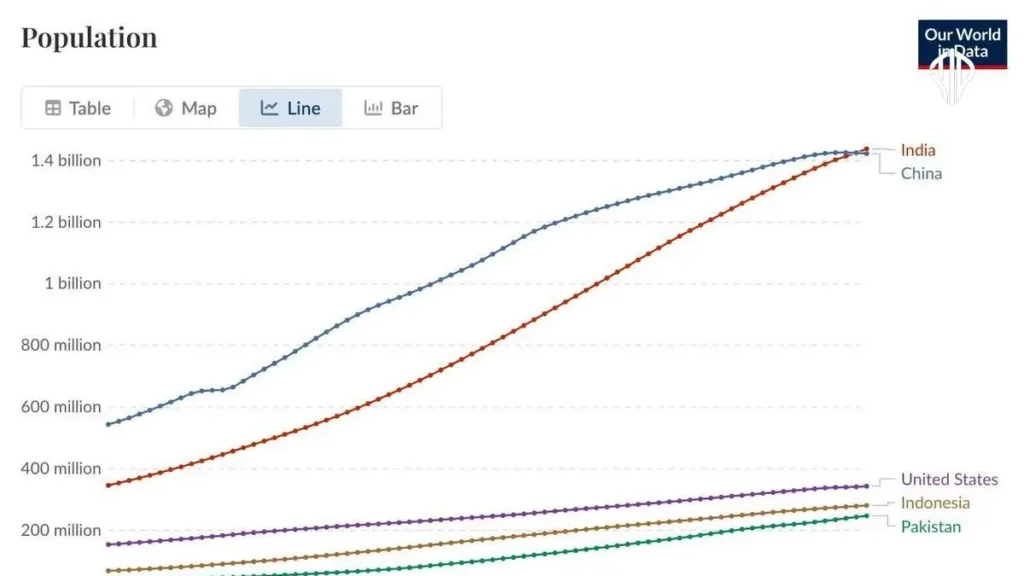
In 1960, a group of researchers published a famous paper in the journal Science predicting that human population would reach infinity by November 2026. This stark claim, detailed in a retrospective analysis, was not a random guess but the result of a rigorous mathematical model using historical data spanning centuries.
Today, as global population sits around 8.3 billion rather than infinity, the failed forecast provides a fascinating historical parallel. It highlights a recurring trap in technological forecasting: mistaking an accelerating short-term trend for an inevitable long-term singularity.
The Mechanics of Hyperbolic Growth
The original researchers used a hyperbolic growth model rather than standard exponential growth. In exponential growth, a population increases at a constant percentage rate over time.
Hyperbolic growth assumes that the growth rate itself accelerates as the population expands, creating a powerful feedback loop. This mathematical structure leads inevitably to a singularity where the calculated curve shoots straight up to infinity within a finite timeframe.
The researchers based their terrifying curve on global estimates from 1 CE through the late 1950s. Their arithmetic was sound, and the model captured reality surprisingly well for nearly two decades.
Humanity reached one billion around 1800, doubled that by 1925, and hit four billion by 1975. Because these doubling intervals kept shrinking, the curve appeared unstoppable, leading researchers to forecast a population doomsday for November 2026, a date chosen partly because it was physicist Heinz von Foerster’s birthday.
Why the Model Failed
The model ultimately failed because it completely ignored human adaptability, economic shifts, and resource constraints. By the mid-1960s, the underlying relationship between population size and growth rates began to break down.
Developed nations entered periods of below-replacement fertility, and global demographic transitions altered birth rates. While total population continued to rise, larger populations stopped growing faster in percentage terms, proving that a close historical fit does not guarantee infinite continuation.
Lessons for Modern AI and Compute Scaling
This demographic miscalculation carries an important lesson for contemporary debates surrounding artificial intelligence and compute scaling laws.
Modern observers frequently look at the explosive progress of large language models, computing power, and hardware capability, concluding that artificial general intelligence or a technological singularity is just around the corner. Proponents of these trends argue that current trajectories must continue upward indefinitely.
The history of population modeling demonstrates the flaw in assuming an accelerating trend will persist without interruption. While exponential scaling laws have driven remarkable advances in AI performance over the past decade, those gains depend on specific economic conditions, massive data availability, energy investments, and semiconductor manufacturing milestones. If any of these foundational pillars face physical, economic, or regulatory limits, the curve will bend.
Empirical Progress Versus Long-Term Inevitability
None of this suggests that artificial intelligence will stop advancing or that current engineering breakthroughs are trivial. Rather, it draws a crucial distinction between empirical evidence of rapid progress and the assumption of an approaching singularity. Observers must separate verifiable short-term acceleration from long-term inevitability.
Understanding how historical models miss the mark helps technology professionals and everyday enthusiasts evaluate bold claims about the future.
When evaluating forecasts about autonomous agents, quantum supremacy, or artificial intelligence milestones, the fundamental question remains the same as it was in 1960. Analysts must ask what hidden conditions allow today’s growth to happen, and how long those specific conditions can realistically persist.
Key Takeaways
- Historical forecasting models, like the 1960 population study, often mistake accelerating short-term trends for inevitable long-term singularities.
- Hyperbolic growth models assume feedback loops that lead straight to infinity, ignoring crucial real-world variables like adaptability and resource constraints.
- Modern debates around artificial intelligence scaling laws share striking similarities with past population growth miscalculations.
- Verifiable short-term technological progress does not guarantee infinite continuation without interruption from physical, economic, or regulatory limits.
- Evaluating future tech claims requires questioning the hidden conditions enabling current growth and how long those conditions can persist.
Join our community by subscribing to our Weekly Newsletter to stay updated on the latest AI updates and technologies, including the tips and how-to guides.
Also, follow us on Instagram (@tid_technology) for more updates in your feed and our WhatsApp Channel to get daily news straight to your Messaging App.
