NASA has just unveiled Athena, a supercomputer poised to redefine space exploration by compressing centuries of computational work into a single day. This cutting-edge system is designed to power the most ambitious Moon and Mars missions, offering unprecedented analytical capabilities.
For many of us, the ideal computer means faster video rendering, seamless gaming, or instant web browsing. We cherish the speed that lets us accomplish tasks in minutes that once took hours, making our digital lives smoother and more productive.
But for an organization like NASA, pushing the boundaries of human knowledge and exploration, “fast” takes on an entirely new dimension. When billions of dollars and human lives are on the line, the computational power required goes beyond anything a consumer device can offer, demanding a leap into the realm of supercomputing.
Athena: A New Era in Space Computation
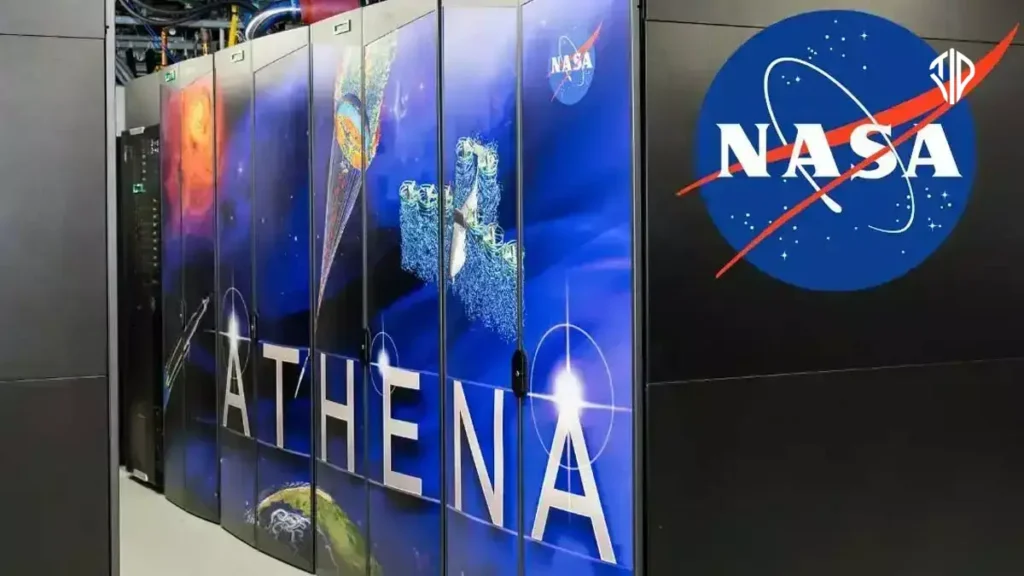
Quietly humming within the Ames Research Center in California, Athena, NASA’s newest and most powerful supercomputer, has just been unveiled. While it lacks the dramatic flashing lights of science fiction, its capabilities are nothing short of astounding.
Experts confirm that Athena can accomplish in a mere 24 hours what an average home PC would require approximately 500 years to complete. This staggering performance gap underscores why Athena is an indispensable tool as space missions grow increasingly complex and the volume of critical data explodes, leaving no room for guesswork.
Setting New Benchmarks: Over 20 Petaflops of Power
Athena isn’t just fast; it sets a new standard for computational prowess. Delivering over 20 petaflops of peak performance, it represents a monumental leap forward. To put that in perspective, one petaflop signifies a quadrillion calculations every second.
Athena performs that feat twenty times over, executing more than 20 quadrillion operations per second. This places it far ahead of NASA’s previous workhorses, such as Pleiades and Aitken, which served the agency admirably for years but are now surpassed by Athena’s immense capacity.
This formidable system resides within NASA’s Modular Supercomputing Facility, an environment specifically engineered for adaptability. Its design allows for constant upgrades of racks and components, and cooling adjustments can be made without extensive overhauls.
This modularity is crucial, as supercomputers age rapidly in the face of continuous technological advancement. Athena is built not just for today’s challenges but to evolve, ensuring sustained capability and efficiency.
Balancing Power with Efficiency and Longevity
Beyond sheer speed, Athena was meticulously designed to deliver extreme performance without incurring extreme energy waste. The modular configuration facilitates superior airflow and cooling, which significantly reduces utility demands compared to older facilities.
In an era where spiraling power costs can impede crucial research, Athena offers a sustainable path forward. This balance between raw power and environmental responsibility is a critical consideration for modern agencies.
The quieter benefits of this design include less heat, reduced stress on hardware, and ultimately, a longer operational lifespan – crucial factors for such a vital asset.
Athena’s Transformative Role in Space Missions
Athena isn’t merely a number-cruncher; it’s a game-changer across NASA’s most ambitious endeavors:
- Reshaping Rocket Simulations: Engineers can now simulate rocket launches with unprecedented precision. Thousands of “what if” scenarios can be run and analyzed before any physical components are even manufactured. This dramatically reduces risk, optimizes designs, and accelerates development cycles.
- Fueling AI Research: Artificial intelligence is a major focus for Athena. The supercomputer is training large-scale AI models to analyze vast datasets spanning Earth observation, intricate climate systems, and groundbreaking aeronautics research. This will unlock deeper insights and predictive capabilities across numerous scientific fields.
- Reducing Mission Risk: From the precise trajectory planning for lunar landers and Mars entry systems to charting courses for deep-space probes, every calculation is critical. Tiny miscalculations can lead to mission failure. Athena’s ability to process complex variables rapidly minimizes these risks.
- Enhancing Planetary Defense: Tracking asteroid paths demands immense and continuous computation, as even small changes in trajectory can have significant implications. Athena can quickly process these updates, enabling NASA to refine impact predictions and enhance planetary defense strategies.
Managed by NASA’s Office of the Chief Science Data Officer, Athena is a cornerstone of the agency’s broader hybrid computing strategy, seamlessly integrating into a robust ecosystem of data analysis and innovation.
The launch of Athena signifies more than just a new piece of hardware; it represents a profound leap in humanity’s capability to explore, understand, and safely navigate the cosmos. With 500 years of computing power compressed into a single day, NASA is not just looking at the Moon and Mars; it’s bringing the future of space exploration closer to reality.
Key Takeaways
- Athena is NASA’s new supercomputer, capable of compressing approximately 500 years of an average home PC’s computational work into a single day.
- It boasts over 20 petaflops of peak performance, executing more than 20 quadrillion operations per second, significantly surpassing its predecessors.
- Designed with modularity and efficiency, Athena prioritizes sustainable performance with superior cooling and reduced energy consumption, ensuring longevity.
- Athena will transform critical space missions by enabling unprecedented precision in rocket simulations, advancing AI research, minimizing mission risks, and enhancing planetary defense strategies.
- Its unveiling marks a profound leap in humanity’s capability to explore and understand the cosmos, integrating into NASA’s broader hybrid computing strategy.
Join our community by subscribing to our Weekly Newsletter to stay updated on the latest AI updates and technologies, including the tips and how-to guides. (Also, follow us on Instagram (@inner_detail) for more updates in your feed). (For more such interesting informational, technology and innovation stuffs, keep reading The Inner Detail).