
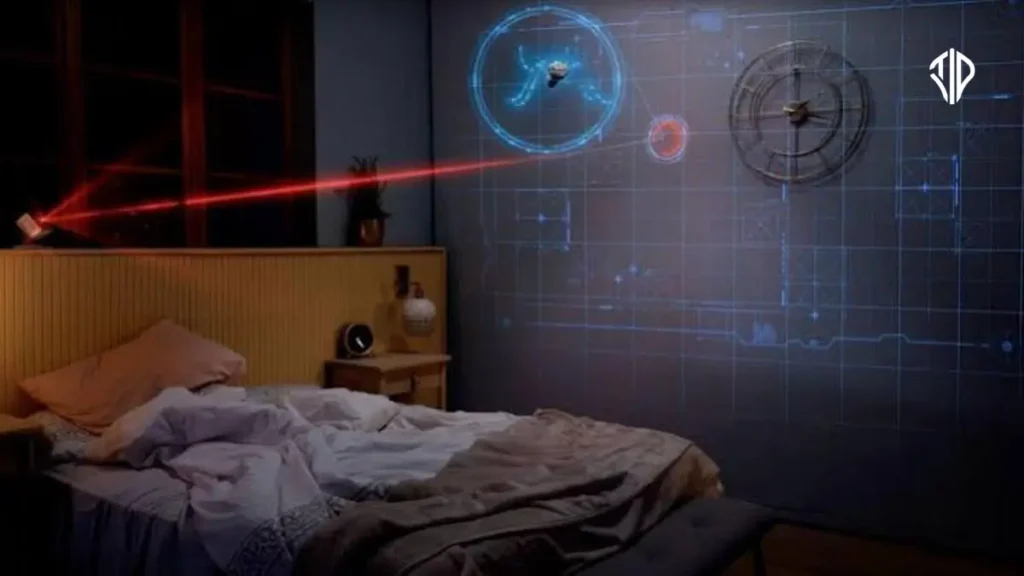
A roboticist has successfully developed an AI-powered laser system designed to detect and neutralize mosquitoes with surgical precision. By combining computer vision with high-speed targeting, this innovation promises a future where home pest control is fully automated and chemical-free.
To put this in perspective, think of the way modern defense systems track incoming drones using advanced sensors and rapid processing.
Traditionally, home mosquito control has relied on passive, less precise methods—like citronella candles, bug zappers that kill beneficial insects indiscriminately, or chemical sprays that linger in the air. This new project shifts the paradigm from “hopeful attraction” to “active defense.”
The system functions much like a security camera with a purpose-built mission. Using a DSLR camera paired with a high-magnification zoom lens, the device scans the room, constantly feeding high-resolution imagery into a custom deep learning model.
This model has been specifically trained to recognize the distinct flight patterns and physical silhouette of a mosquito. Once a target is locked, an industrial-grade gimbal aligns a laser precisely enough to eliminate the pest in mid-air.
The Fatal Flaw of Historic Pest Control
Traditional methods of mosquito eradication have long relied on broad-spectrum approaches that cause more inconvenience to humans than harm to target pests.
Chemical repellents often carry unpleasant, synthetic odors and raise long-term health concerns when breathed continuously overnight. Standard indoor ultraviolet bug zappers are notoriously inefficient against mosquitoes because, unlike moths or beetles, mosquitoes are drawn to the carbon dioxide, heat, and moisture emitted by human skin rather than ambient light.
Furthermore, mosquitoes are master evasive flyers. Their chaotic flight trajectories and ability to utilize micro-shadows—such as hiding beneath a desk, behind curtains, or in the folds of hanging clothes—make manual swatting an ongoing exercise in frustration.
Historic pest control has failed because it expects a microscopic, highly adapted insect to fly into a static trap, rather than actively hunting the pest down where it rests.
The Real-World AI Breakthrough: Bzigo Iris and Computer Vision
The theoretical dream of automated bug hunting became a commercial reality with the launch of consumer devices like the Bzigo Iris.
Instead of relying on a human to spot a moving speck on the wall, these smart-home appliances utilize high-fidelity infrared sensors paired with localized edge-AI processors to scan a room continuously.
The breakthrough lies in training algorithms to understand custom insect kinematics. An insect’s wing-beat frequency and flight cadence act as a distinct biometric signature. Bzigo’s computer vision software is trained on deep learning datasets to instantly distinguish a tiny, blood-sucking mosquito from a harmless housefly, a drifting speck of dust, or a fruit fly.
The moment a mosquito lands or enters the room, the system tracks its exact 3D coordinates. Because it uses an eye-safe, low-intensity laser pointer, it doesn’t fire a dangerous weapon; instead, it projects a precise tracking dot directly onto the resting pest and sends an instantaneous push notification to the homeowner’s smartphone, removing the frantic search entirely.
The AI Laser Air Defense
While tracking and pointing solve the navigation problem, independent engineers and pioneering hardware startups are closing the loop by completely automating the elimination phase.
Computer vision and robotics expert Steven Cheng made headlines across the tech community after documenting a custom-built, fully automated mosquito defense turret that successfully eliminated every mosquito in his residence during an overnight operation.
Developed over four months, Cheng’s system utilizes a dual-camera array—one high-speed camera to track the insect’s 3D vector and a wide-angle secondary camera acting as a safety monitor.
When a mosquito is identified, the system processes its coordinates through a deep learning model and communicates via high-precision industrial rotary stages (gimbals).
The gimbal rapidly maneuvers a specialized laser powerful enough to neutralize the insect mid-air. Similarly, on crowdfunding platforms like Indiegogo, tech startup Photonmatrix has introduced a consumer-grade “Mosquito Air Defense System.”
Using a high-speed LiDAR scanner paired with a galvanometer-directed laser, the device calculates a pest’s distance, orientation, and body size within 3 milliseconds, boasting the ability to neutralize multiple pests per second across a 6-meter radius by targeting their wings.
Multi-Sensor Safeguards and Edge-Privacy Architecture
The concept of bringing tracking cameras and targeted lasers into private bedrooms understandably introduces stringent questions regarding data privacy and physical safety. To mitigate eye hazards or accidental burns, modern consumer-facing AI laser systems utilize highly restrictive, fail-safe parameters.
In Steven Cheng’s real-world model, the software executes an instantaneous shutdown if the wide-angle camera detects a human face, a pet, or a flammable material anywhere near the laser’s projected optical path. Similarly, commercial LiDAR solutions disable their high-power lasers automatically if a solid, predictable background isn’t detected behind the target.
On the data security front, these appliances are engineered with strict “edge-only” computational frameworks. Visual streams from the infrared cameras and LiDAR sensors are processed entirely on the local microchip. Because the operational code executes offline without uploading raw video feeds to cloud servers, homeowners receive a whisper-quiet, chemical-free shield that protects their bedrooms without risking their digital privacy.
Join our community by subscribing to our Weekly Newsletter to stay updated on the latest AI updates and technologies, including the tips and how-to guides. (Also, follow us on Instagram (@inner_detail) for more updates in your feed).
(For more such interesting informational, technology and innovation stuffs, keep reading The Inner Detail).
