
For years, Stack Overflow stood as the unwavering pillar of the coding world. A digital sanctuary where developers, from seasoned veterans to curious newcomers, could seek solace, ask perplexing questions, and find ingenious solutions to their most stubborn bugs.
It was a place of collaborative learning, a testament to the power of human intellect coming together to build the future, one elegant answer at a time. Yet, a seismic shift has been occurring, quietly at first, but now with undeniable force: Stack Overflow, in its traditional role, is facing an existential crisis, largely driven by the relentless rise of artificial intelligence.
Unmistakable Decline of Stack Overflow
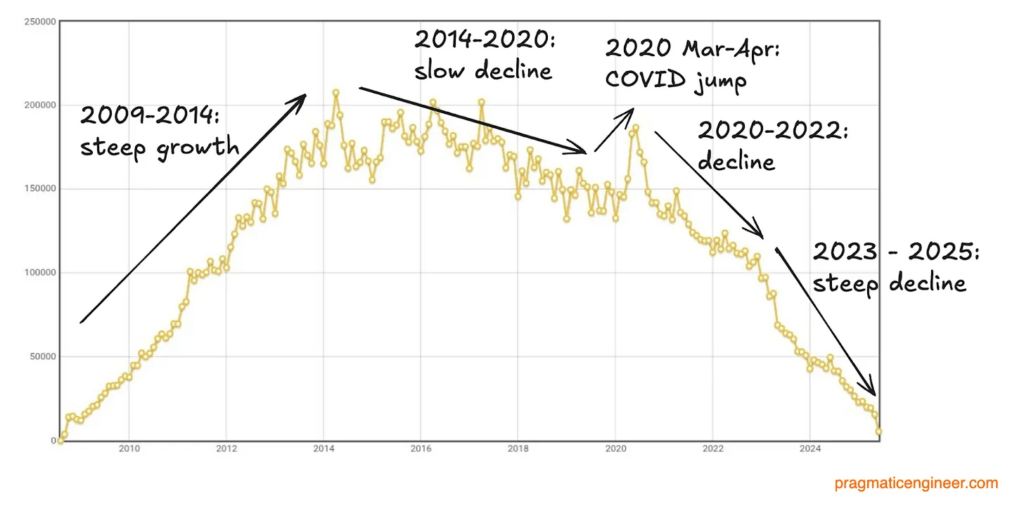
Recent data paints a stark picture, revealing an alarming nosedive in activity on the platform. What was once a vibrant hub of continuous inquiry has seen its volume of new questions dwindle to levels not witnessed since its nascent days in 2009.
Marc Gravell, a prolific contributor ranked among the top 10 all-time on Stack Overflow, highlighted this precipitous drop, underscoring a trend that began accelerating long before the current AI boom but has now reached terminal velocity. The community’s digital heartbeat, measured by the stream of new inquiries, is barely a whisper.
Tracing the Decline’s Roots
The seeds of Stack Overflow’s current predicament were sown over a decade ago, long before large language models (LLMs) like ChatGPT became ubiquitous.
The Seeds of Discontent
Around 2014, a noticeable shift began. Stack Overflow significantly refined its moderation processes, leading to a much higher efficiency in closing questions, particularly those deemed “low quality.” While ostensibly aimed at improving the site’s overall standard, this period coincided with many legitimate questions being removed, fostering a sense of unwelcomeness among users. For some, the once-inviting atmosphere began to feel like a power trip by moderators, leading to a personal exodus from asking questions on the platform.
The Pandemic Anomaly
Fast forward to March 2020, and the world plunged into lockdowns. This unprecedented global event triggered a massive, albeit temporary, surge in Stack Overflow traffic. With colleagues suddenly remote, developers instinctively turned to Google and, by extension, Stack Overflow, for immediate assistance.
This period offered a brief reprieve, a fleeting return to its peak usage. However, the surge was short-lived; by June 2020, questions began to decline again, and at an accelerated pace, notably two years before ChatGPT’s public debut.
The Strategic Exit
In June 2021, Stack Overflow was acquired by private equity investor Prosus for a substantial $1.8 billion. In hindsight, the timing of this sale by founders Jeff Atwood and Joel Spolsky appears almost prophetic, occurring just as the platform stood at the precipice of its terminal decline. They exited at what many now perceive as the opportune moment, before the full impact of emerging technologies became apparent.
The AI Tsunami: ChatGPT’s Pivotal Role
While internal dynamics and user sentiment contributed to its gradual weakening, the arrival of ChatGPT in November 2022 acted as a decisive, accelerating force, pushing Stack Overflow further towards irrelevance. The reasons for this rapid shift are clear and compelling:
- Speed and Efficiency: ChatGPT offers instant answers, sidestepping the wait times inherent in human-driven Q&A.
- Politeness and Accessibility: Unlike the sometimes terse or judgmental responses from human moderators or users, AI is unfailingly polite and willing to answer any question without criticism.
- Comprehensive Answers: ChatGPT, having been trained on vast datasets, including a significant portion of Stack Overflow’s own content, often provides answers of comparable, if not superior, quality. It eliminates the need to navigate forums or sift through multiple, potentially conflicting human responses.
By May 2025, the impact is undeniable: the monthly volume of questions on Stack Overflow now mirrors its launch figures from 2009. The data strongly confirms that LLMs are not just making Stack Overflow irrelevant; they are rendering it largely obsolete for many of its former users.
Beyond AI: Inevitable or Accelerated?
While AI has undoubtedly been the primary catalyst for Stack Overflow’s rapid decline, it is a nuanced truth that the platform might have eventually faded into obscurity even without it. Factors like evolving moderation policies, shifting developer preferences, or the natural lifespan of online communities could have contributed to a slow descent. However, what LLMs have done is dramatically accelerate this process, transforming a potential slow fade into a swift and decisive exit from its former prominence.
A Fond Farewell and a Look Ahead
It is a true shame to witness the diminishment of a platform that served as an indispensable digital lifeline for countless developers, helping them get “unstuck” and fostering a culture of mutual assistance. Many of us remember the immense pride of receiving our first upvote, or the satisfaction of contributing a helpful answer. That sense of human connection, of solving a problem with a fellow developer, is something that AI, for all its brilliance, cannot fully replicate.
While Stack Overflow’s days as the undisputed champion of developer Q&A may be numbered, the inherent need for developers to connect, collaborate, and help each other remains as strong as ever. We are already seeing new spaces emerge and thrive, whether they are vibrant Discord servers, focused WhatsApp or Telegram groups, or other community-driven platforms.
The spirit of collective problem-solving will undoubtedly persist; it will simply evolve and find new digital homes, carrying forward the legacy of human ingenuity in the ever-changing landscape of technology.
Key Takeaways
- Stack Overflow has experienced a significant and accelerating decline in activity, with new questions mirroring 2009 levels.
- The decline’s roots trace back over a decade, with refined moderation processes around 2014 contributing to user discontent and a feeling of unwelcomeness.
- While the platform’s weakening pre-dates the AI boom, the arrival of ChatGPT in November 2022 dramatically accelerated Stack Overflow’s irrelevance by offering instant, polite, and comprehensive answers.
- The acquisition of Stack Overflow in June 2021 by Prosus appears strategically timed, occurring just before the full impact of AI became apparent.
- Despite Stack Overflow’s diminishing role, the fundamental need for developers to connect, collaborate, and solve problems persists, finding new homes in emerging community platforms like Discord, WhatsApp, and Telegram groups.
Join our community by subscribing to our Weekly Newsletter to stay updated on the latest AI updates and technologies, including the tips and how-to guides. (Also, follow us on Instagram (@inner_detail) for more updates in your feed).
(For more such interesting informational, technology and innovation stuffs, keep reading The Inner Detail).
