
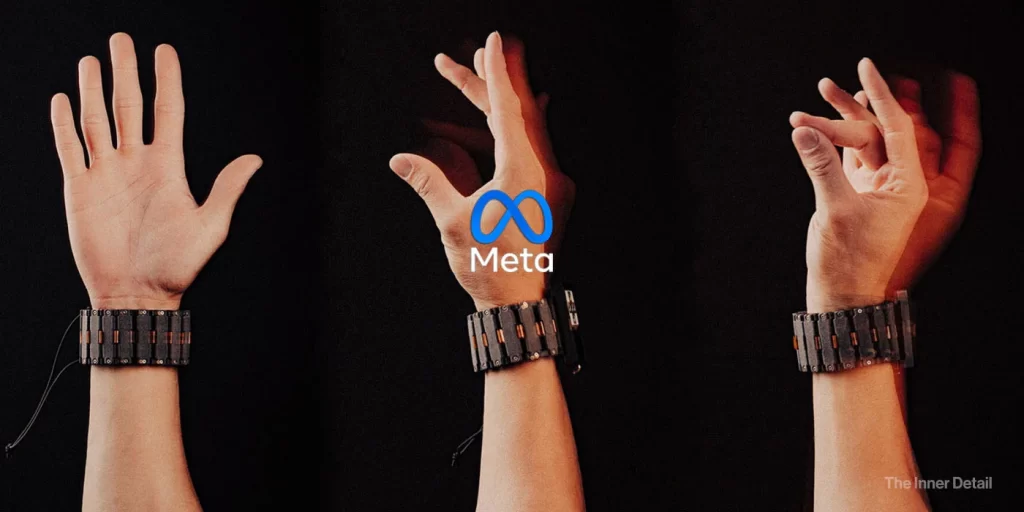
Imagine interacting with your computer or augmented reality glasses without touching a single device, simply by intending to move your hand. Meta’s Reality Labs has introduced a groundbreaking non-invasive neuromotor interface – a wristband that transforms subtle muscle signals into digital commands, aiming to revolutionize human-computer interaction.
The quest for more intuitive and universal computer input technologies is a persistent trend in the industry. While traditional methods like keyboards, mice, and touchscreens are ubiquitous, they often limit interaction in “on-the-go” scenarios and can be challenging for those with limited motor abilities. Existing gesture-based systems rely on cameras or inertial sensors, which struggle with obscured movements, and high-bandwidth brain-computer interfaces (BCIs) have historically required invasive surgery and bespoke calibration for each individual.
Let’s delve into this innovative technology.
What is Meta’s New Wristband?
Meta‘s new device is a generic non-invasive neuromotor interface in the form of an sEMG wristband. It’s designed to be highly sensitive and easily donned, offering a comfortable, wireless, and multi-channel recording platform that can be put on or taken off in seconds.
The wristband is engineered to capture subtle electrical signals from the muscles in the wrist, providing a “window into the motor commands issued by the central nervous system”.
What Can it Do?
This smart wristband enables diverse computer interactions, aiming to replace traditional input devices entirely. Users can send messages without a keyboard, navigate menus without a mouse, and engage with digital content without looking at a smartphone.
It recognizes a wide range of gestures like tapping, pinching, and swiping, even when your hand is at rest, and supports handwriting recognition, allowing you to “write” on surfaces like a desk or your leg.
The technology has demonstrated performance in continuous 1D navigation, discrete gesture detection, and handwriting transcription.
How Does it Work?
The core of the technology is surface electromyography (sEMG), which reads the electrical motor nerve signals traveling through the wrist to the hand. These are the same signals your brain sends to command your hand to perform actions.
The system employs neural networks trained on data collected from thousands of consenting participants, enabling generic sEMG decoding models that generalize across different people without the need for person-specific training or calibration.
The models use AI and machine learning and can even learn from personal use to become more accurate over time, for example, by improving handwriting recognition based on an individual’s writing style.
Potential Impact and Benefits
This non-invasive approach addresses long-standing trade-offs in input modalities, offering portability, throughput, and accessibility. It is particularly valuable for “on-the-go” mobile computing scenarios with devices like smartwatches or smart glasses.
Crucially, the wristband holds immense potential for people with reduced or limited motor abilities, as it can understand intended actions even with minimal or no overt hand movement, including those with spinal cord injuries or complete hand paralysis.
Unlike invasive brain-computer interfaces (BCIs) like Neuralink that require surgery, Meta’s sEMG wristband is non-invasive and attaches directly to the skin, making it a much safer alternative. While still having room for improvement compared to traditional devices, the sEMG decoders are performant enough for reliable task completion without cumbersome equipment. Performance can also be further enhanced through personalization, offering a 16% improvement in handwriting models.
Key Takeaways
- Meta’s Reality Labs has developed a non-invasive neuromotor interface wristband.
- The wristband uses sEMG to translate muscle signals into digital commands.
- It offers potential benefits for accessibility, mobile computing, and those with motor impairments.
Join our community by subscribing to our Weekly Newsletter to stay updated on the latest AI updates and technologies, including the tips and how-to guides. (Also, follow us on Instagram (@inner_detail) for more updates in your feed).
(For more such interesting informational, technology and innovation stuffs, keep reading The Inner Detail).
