
The rapid advancements in science and technology are truly remarkable, particularly within the realm of transportation. From self-driving cars and flying vehicles to supersonic jets, hyperloops, and even Virgin Galactic’s space tourism, innovation is accelerating. While these developments capture headlines, a quieter, yet profoundly significant project has been underway for over two decades: the concept of space elevators. Researchers assert that these “elevators to space,” designed to transport people and cargo, could soon become a tangible reality, fundamentally changing space access.
Understanding Space Elevators: What Are They?
A space elevator, as its name suggests, represents a long-standing aspiration for scientists: a monumental structure designed to transport individuals and cargo directly from Earth’s surface into space.
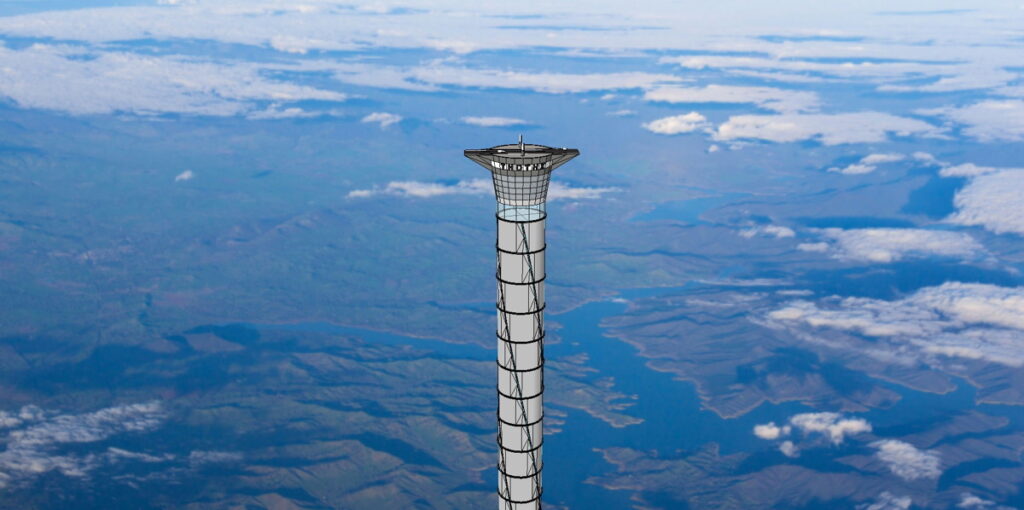
At its core, the space elevator concept involves a robust cable, securely anchored to Earth’s surface near the equator, extending far into space beyond geostationary orbit, reaching an altitude of approximately 35,786 km. This innovative design would allow specialized vehicles to ascend along the cable from the planet’s surface directly into orbit, eliminating the need for conventional rocket launches and their immense fuel requirements.
The Historical Journey and Key Challenges of Space Elevators
The vision of space elevators dates back to the 19th century. Following a visit to Paris’s Eiffel Tower, Soviet rocket scientist Konstantin Tsiolkovsky conceptualized a tower extending to geostationary orbit. Later, Soviet engineer Yuri Artsutanov proposed a more practical approach: deploying a station in Geostationary Earth Orbit (GSO) and extending a tensioned tether downwards to Earth’s surface. This innovative “tether” system would enable payloads to be lifted into orbit with significantly less energy than traditional rockets.
In 1966, a similar concept, known as the ‘Sky-Hook,’ was put forth by four American engineers. Their proposal also involved a suspension structure designed to facilitate the ascent of a lift into space.
Progress in this field remained slow for decades, primarily due to the immense material science challenges. The conceptual design required an exceptionally strong yet lightweight material for the central cable – one capable of withstanding extreme stresses, demanding a tensile strength of at least 100 Gigapascals (180 times that of steel). This crucial material requirement posed a significant hurdle, stalling development until the early 21st century.
Graphene: Powering the Space Elevator Dream
As scientists intensified their search for a viable material to realize space elevators, graphene emerged as a frontrunner due to its exceptional properties. Graphene, a carbon allotrope characterized by single layers of atoms in a honeycomb lattice nanostructure, was once deemed impossible to produce efficiently, as noted by Adrian Nixon, a Chartered Chemist and member of the Royal Society of Chemistry.
Nixon further elaborated on the collaborative efforts, explaining that the National Graphene Institute (NGI) focuses on fundamental scientific research, while the Graphene Engineering Innovation Centre (GEIC) translates this science into applied technology. GEIC plays a crucial role in bridging the “valley of death” by facilitating the scaling up of graphene technology for industrial and commercial applications.
Significant breakthroughs in graphene production have occurred over time. By 2009, new techniques like chemical vapor deposition (CVD) allowed for the creation of single-crystal graphene sheets measured in centimeters, not just microns. Although CVD offered low cost and scalability, it struggled with the demands of large-scale graphene production. However, approximately a decade later, MIT researchers developed a groundbreaking roll-to-roll technique, demonstrating the ability to produce continuous graphene fibers on a kilometer scale. This method generated large graphene sheets at an impressive rate of about 6.5 feet (2 meters) per minute. Furthermore, when synthesized as single-crystal sheets, graphene exhibits an astounding tensile strength of around 130 Gigapascals (GPA), making it 236 times stronger than steel.
Space Elevators: A Cost-Effective Future for Space Travel
The potential advantages of implementing a space elevator are both extensive and transformative. A University of Colorado study suggests that utilizing a space elevator could reduce the cost of sending payloads to space to an unprecedented $250 per kilogram. This represents a significant cost reduction, being five to ten times cheaper than current expenses associated with launching payloads and crews via modern reusable rockets.
Related Article: Solar Panel in Space Might Soon Beam Electricity to Earth – Scientists Tested!
Beyond current savings, space elevators offer even more drastic cost reductions compared to historical space travel. They are estimated to be approximately seventy-four times more economical than traditional rocket launch systems used for space access between 1970 and 2000.
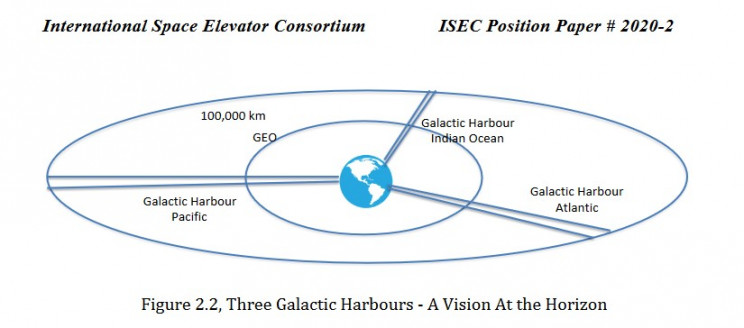
The International Space Elevator Consortium (ISEC) envisions an even grander architecture, termed the “Galactic Harbor,” which extends beyond a single space elevator. As detailed in their 2020 position paper, “Space Elevators are the Transportation Story of 21st Century,” the ISEC plans to deploy a network of six elevators, constructed in pairs across three global locations: the Atlantic, Indian, and Pacific Oceans. This ambitious infrastructure promises to revolutionize space transportation, potentially enabling efficient interplanetary travel by the latter half of this century.
Key Benefits and Advantages of Space Elevators
Dr. Swan and his team comprehensively detailed this architectural vision in their 2020 ISEC position paper, “Space Elevators are the Transportation Story of 21st Century.” The myriad benefits they identify for a fully operational space elevator system include:
- Opening vast opportunities for commercial ventures, scientific research, and space tourism.
- Facilitating the transport of up to 170,000 metric tons of cargo annually to Geostationary Earth Orbit (GEO) and beyond.
- Enabling the construction and maintenance of new space stations at GEO, Lagrange Points, and other strategic locations.
- Providing routine, safe, and robust rapid transit to orbit at speeds of 7.76 km/sec.
- Allowing significantly faster transit times to Mars, ranging from a minimum of 61 days to over 400 days.
- Making daily launches for Mars missions feasible, rather than being limited to every 26 months.
- Eliminating harmful rocket exhaust, thereby not contributing to global warming.
- Preventing the creation of additional space debris.
Further Reading: Satellites Can 3D-Print Themselves in Space – Ushering in Space Manufacturing
The Environmental Benefits of Space Elevators
As the commercial space sector expands and interest in space exploration intensifies, nations such as the U.S., China, and India aim to significantly increase their annual launch rates. Concurrently, space visionaries like Elon Musk and Jeff Bezos are championing ambitious projects, including Martian cities and orbital habitats, which would necessitate thousands of launches annually.
Space elevators offer a crucial solution to mitigating carbon emissions associated with space travel. Eliminating just one rocket launch can prevent approximately 300 tons of carbon dioxide from entering the atmosphere. Reports indicate that in 2018 alone, a staggering 900 million metric tons of carbon dioxide were released, highlighting the environmental imperative for cleaner launch alternatives.
Furthermore, space elevators enable other environmentally beneficial technologies, such as the widespread deployment of space-based solar arrays. Scientists have long viewed this as one of the most promising methods for combating global warming. By facilitating the transport of massive payloads to orbit affordably and without atmospheric carbon deposition, space elevators possess the transformative potential to significantly contribute to resolving the climate crisis.
Join our community by subscribing to our Weekly Newsletter to stay updated on the latest AI updates and technologies, including tips and how-to guides. Also, follow us on Instagram (@inner_detail) for more updates in your feed.
For more interesting informational, technology, and innovation content, keep reading The Inner Detail.
