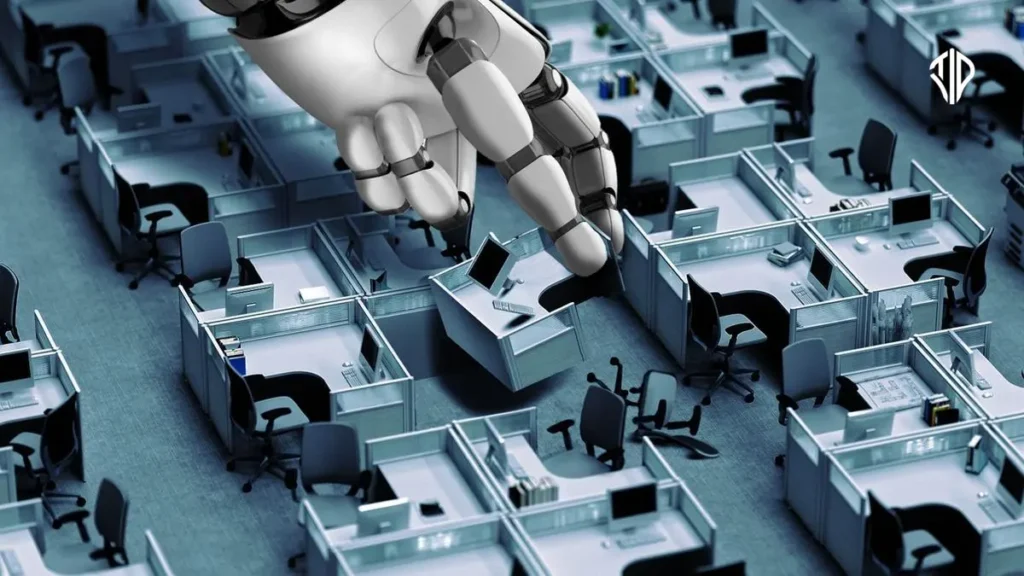
Microsoft AI chief Mustafa Suleyman warns that the rapid advancement of artificial intelligence could automate most white-collar functions within the next 18 months. This shift signals a transition from AI as a supportive tool to autonomous agents capable of handling complex professional workflows.
For decades, the concept of automation was largely synonymous with the factory floor, where mechanical arms replaced manual labor in the pursuit of efficiency. However, the digital revolution has shifted the focus from the assembly line to the office desk, where cognitive tasks are now being processed by sophisticated algorithms at unprecedented speeds.
Today, the professional landscape stands at a crossroads as generative models begin to mimic human reasoning and creativity. What was once considered the exclusive domain of human intellect—drafting legal documents, balancing spreadsheets, or writing software—is now being performed by systems that learn and adapt in real-time.
The 18-Month Countdown
Mustafa Suleyman, the head of Microsoft’s AI division, recently shared a provocative timeline for the future of work. He suggests that within 12 to 18 months, AI systems will likely achieve human-level performance across a vast array of professional duties.
This rapid acceleration is driven by an exponential increase in computing power and the refinement of foundation models, which are becoming the bedrock of modern enterprise.
Professional Sectors Facing Disruption
The disruption is not limited to entry-level data entry but extends to highly specialized fields that require years of formal education. Suleyman emphasizes that any role primarily involving computer-based work is currently in the line of transformation.
Key Roles at Risk:
- Legal Services: Drafting contracts, conducting case law research, and analyzing discovery documents.
- Accounting and Finance: Auditing, tax preparation, and complex financial forecasting.
- Marketing and Content: SEO strategy, campaign management, and personalized copywriting.
- Software Engineering: Generating, debugging, and optimizing code with minimal human oversight.
- Project Management: Coordinating cross-functional teams and autonomous decision-making in workflows.
From Copilots to Autonomous Agents
Current technology often positions AI as a copilot designed to assist humans, but the next phase involves the rise of autonomous agents. These are systems capable of managing entire workflows independently, reducing the need for constant human intervention.
Suleyman predicts that creating a custom AI model for a specific business need will soon be as simple as producing a podcast or a blog post, democratizing the power of high-level computation.
While the timeline may seem aggressive, the underlying message is one of necessary adaptation. Organizations are being urged to develop their own foundation models to maintain a competitive edge.
The focus is shifting from simply using AI to achieving AI-sufficiency, where the technology is integrated into the very fabric of institutional operations.
Comparing the AI Evolution
| Feature | Current AI Usage | Future AI Agent State |
|---|---|---|
| Primary Role | Productivity Assistant | Autonomous Decision-Maker |
| Task Complexity | Single tasks (e.g., writing a mail) | Full workflows (e.g., managing a project) |
| Human Oversight | High intervention required | Minimal supervision required |
| Implementation | Specialized technical setup | User-friendly customization |
The narrative of AI is moving away from basic augmentation toward total task automation. As these systems reach the absolute frontier of performance, the definition of a white-collar career will inevitably undergo a profound reconfiguration.
Key Takeaways
- Mustafa Suleyman forecasts that AI will reach human-level performance in most professional roles within the next 12 to 18 months.
- The industry is shifting from AI as a “copilot” to fully autonomous agents capable of managing entire business workflows.
- High-level sectors such as law, finance, and software engineering are identified as the most likely areas for immediate transformation.
- Organizations are encouraged to move beyond basic tool usage toward “AI-sufficiency” by developing proprietary foundation models.
Join our community by subscribing to our Weekly Newsletter to stay updated on the latest AI updates and technologies, including the tips and how-to guides. (Also, follow us on Instagram (@inner_detail) for more updates in your feed).
(For more such interesting informational, technology and innovation stuffs, keep reading The Inner Detail).