

Mercor CEO Brendan Foody believes that despite current limitations, AI agents are rapidly evolving and will soon be capable of replacing human consultants, particularly in lower-level roles. This outlook challenges the traditional consulting model, prompting a re-evaluation of how professional services will operate in the near future.
Consider the role of a highly skilled craftsperson, whose hands-on expertise and nuanced judgment are irreplaceable in creating bespoke items. For generations, complex problem-solving in business has been viewed similarly, requiring unique human insight, strategy, and interaction.
However, the world is moving towards a landscape where even these intricate tasks are being systematically dismantled and re-engineered. Just as automated assembly lines transformed manufacturing, AI is poised to revolutionize the intellectual labor once reserved for human experts, pushing the boundaries of what machines can achieve in professional services.
The Rise of AI Agents in Consulting
New research from Mercor, an AI training powerhouse, offers a fascinating glimpse into the immediate future of artificial intelligence in high-stakes professional services like consulting, banking, and law.
While initial tests reveal that today’s leading AI models, when acting as agents, still struggle with real-world consulting tasks, Mercor’s CEO, Brendan Foody, remains incredibly optimistic about their trajectory. He suggests that the question isn’t if AI will replace human consultants, but when.
Mercor’s APEX-Agents benchmark was meticulously designed to mimic authentic management consulting work, drawing insights from experts at prestigious firms like McKinsey, BCG, Deloitte, Accenture, and EY.
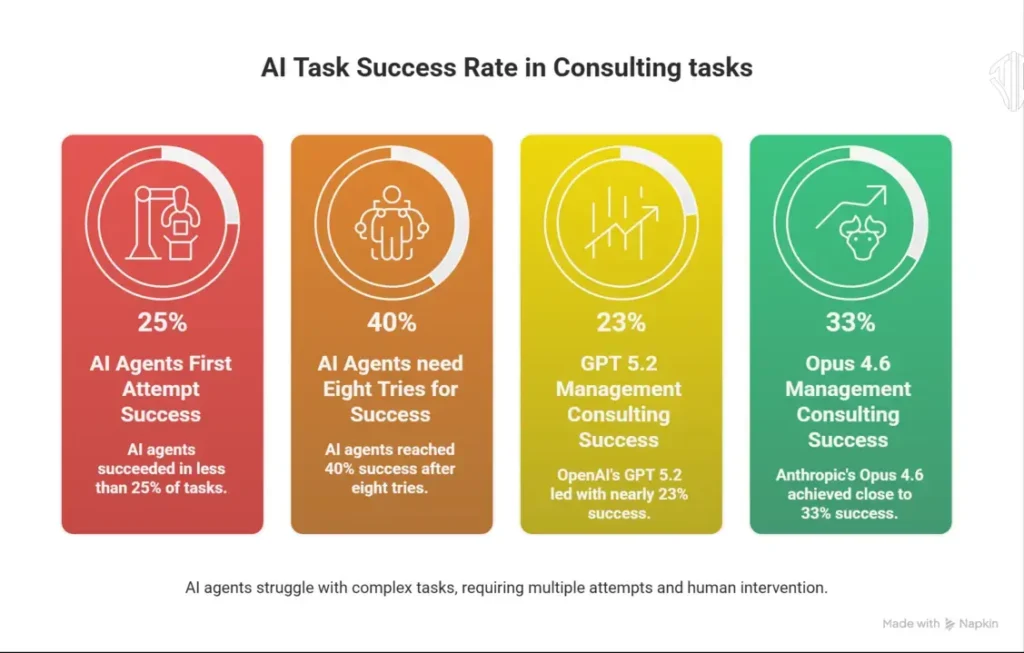
The results were telling: AI agents succeeded in less than 25% of tasks on their first attempt, and only reached 40% even after eight tries. For management consulting, OpenAI’s GPT 5.2 led with nearly 23% success on the first attempt, while Anthropic’s Opus 4.6, a newer contender, achieved close to 33%.
A Trajectory of Unprecedented Improvement
While these numbers might seem modest, Foody highlights a critical detail: the rate of improvement is staggering. GPT-3’s success rate was a mere 3%, leaping to 23% for GPT 5.2.
Similarly, Anthropic’s model improved from 13% to 33% on consulting tasks within a matter of months. Foody projects that by the end of this year, the success rate of these models could be closer to 50%.
“These are some of the hardest tasks in the economy that people pay millions of dollars to consulting firms to do,” Foody noted, “and the models are finally being able to do them with an incredible rate of progress.” This rapid advancement isn’t just theoretical; it’s already disrupting the consulting industry, altering hiring practices and revenue models.
McKinsey, for instance, has publicly stated that 25,000 of its 60,000 “employees” are now AI agents, marking the first time the firm has grown without proportionally increasing its human headcount.
Where AI Agents Currently Fall Short
Despite their impressive gains, AI agents still face significant hurdles in replicating the full scope of human consulting. Mercor’s research identified key areas of struggle:
- Longer-Horizon and Multi-Step Tasks: The more steps a task requires, or the longer it takes a human to complete, the more likely AI agents are to falter. They struggle with maintaining coherence and context over extended processes.
- Navigating Complex Information Systems: Unlike humans, AI models find it difficult to intuit where to find specific information within a file system, often scanning irrelevant files.
- Strategic Planning and Tool Integration: AI agents currently lack the nuanced planning capabilities to effectively use multiple tools or cross-reference diverse files simultaneously to solve a complex problem.
- Nuance and “Client-Ready” Output: Former KPMG consultant Frank Jones emphasized that AI models require very specific prompts. They often miss the implicit expectations and common phrases in consulting, like producing “client-ready” work, which encompasses not just accuracy but also polish, context, and persuasive framing. Foody likened current AI agent performance to that of an intern, requiring significant oversight and refinement.
The Inevitability of Further Evolution
Foody asserts that continued improvement doesn’t necessitate new scientific breakthroughs but rather more and better training data—an area where frontier AI labs are investing heavily. Mercor itself, valued at $10 billion, plays a crucial role in this, employing over 30,000 contractors globally to train AI models by refining chatbot responses and other tasks.
Read this: Which Jobs are at risk to Vanish in the Next 20 Years, as per AI Experts?
Foody firmly believes that consulting, especially lower-level roles, is ripe for displacement by AI. He envisions future AI benchmarks that evaluate not just the capabilities of an analyst but the entire value chain of a professional services firm.
While the current APEX benchmark might offer a comfortable narrative for firms—showing AI as an augmentation tool—Foody warns that the “next version of APEX tells a very scary story for McKinsey,” predicting that “in the coming two years, we’re going to have chatbots that are as good as the best consulting firm.”
The Shifting Landscape and What It Means for Consultants
While the vision of AI fully replacing human consultants is still debated, the industry is undeniably at a tipping point. Major consulting firms are not just observing but actively integrating AI into their operations, leveraging it for enhanced data analysis, market research, and predictive modeling.
The focus, for now, often remains on augmentation—empowering human consultants with AI tools to increase efficiency and derive deeper insights, rather than outright replacement.
Consultants are increasingly needing to adapt, developing skills in prompt engineering, validating AI outputs, and seamlessly integrating AI tools into their workflows. Ethical considerations, data privacy, and robust governance frameworks for AI in professional services are also becoming paramount as AI agents handle increasingly sensitive client information.
The rapid advancements highlighted by Mercor’s CEO suggest that while human judgment, emotional intelligence, and complex client relationship management will remain critical, the scope of tasks an AI agent can handle is expanding at an alarming rate.
The future of consulting will likely involve a dynamic partnership between human expertise and increasingly sophisticated AI, with the balance potentially shifting faster than many anticipate.
Key Takeaways
- AI agents are rapidly improving, with Mercor’s CEO projecting a 50% success rate on complex consulting tasks by the end of the year.
- Despite current struggles with multi-step tasks, nuanced output, and complex information navigation, the rate of AI agent advancement is “staggering.”
- This rapid evolution is already disrupting the consulting industry, exemplified by firms like McKinsey integrating thousands of AI agents into their workforce.
- Future improvements in AI agent capabilities will largely come from more and better training data, not necessarily new scientific breakthroughs, further accelerating displacement in lower-level consulting roles.
- Consultants must adapt by focusing on unique human skills like judgment, emotional intelligence, and client relationship management, while also developing expertise in integrating and validating AI tools.
Join our community by subscribing to our Weekly Newsletter to stay updated on the latest AI updates and technologies, including the tips and how-to guides. (Also, follow us on Instagram (@inner_detail) for more updates in your feed).
(For more such interesting informational, technology and innovation stuffs, keep reading The Inner Detail).
