

A report by WEF showcases the most in-demand skills that students and employees should seek to learn now to safeguard themselves from layoff trends.
In recent years, the rapid integration of artificial intelligence and automation has reshaped the core competencies required across nearly all industries. The traditional emphasis on routine tasks is giving way to a demand for skills that machines cannot easily replicate, such as complex problem-solving, critical thinking, and advanced digital literacy. This dynamic environment calls for a continuous learning mindset and a strategic approach to skill acquisition to remain competitive and relevant.
Let’s dive into the essential skills that are increasingly crucial for students and freshers to cultivate for the job market of tomorrow.
The Evolving Landscape of In-Demand Skills
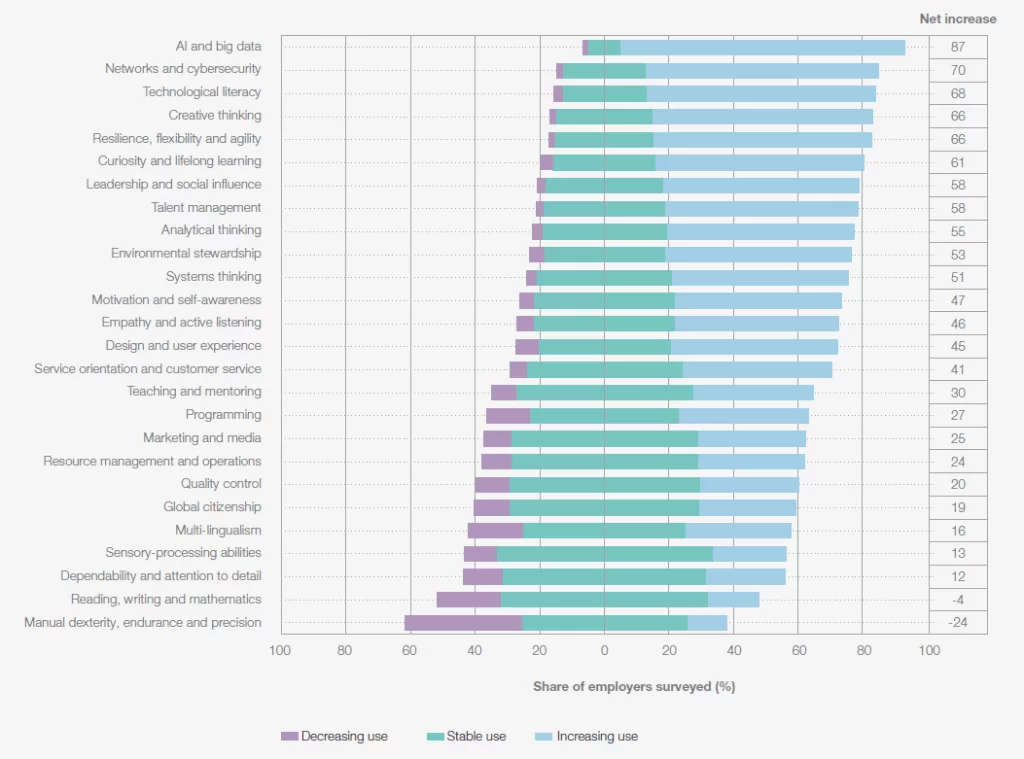
The “Future of Jobs Report 2025” by the World Economic Forum, based on insights from over 1,000 global employers, sheds light on the significant shifts in the skills landscape. On average, workers can expect that two-fifths (39%) of their existing skill sets will be transformed or become outdated over the 2025-2030 period. This “skill instability” highlights the urgent need for continuous upskilling and reskilling.
The report identifies several key skills that are either already highly sought after or are rapidly growing in importance:
- AI and Big Data Skills: Unsurprisingly, skills related to artificial intelligence and big data top the list of fastest-growing skills. This includes understanding AI principles, working with large datasets, and leveraging AI tools for various applications. This demand is widespread, with over 90% of respondents in the top 10 industries expecting this skill to increase in use.
- Networks and Cybersecurity: With increasing digitalization and reliance on interconnected systems, networks and cybersecurity skills are also in high demand. Protecting data and systems from threats is paramount for businesses globally.
- Technology Literacy: Beyond specialized AI and cybersecurity skills, a foundational understanding of various technologies and the ability to use digital tools effectively is becoming a universal requirement. Getting yourself updated with the latest technological updates and being proficient with latest software including AI-tools might get you in higher positions easily.
- Creative Thinking: Complementing analytical skills, creative thinking is also expected to rise in importance. As AI automates routine tasks, human creativity will be vital for innovation, generating new ideas, and approaching challenges from novel perspectives.
- Resilience, Flexibility, and Agility: These attributes are critically important in a volatile and uncertain world. Employers highly value individuals who can adapt to rapid changes, recover quickly from setbacks, and navigate ambiguous situations with ease.
- Curiosity and Lifelong Learning: The pace of change necessitates a continuous learning mindset. Individuals who are curious and committed to lifelong learning will be better equipped to acquire new skills and adapt to future demands. This is particularly true in industries like Education and Training and Telecommunications.
- Leadership and Social Influence: These human-centered skills are gaining significant importance. The ability to inspire, motivate, and guide teams, as well as influence stakeholders, remains invaluable even with technological advancements.
- Talent Management: 58% of employers say that talent management is one of the core skills in-demand for the next 5 years. The skill is most needed for infrastructure, automotive, mining, chemical and supply chain realms.
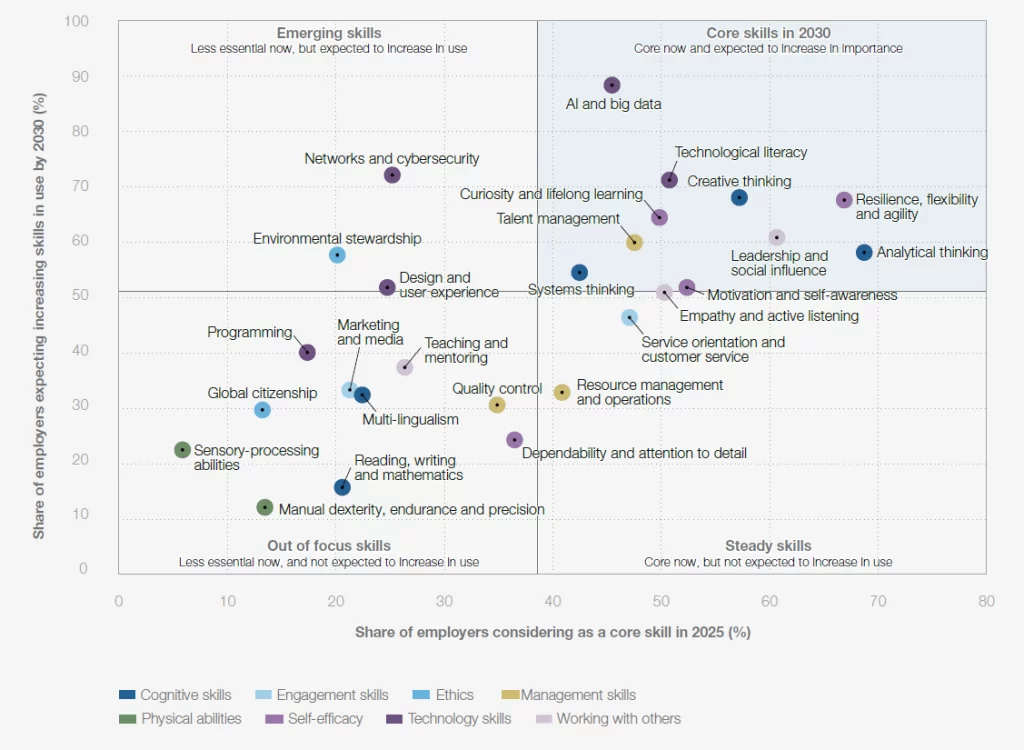
- Analytical Thinking: This remains the most crucial core skill, with seven out of 10 companies deeming it essential in 2025. The ability to analyze information, break down complex problems, and make data-driven decisions is foundational in an increasingly data-rich world.
- Environmental Stewardship: Driven by the green transition, environmental stewardship has entered the list of top 10 fastest-growing skills for the first time. This highlights the increasing focus on sustainability and climate action across industries. This skill is particularly emphasized in the Mining and Metals and Government and Public Sectors.
Conversely, skills like manual dexterity, endurance, and precision are expected to see a notable decline in demand, with 24% of respondents foreseeing a decrease in their importance. Similarly, basic reading, writing, and mathematics, while still important, are not seeing the same projected growth in future demand as advanced cognitive and technological skills.
Bridging the Skill Gap
The report emphasizes that skill gaps are the biggest barrier to business transformation, with 63% of employers identifying them as a major hurdle over the 2025-2030 period. This underscores a critical need for focused efforts in reskilling and upskilling the workforce. Employers are prioritizing upskilling their current employees (85%) and hiring staff with new skills (70%).
For students and freshers, this means that merely acquiring a degree might not be enough. The focus must shift from a fixed set of knowledge to a dynamic portfolio of adaptable skills. The diverse requirements of the largest-growing jobs often call for competencies that can be gained through vocational training, apprenticeships, on-the-job experience, or associate degrees.
What Should Students & Freshers Learn Now?
The landscape of work is changing, and so too are the demands on the workforce. For students currently in their academic journey and freshers stepping into the professional world, understanding and acquiring the right skills is more critical than ever. The insights from the World Economic Forum’s report serve as a powerful guide, highlighting not just what skills are in demand, but why they are essential in an increasingly automated and interconnected global economy.
To gain a deeper understanding of the fastest growing jobs in the market for the next 5 years, I strongly encourage you to read my dedicated article: Future of Work: Fastest Growing & Declining Jobs by 2030. It’s designed to provide a comprehensive roadmap for your career, by listing you the fastest growing jobs.
Conclusion
The future of work will be defined by continuous learning and adaptability. Students and freshers who proactively invest in developing analytical, creative, and technological skills, coupled with strong human-centric attributes like resilience and lifelong learning, will be well-positioned to thrive. The evolving job market presents both challenges and unparalleled opportunities for those prepared to embrace change and commit to continuous growth.
Key Takeaways
- AI, Big Data, and Cybersecurity skills are rapidly growing in importance.
- Creative and Analytical thinking will remain essential in the age of automation.
- Resilience, adaptability, and lifelong learning are crucial for navigating the changing job market.
Join our community by subscribing to our Weekly Newsletter to stay updated on the latest AI updates and technologies, including the tips and how-to guides. (Also, follow us on Instagram (@inner_detail) for more updates in your feed).
(For more such interesting informational, technology and innovation stuffs, keep reading The Inner Detail).