
In recent times, you’ve likely encountered news of paintings and digital creations fetching millions as Non-Fungible Tokens (NFTs) online. This captivating subject has captivated social media, particularly with the story of a digital artist who sold a JPG file—a collage of 5,000 images—for an astonishing $69 million (₹500 Crores) as an NFT.
But what exactly does NFT mean? And why has the global fascination with NFTs surged so dramatically? Continue reading to uncover the answers to these compelling questions.
Understanding NFTs: What Does NFT Stand For?
NFT stands for Non-Fungible Token. To clarify, a non-fungible token represents a unique digital asset that cannot be directly replaced by another identical item. The term “fungible” implies interchangeability; for instance, a Bitcoin is fungible because one Bitcoin can be exchanged for another. Conversely, “non-fungible” signifies something unique and irreplaceable. Examples of non-fungible physical assets include copyrights, unique agreements, rare diamonds, or specific parcels of land—items that can be bought or sold but not interchanged.
To illustrate, you can easily exchange a $10 bill for two $5 bills, but you cannot simply trade one NFT for another, as each possesses distinct characteristics.
Technically, an NFT functions as a unique unit of data recorded on a digital ledger known as a blockchain. Each NFT signifies ownership of a distinct digital artifact. NFTs have become a popular medium for commodifying various digital creations, including digital art, in-game assets, music files, and video clips. Furthermore, an NFT can also serve as a virtual token representing ownership of a real-world physical item, such as the original Mona Lisa painting.
The Purpose and Functionality of Non-Fungible Tokens (NFTs)
Unlike physical paintings, which are inherently unique, digital artworks and other digital creations can be effortlessly copied or duplicated. NFTs address this by “tokenizing” digital assets, thereby generating a verifiable digital certificate of ownership that can be securely bought, sold, and traded. This innovation empowers artists and and designers to establish and maintain ownership rights over their digital files.
It’s important to note that owning an NFT does not restrict access to copies of the original digital file. For instance, you might use an NFT’s associated image as your WhatsApp profile picture for personal enjoyment. However, using the digital file for commercial or professional purposes typically remains prohibited, as the NFT primarily confers ownership of the token, not necessarily the broader usage rights to the underlying asset.
Most NFTs are built on the Ethereum blockchain. While Ethereum is widely known as a cryptocurrency, similar to Bitcoin or Dogecoin, its robust blockchain infrastructure also facilitates the creation and management of NFTs, embedding crucial metadata directly within the token.
Why Do Individuals Invest Millions in Digital Art and NFTs?
The concept of investing significant sums in art is not new, tracing back centuries to physical auctions. Historically, wealthy art collectors have paid enormous amounts for masterpieces, exemplified by the $450 million (₹3268 Crores) paid for Leonardo da Vinci’s “Salvator Mundi.” This demonstrates a long-standing appreciation among collectors for unique and valuable works, regardless of the medium.
One might logically question the value of a digital file compared to a tangible painting. It’s true that downloading a Beeple video takes mere moments, yet one such video famously sold for $6.6 million. This highlights a fundamental shift in asset valuation.
While it’s true that digital files, including the artwork underlying an NFT, can be downloaded and duplicated endlessly, discerning collectors continue to invest in them. The true value derived from purchasing an NFT is not the file itself, but the verifiable digital ownership of that specific token. Analogous to traditional art collecting, anyone can acquire a print of a Monet painting, but only one individual can possess the original masterpiece.
Generating Revenue with NFTs: A New Frontier for Creators
From another perspective, NFTs represent a groundbreaking revolution for creators seeking to monetize their digital works. This emergent ecosystem offers significant promise for artists, editors, and video creators looking to sell their unique digital assets.
The process of creating an NFT, often referred to as “minting,” involves uploading a digital file, like an artwork, to an NFT marketplace such as KnownOrigin, Rarible, or OpenSea. This action records a unique token representing that file on the blockchain, which can then be purchased and resold using cryptocurrency. It’s important to understand that while an artist can sell an NFT associated with their work, they typically retain the copyright and can even mint multiple NFTs from the same creation. Furthermore, purchasing an NFT does not grant the buyer exclusive access to the digital work or possession of the “original” digital file. A significant concern in the NFT space is that creators are not always required to prove original authorship when minting, leading to instances where art has been tokenized without the actual creator’s consent.
Is There a Market for Your Digital Creations as NFTs?
Indeed, the market for NFTs is driven by appeal and uniqueness. If your digital work is truly captivating and innovative, there’s potential for significant financial returns. Why not explore this exciting avenue?
As a Tamil saying goes, “Vandha Malai, Pona Mudi,” which translates to “If you gain, you gain a mountain; if you lose, you lose a strand of hair.” This proverb perfectly encapsulates the potential rewards versus risks in ventures like NFTs.
Therefore, embrace the opportunity and don’t hesitate to begin your journey into the world of NFTs!
Notable Record-Breaking NFT Sales
CROSSROAD by Beeple: A $6.66 Million NFT Sale on Nifty Gateway
On February 24th, the prominent digital art platform Nifty Gateway announced via Twitter that Beeple’s “CROSSROAD” NFT achieved a remarkable $6.6 million on the secondary market. This significant sale was facilitated through Nifty Gateway’s brokerage services. Notably, this particular NFT incorporated an anti-Trump message.
CryptoPunks #7804 and #3100: Selling for $7.6 Million Each at Larva Labs

On March 11, these highly sought-after CryptoPunk collectibles, specifically #7804 and #3100, were each sold for a value equivalent to 4.2k Ethereum, making them two of the highest-value CryptoPunk token sales ever recorded. Larva Labs, the creators, describe CryptoPunks as “unique collectible characters with proof of ownership stored on the Ethereum blockchain,” highlighting their significance as early NFT pioneers.
“Everydays: The First 5,000 Days” by Beeple: Christie’s Auctions a $69 Million NFT
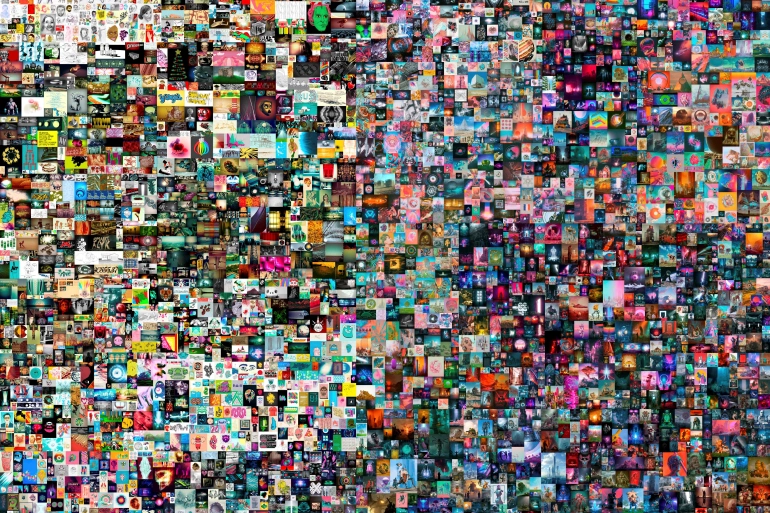
To date, the most valuable NFT sale is “Everydays: The First 5,000 Days,” a groundbreaking piece by renowned crypto-artist Beeple. This monumental artwork was auctioned at Christie’s, marking the first time a traditional, historic auction house sold an NFT, which significantly validated the burgeoning digital art market. The piece itself is a comprehensive compilation of 5,000 unique artworks created daily by Beeple over more than thirteen years.
Join our community by subscribing to our Weekly Newsletter to stay updated on the latest AI updates and technologies, including the tips and how-to guides. (Also, follow us on Instagram (@inner_detail) for more updates in your feed).
(For more such interesting informational, technology and innovation stuffs, keep reading The Inner Detail).