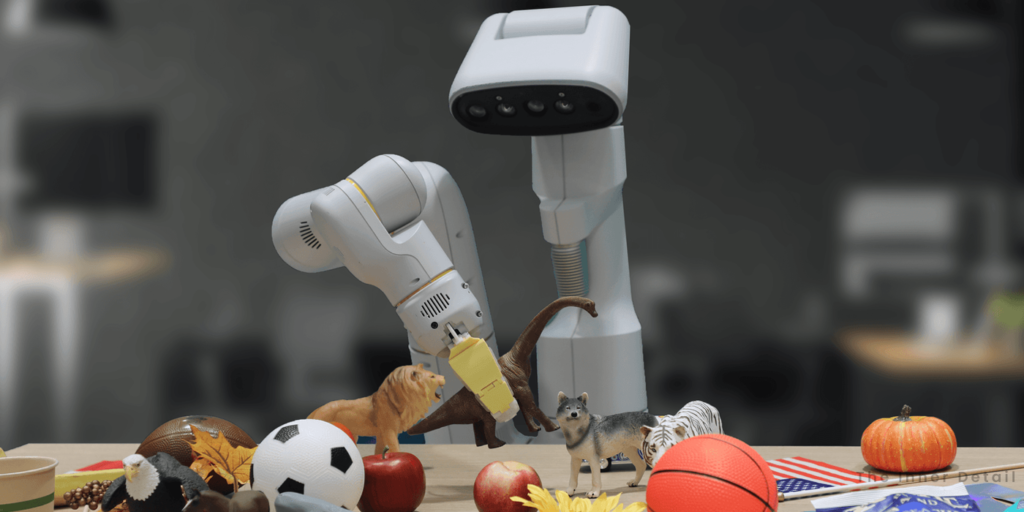
A new field of robotics has emerged called “Cobots” – a portmanteau of ‘collaborative robots’, which has become one of the key players in industrial automation.
In the rapidly evolving world of industrial automation, two elements that stands out are: traditional industrial robots and collaborative robots, or cobots. While both are designed to enhance efficiency and productivity, they have distinct characteristics and applications. Understanding these differences is crucial for choosing the right automation solution.
What is a Cobot?
Cobots are a type of robot specifically designed to work safely alongside humans in a shared workspace. They are built with features that prioritize human safety, such as force and torque sensors that detect contact and allow them to slow down or stop their movement to prevent accidents.
Cobots are often lightweight and compact, with features like rounded edges and soft padding. They are known for their user-friendliness and simple programming, often achievable by physically guiding the robot arm or using intuitive interfaces. Common applications include assembly, pick and place, machine tending, packaging, and quality inspection.
What is a Traditional Industrial Robot?
Traditional industrial robots, sometimes called ‘non-collaborative robots’, are designed to work autonomously, often in large-scale operations with high volumes and repetitive tasks. They are typically larger, faster, and more powerful than cobots, capable of handling heavy loads and intricate movements at rapid speeds.
Due to their speed and power, they can pose a risk to human workers, necessitating safety measures such as machine guarding or safety cages to ensure human safety. Traditional robots often require extensive and specialized programming, which can be time-consuming and may require professional services. Their applications frequently include welding, painting, and heavy material handling.
Key Differences Between Cobots and Traditional Industrial Robots
Understanding the distinctions between collaborative robots (cobots) and traditional industrial robots is crucial when considering automation solutions. While both aim to improve efficiency and productivity, they are designed for different environments, tasks, and levels of human interaction.
| Feature | Cobots | Traditional Industrial Robots |
|---|---|---|
| Designed Interaction | Designed to work safely alongside humans in a shared workspace. Foster an environment where human intervention is encouraged. Augment human worker capabilities. | Designed to work autonomously and independently. Little need for human intervention or involvement once programmed. Often designed to replace human workers. |
| Safety & Workspace | Prioritize human safety. Equipped with safety features like force and torque sensors that detect contact and allow them to slow down or stop. Often have rounded edges and soft padding. Can generally work near people with minimal or no safety fencing or cages after a risk assessment. More compact and lightweight. Smaller footprint. | Potential risk to human workers due to speed, power, and size. Require safety measures such as machine guarding or safety cages/barriers to ensure human safety. Typically separated from human workers. Need larger areas to perform tasks and space for safety measures. Often require specific environmental conditions, including safety enclosures. |
| Programming | Generally need simple programming. User-friendly. Can be easily reprogrammed by physically guiding the arm. Lower learning curve. Quick setup and integration. Minimal programming setup. Can often be programmed by anyone, not just specialists. | Need extensive programming. Complex robots that often require the help of professional services for programming. Require specialized programming languages and expertise. Steeper learning curve. Can be costly and time-consuming to program. |
| Flexibility & Adaptability | Offer greater adaptability for various tasks. Highly flexible. Can be easily reconfigured. Offer more general-purpose utility. Beneficial for manufacturers handling lower volumes. Can handle various tasks from assembling parts to quality control. | Generally less flexible and adaptable. Often designed for specific tasks in a highly structured, automated environment. Suitable for production processes that will not vary for a long time. Often specialized for specific, repetitive tasks. |
| Payload & Speed | Generally operate at slower speeds. Have lower payload capabilities. Designed for light-weight, precise tasks. Not designed for heavy-duty tasks. Average speed can be four times slower than a conventional industrial robot. | Can handle various payloads. Capable of handling heavy loads. Operate at high speeds. Designed for heavy-duty operations. |
| Cost & ROI | Generally more affordable. Lower upfront costs. More cost-effective. Faster return on investment (ROI), often within just a few months or an average ROI of one year. Reduced setup and training costs. Lower purchase costs, maintenance costs, and energy consumption. Can be far more accessible to a wider customer base. | Costly initial investment. Higher upfront cost. Costs may rise further due to professional services for programming and the need for safety infrastructure. Can reduce labor costs in the long term. Provide higher ROI in certain high precision, speed, or payload applications. |
| Durability | Generally not designed for the same degree of ruggedness. Designed for less harsh environments. | Typically built to be robust and durable. Longer operational life. Designed for heavy-duty applications. |
| Regulatory Compliance | Must comply with safety regulations for human interaction such as ISO 10218-1 and ISO 13849-1. Adhere to rigorous ISO standards. Safety clearances can be challenging. | Regulations may be less stringent as they operate in isolated environments. |
Benefits of Cobots
Collaborative robots, or cobots, offer several significant advantages, making them a popular automation solution, especially for smaller operations or tasks requiring human interaction.
A key benefit is their user-friendliness and simplicity in programming, often allowing non-experts to easily reprogram them by physically guiding the arm or using intuitive interfaces. This ease of use contributes to lower upfront costs, faster return on investment (often within a year), and reduced setup and training expenses.
Cobots are also highly flexible and adaptable, easily reconfigured for different tasks and workspaces, which is beneficial for handling lower volumes or varied products. Designed with safety in mind, they can work alongside humans with minimal or no safety fencing, minimizing injury risk with built-in sensors and force limitations.
By handling dangerous or repetitive tasks, they boost productivity and allow human workers to focus on more complex, value-added activities.
Limitations of Cobots
Despite their many benefits, cobots do have some limitations compared to traditional industrial robots.
They generally have lower payload capabilities and operate at slower speeds. This means they are typically not designed for heavy-duty tasks or applications where rapid speed is critical.
While designed for collaboration, cobots may still require human supervision or assistance and cannot entirely replace a human worker in all contexts, whereas industrial robots can operate autonomously for extended periods.
Compared to the robustness of industrial robots, cobots are often not designed for the same degree of ruggedness or harsh environments.
Additionally, obtaining safety clearances for cobots can sometimes be challenging, especially when modifying tasks or tooling, potentially requiring additional time and cost.
Cost of Cobots
Cobots are generally considered more cost-effective and have lower upfront investment compared to traditional industrial robots. Their ease of programming and integration also leads to reduced setup and training costs. The overall cost can vary based on the manufacturer, functionality, features, and the specific end-of-arm tooling required.
Basic assembly cobots can cost around $8,000, while models for material handling might be closer to $20,000. More advanced cobots equipped with features like vision systems can exceed $35,000, and some high-end cobots can cost over $100,000.
Despite the range, the lower initial purchase price, combined with reduced operating costs like maintenance and energy consumption, contributes to a faster return on investment, often averaging around one year.
Both cobots and traditional robots offer significant advantages in boosting productivity and efficiency. Traditional robots excel in high-speed, heavy-duty, repetitive tasks often in large-scale manufacturing.
Cobots are ideal for tasks requiring human collaboration, flexibility, and ease of deployment, particularly beneficial for manufacturers handling lower volumes or intricate tasks. The choice depends on the specific tasks, required speed and payload, available workspace, and budget. Cobots are increasingly popular due to their accessibility and ability to augment human capabilities rather than replace them entirely.
Key Takeaways
- Cobots are designed to work safely alongside humans, while traditional robots are designed for autonomous operation.
- Cobots offer greater flexibility and adaptability compared to traditional industrial robots.
- Cobots generally have lower upfront costs and a faster return on investment compared to traditional robots.
Join our community by subscribing to our Weekly Newsletter to stay updated on the latest AI updates and technologies, including the tips and how-to guides. (Also, follow us on Instagram (@inner_detail) for more updates in your feed).
(For more such interesting informational, technology and innovation stuffs, keep reading The Inner Detail).