
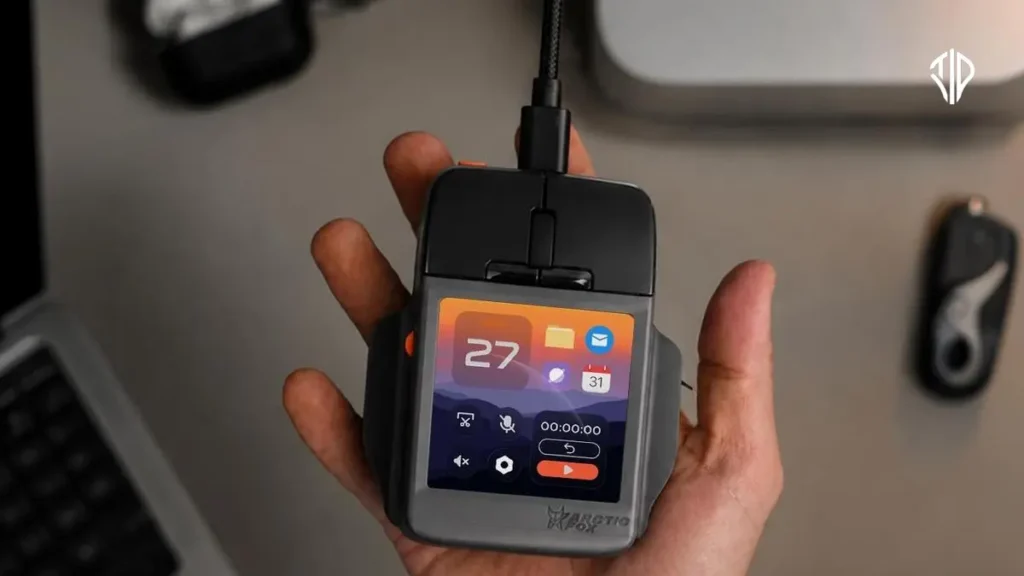
Hardware innovation in computer peripherals often focuses on lighter chassis designs, higher polling rates, or advanced optical sensors. However, industry announcements like this hardware release challenge traditional ergonomic standards by turning the surface beneath the user’s hand into an interactive display. The Super Mouse developed by Arctic Fox Technologies attempts to consolidate desk space by merging a standard mouse with a compact touchscreen interface.
Instead of peppering the exterior with dozens of physical macro buttons or relying solely on side-mounted thumb grids, this device integrates a 3.1-inch square display directly front and center. Positioned neatly beneath standard mechanical mouse buttons and a scroll wheel, the screen transforms a typical pointing device into a dynamic command center. While experimental peripherals have previously experimented with small utility screens, this model aims to function as a trackpad, macro pad, and streaming controller all at once.
Understanding the Touchscreen Mouse Workflow
Understanding how a touchscreen mouse changes everyday workflow requires looking past the conventional design of computer mice. Peripheral evolution has largely followed predictable paths, transitioning from mechanical ball rollers to optical lasers and ergonomic vertical profiles. Integrating a high-resolution display into the chassis alters the physical interaction between the user’s hand and the computer.
The primary utility of the built-in display stems from its contextual awareness and customizability through companion desktop software. When users open applications like Adobe Premiere or graphic design suites, the touchscreen dynamically updates to present playback controls, timeline scrubbing, or editing shortcuts. For general productivity, the interface can display calendar reminders, focus timers, or launch sequences containing up to sixteen distinct macros.
Hardware Specifications and Design Trade-Offs
Examining the hardware specifications reveals deliberate engineering choices alongside distinct compromises. The device features a 720 by 720 resolution square display paired with a built-in gyroscope for motion-based presentation control and video scrubbing. Local voice-to-text processing occurs directly on the mouse hardware rather than relying entirely on cloud processing.
One of the most notable design trade-offs involves power delivery and connectivity requirements. Unlike modern wireless mice powered by internal rechargeable batteries, the Super Mouse relies entirely on a tethered USB-C cable for constant power. This wired requirement ensures uninterrupted display operation and eliminates battery degradation concerns, though it departs from the current consumer preference for cable-free desks.
Market Position and Ergonomic Considerations
Evaluating the market position of hybrid touch peripherals involves comparing historical attempts to merge mice and auxiliary displays. Manufacturers have previously experimented with narrow side screens or gesture-sensitive surfaces, yet few have integrated a display large enough to support swipe typing or complex app launchers. Pricing during the initial crowdfunding phase sits at $199, with planned retail distribution increasing to $249.
Prospective buyers must weigh the potential productivity gains against ergonomic considerations and financial risks associated with hardware crowdfunding campaigns. The boxy structural profile differs significantly from contoured ergonomic mice designed for prolonged strain reduction. Users accustomed to lightweight, wireless pointers may find the tethered structure and unique shape require an adjustment period.
The Future of Peripheral Consolidation
The introduction of multifunction hardware highlights a broader industry trend toward peripheral consolidation. As desktop setups shift toward minimalist workspaces, devices that eliminate the need for separate stream decks, macro pads, and shortcut keyboards find eager niche audiences. Whether this form factor influences mainstream peripheral design or remains a specialized tool depends on software ecosystem support and user adoption rates.
Key Takeaways
- The Super Mouse integrates a 3.1-inch 720×720 touchscreen display directly into the chassis to act as a trackpad, macro pad, and streaming controller.
- Features include a built-in gyroscope for motion controls and local hardware-based voice-to-text processing.
- Unlike modern wireless mice, it requires a constant tethered USB-C connection to power the display.
- Crowdfunding pricing starts at $199 before rising to a planned $249 retail distribution price.
Join our community by subscribing to our Weekly Newsletter to stay updated on the latest AI updates and technologies, including the tips and how-to guides.
Also, follow us on Instagram @tid_technology for more updates in your feed and our WhatsApp Channel to get daily news straight to your Messaging App.
