
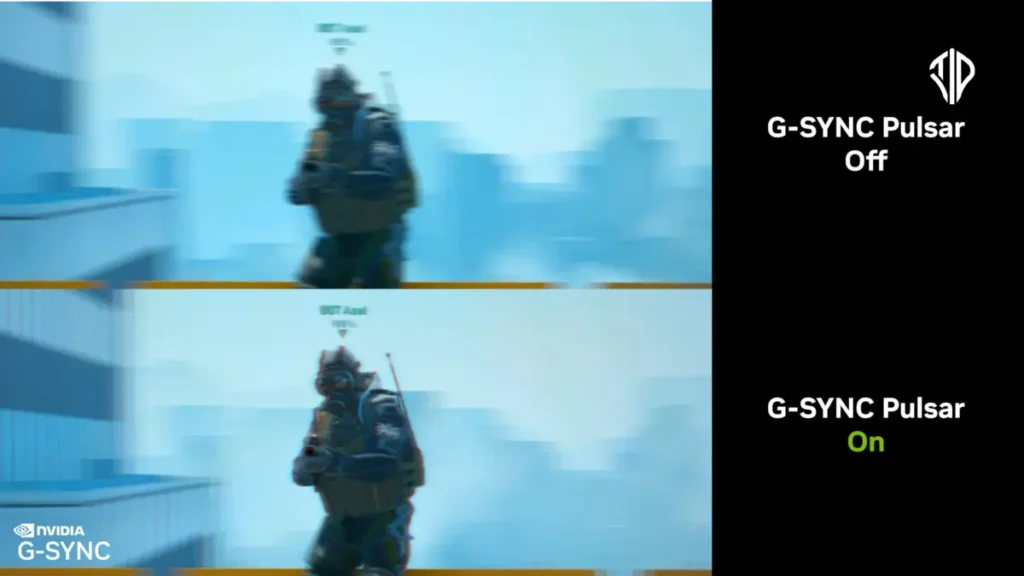
NVIDIA, a company synonymous with pushing graphical boundaries, has once again revolutionized the display landscape by introducing G-SYNC Pulsar, a groundbreaking technology that promises over 1,000 Hz of effective motion clarity.
In the dynamic world of PC gaming, every millisecond and every pixel of clarity can make a profound difference. For over a decade, gamers have grappled with a fundamental trade-off: choose between the seamless, tear-free experience of variable refresh rate (VRR) technology or the enhanced motion clarity offered by display strobing.
However, Nvidia’s G-SYNC Pulsar is set to unite these elements providing both seamless VRR tech and the enhanced motion clarity.
The Evolution of G-SYNC
Back in 2013, G-SYNC emerged as a game-changer, bringing variable refresh rate technology to the forefront and eliminating screen tearing and stuttering.
This innovation meant that displays could dynamically match their refresh rate to the GPU’s frame rate, delivering buttery smooth gameplay without the visual artifacts that plagued traditional fixed-refresh monitors.
Over the years, NVIDIA continued to refine G-SYNC, extending its reach to TVs and even cloud gaming platforms. Now, in what marks the next generation of this pioneering technology, G-SYNC Pulsar steps onto the scene, offering a new gold standard for visual fidelity and responsiveness.
Unpacking G-SYNC Pulsar: Clarity Redefined
G-SYNC Pulsar is not merely an incremental update; it’s a fundamental re-engineering of display technology. It masterfully delivers both a stutter-free experience, a hallmark of G-SYNC, and an unprecedented level of motion clarity through the ingenious invention of variable frequency backlight strobing.
Unlike previous strobing solutions like ULMB and ULMB2, which only functioned at fixed refresh rates, G-SYNC Pulsar works in harmony with VRR, ensuring both tear-free frames and incredible clarity.
How does it achieve such remarkable clarity? By precisely pulsing the display’s backlight, G-SYNC Pulsar screens can deliver a perceived effective motion clarity of over 1,000 Hz. This means that if you’re playing a game at 250 frames per second, G-SYNC Pulsar effectively quadruples that refresh rate in terms of motion clarity.
This incredible advancement significantly boosts the visibility and sharpness of content in motion, empowering players to track and target enemies with unparalleled precision in fast-paced competitive titles like Counter-Strike 2. The difference is stark, as demonstrated by pursuit camera footage showing a dramatic reduction in monitor-based motion blur, leading to improved hit rates and overall competitiveness.
For immersive games like Anno 117: Pax Romana, the technology ensures that navigating bustling scenes or locating structures on the map remains crystal clear, deepening the sense of immersion.
The Science Behind the Smoothness
Traditional VRR dynamically adjusts the display’s refresh rate to match the GPU’s output, eliminating stutter and tearing. However, display motion blur, distinct from in-game motion blur, persists due to two main factors: slow LCD pixel transitions and the phenomenon of “motion hold.”
Motion hold occurs because the backlight on most LCD panels is constantly illuminated. As our eyes track moving objects on screen, the image “holds” in a position before fading to the next, causing blurriness.
G-SYNC Pulsar tackles this by employing a sophisticated ‘rolling scan’ scheme. Instead of a single, always-on backlight, G-SYNC Pulsar displays feature multiple horizontal backlight sections that are independently pulsed from top to bottom. This ensures that pixels have almost an entire frame time to reach their correct color values before being backlit.
The backlight then pulses for a brief 25% of a frame time, right before new pixel data is scanned out. This precise timing ensures that the image is shown at the exact right location on screen, and then quickly extinguished before the next frame.
The result is an illusion of motion that is exceptionally clear and smooth, available from 90 FPS up to the monitor’s maximum refresh rate.
G-SYNC Ambient Adaptive Technology
Beyond the revolutionary Pulsar technology, the new G-SYNC displays also introduce G-SYNC Ambient Adaptive Technology. This thoughtful feature utilizes a built-in light sensor to automatically adjust the monitor’s color temperature and brightness based on the ambient lighting conditions in your room.
This means you won’t be blinded by a bright screen in a dark room late at night, nor will you struggle to see details in a brightly lit environment, all without the need for manual adjustments.
A significant development accompanying G-SYNC Pulsar is NVIDIA’s collaboration with MediaTek, a global leader in gaming display scalers. By incorporating G-SYNC technologies directly into MediaTek’s display scalers, NVIDIA has streamlined the production process.
This partnership bypasses the need for dedicated G-SYNC modules, making the technology more accessible for monitor manufacturers and ultimately accelerating its availability to a broader consumer base.
Availability and What to Expect
The initial wave of G-SYNC Pulsar displays, featuring Ambient Adaptive Technology, launched on January 7th, 2026, from leading brands including Acer, AOC, ASUS, and MSI. These debut models boast impressive specifications: 27-inch 2560×1440 IPS panels, a blazing 360Hz refresh rate, and 500 nits of peak brightness in HDR.
Starting prices are set at $599 in the United States, with more retailers and units expected in the coming weeks. Crucially, all these monitors are designed to receive firmware updates via a micro-B USB port, ensuring continuous improvements to G-SYNC Pulsar can be delivered to end-users.
The Broader G-SYNC Ecosystem
NVIDIA continues to expand its G-SYNC Compatible program, validating a further 63 displays in its latest GeForce Game Ready Driver. This includes new 2026 TV models from LG and Samsung, as well as an exciting array of new monitors.
Among them is the Samsung Odyssey G60H, hailed as the world’s first 1,040Hz dual-mode competitive gaming display, alongside the ASUS ROG Strix 5K XG27JCG, a 27-inch, 180Hz, Fast IPS 5120×2880 (5K) display offering an astonishing 218 pixels per inch for unparalleled image sharpness. The XG27JCG also features a competitive 2560×1440 330Hz mode for gamers prioritizing speed.
Whether you’re gaming on a high-end monitor, a large TV, locally on a PC, or streaming via GeForce NOW, G-SYNC technology continues to enhance your experience. Every G-SYNC display undergoes rigorous factory calibration and testing in NVIDIA’s labs, ensuring that the G-SYNC badge represents a commitment to excellence.
With G-SYNC Pulsar, NVIDIA has once again addressed a long-standing challenge, delivering unprecedented motion clarity and the best-in-class variable refresh rate experience. The best truly just got better.
Key Takeaways
- G-SYNC Pulsar unifies variable refresh rate (VRR) and display strobing to achieve over 1,000 Hz of effective motion clarity.
- This new technology employs variable frequency backlight strobing with a ‘rolling scan’ scheme, working in harmony with VRR for tear-free and clear visuals.
- New G-SYNC displays also feature G-SYNC Ambient Adaptive Technology, which automatically adjusts screen color temperature and brightness based on room lighting.
- NVIDIA’s partnership with MediaTek integrates G-SYNC into display scalers, making the technology more accessible for manufacturers and consumers.
- Initial G-SYNC Pulsar displays launched in January 2026, offering 27-inch 1440p 360Hz IPS panels, with continuous updates and expansion across the broader G-SYNC ecosystem.
Join our community by subscribing to our Weekly Newsletter to stay updated on the latest AI updates and technologies, including the tips and how-to guides. (Also, follow us on Instagram (@inner_detail) for more updates in your feed).
(For more such interesting informational, technology and innovation stuffs, keep reading The Inner Detail).