
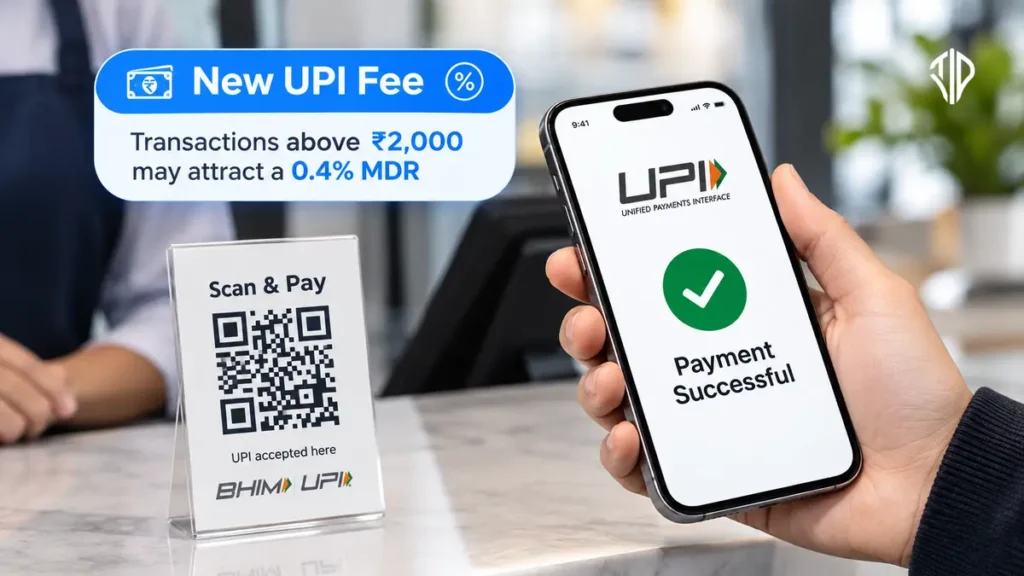
The National Payments Corporation of India (NPCI) has introduced a new Merchant Discount Rate (MDR) framework for selected UPI payments. Under the new rules, eligible merchant transactions above ₹2,000 will attract an MDR of 0.4%, while several important categories will continue to remain completely free.
For years, one of the biggest reasons behind the explosive growth of UPI in India has been its simple promise: scan, pay and move on without worrying about transaction charges. That picture is now changing — but only for certain transactions.
The new framework will come into effect from October 15, 2026. Most importantly for ordinary users, this is not a 0.4% fee that will be deducted from your bank account every time you make a UPI payment. The charge applies to eligible merchants and is shared among participants in the payments ecosystem. The government has also advised banks to ensure that merchants do not pass the MDR on to customers.
So, what exactly is changing, who will pay, who remains exempt, and what happens when you make a ₹5,000, ₹50,000 or ₹1 lakh UPI payment? Here’s everything you need to know.
First, UPI Is Not Becoming a Paid Service for Everyone
The headline “UPI will now have a fee” can easily create confusion. The new MDR is not a blanket charge on UPI users. Person-to-person payments remain free regardless of the transaction amount. For example, if you send ₹5,000 to a friend, transfer ₹50,000 to a family member or send a larger amount to another individual, the new MDR does not apply.
The charge is primarily aimed at person-to-merchant (P2M) transactions above ₹2,000, subject to the exemptions and special sector rules.
The Ministry of Finance has explicitly said that consumers making payments will not face transaction charges and that P2P transactions will remain free.
The UPI Fee Situation in One Table
| Type of UPI Payment | Transaction Amount | MDR from Oct. 15, 2026 | Who Pays? |
| Person to Person (P2P) | Any amount | 0% | No charge |
| Merchant payment | Up to ₹2,000 | 0% | No MDR |
| Eligible small P2PM merchant | Any amount, within eligibility | 0% | Merchant exempt |
| Regular merchant | Above ₹2,000 | 0.4% | Merchant/payment ecosystem |
| Railways, telecom, insurance, fuel, agriculture inputs, etc. | Above ₹2,000 | ₹5 flat | Merchant/payment ecosystem |
| Mutual funds, securities, stock brokers/dealers | Above ₹2,000 | 0.02% | Merchant/payment ecosystem |
| Eligible high-value merchant payment | ₹75,000 and above | Capped at ₹300 | Merchant/payment ecosystem |
What Is MDR and Why Is It Being Introduced?
MDR stands for Merchant Discount Rate. It is essentially a fee associated with processing a merchant payment and is distributed among participants in the payment ecosystem, including banks and payment-app providers.
For years, UPI merchant payments have operated without a conventional MDR for users and merchants, supported in part through government incentive mechanisms. The government had previously stated that consumers would not be charged for UPI and that any future MDR would be limited to selected merchant transactions.
The new framework changes that arrangement for certain higher-value merchant payments.
According to the government, the goal is to make the UPI ecosystem more financially sustainable, while encouraging further expansion into rural and semi-urban areas and maintaining investment in infrastructure and innovation.
The ₹2,000 Threshold Is the Key Number for UPI
Under the new framework, a regular person-to-merchant UPI transaction above ₹2,000 can attract the 0.4% MDR. Transactions up to ₹2,000 remain exempt.
That means buying something for ₹500, ₹1,000 or ₹2,000 from an eligible merchant does not suddenly become chargeable because of these new rules. However, if you make a ₹3,000 eligible merchant payment, the applicable MDR would be 0.4%, which works out to ₹12.
| UPI Merchant Payment | 0.4% MDR Calculation | MDR |
| ₹1,000 | Exempt | ₹0 |
| ₹2,000 | Exempt | ₹0 |
| ₹3,000 | ₹3,000 × 0.4% | ₹12 |
| ₹5,000 | ₹5,000 × 0.4% | ₹20 |
| ₹10,000 | ₹10,000 × 0.4% | ₹40 |
| ₹25,000 | ₹25,000 × 0.4% | ₹100 |
| ₹50,000 | ₹50,000 × 0.4% | ₹200 |
| ₹75,000 | ₹75,000 × 0.4% | ₹300 |
| ₹1,00,000 | 0.4%, subject to cap | ₹300 |
The important distinction is that these amounts represent the MDR applicable to the eligible merchant transaction, not an additional fee that the customer is supposed to pay on top of the UPI amount.
What Happens When You Send Money to Another Person?
Nothing changes. If you use Google Pay, PhonePe, Paytm, BHIM or another UPI app to send money to another individual, the new MDR does not apply.
The Ministry of Finance specifically stated that all P2P transactions will remain free regardless of transaction value. It said P2P transactions account for 37% of UPI transactions by volume and 70% by value.
So these transactions remain free:
| Example | Amount | New MDR |
| Send money to a friend | ₹5,000 | ₹0 |
| Send rent to an individual | ₹25,000 | ₹0 |
| Transfer money to a family member | ₹50,000 | ₹0 |
| Transfer a larger amount to another person | ₹1,00,000 | ₹0 |
The crucial question is therefore not simply “How much are you paying?” but “Who are you paying?”
UPI Fee for Small Street Vendors and Merchants
Small merchants classified under the P2PM (Person-to-Person Merchant) category and receiving up to ₹1 lakh per month through UPI QR codes will not have to pay MDR on the UPI payments they receive.
This is particularly important for India’s huge network of street vendors, small shops and informal businesses. For example, a small roadside tea seller, vegetable vendor or local shop using an eligible UPI QR code can remain outside the MDR system if the merchant meets the specified P2PM classification and monthly threshold.
The government says this is intended to help bring informal businesses into the formal digital-payment ecosystem without imposing additional payment costs on them.
Small Merchant vs Regular Merchant
| Merchant Category | Monthly UPI QR Receipts | Payment Above ₹2,000 | MDR |
| Eligible P2PM small merchant | Up to ₹1 lakh | Yes | 0% |
| Regular merchant | Any applicable volume | Yes | Generally 0.4% |
| Any merchant | Payment up to ₹2,000 | Yes | 0% |
This exemption is one reason the government says the new MDR will affect only a relatively small share of merchant transactions. According to the Finance Ministry’s analysis, only about 4% of merchant transactions will be affected by the introduction of MDR.
The reason is that the majority of transactions either fall below the ₹2,000 threshold or qualify under the zero-MDR P2PM framework. This is an important detail because UPI is heavily used for small-value everyday purchases. A ₹100 grocery payment and a ₹500 restaurant bill are much more common use cases than a ₹50,000 merchant transaction.
The government’s broader objective is therefore to introduce a source of revenue from higher-value merchant payments without fundamentally changing the low-cost nature of everyday UPI transactions.
Sector-wise Differentiation of MDR in UPI
Certain sectors will not follow the standard 0.4% MDR structure. Instead, eligible transactions above ₹2,000 in sectors including railways, telecom, insurance, fuel and agriculture inputs will attract a flat ₹5 MDR per transaction.
The government says the flat-rate approach is designed to provide greater cost predictability for essential services and industries where margins can be relatively thin.
Sector-Specific MDR
| Sector | Transaction | MDR |
| Railways | Above ₹2,000 | ₹5 flat |
| Telecom | Above ₹2,000 | ₹5 flat |
| Insurance | Above ₹2,000 | ₹5 flat |
| Fuel | Above ₹2,000 | ₹5 flat |
| Agriculture inputs | Above ₹2,000 | ₹5 flat |
So, a ₹20,000 eligible payment in one of these sectors would not result in a ₹80 MDR under the normal 0.4% formula. Instead, the applicable MDR would be ₹5.
Mutual Funds and Stock Market Payments Get an Even Lower Rate
Transactions involving mutual funds, securities, stock brokers and dealers will have a separate MDR structure. The applicable rate will be 0.02%, with a maximum MDR of ₹300 per transaction.
This is considerably lower than the standard 0.4% rate.
| Financial Market Payment | MDR |
| Eligible transaction above ₹2,000 | 0.02% |
| ₹10,000 | ₹2 |
| ₹50,000 | ₹10 |
| ₹1 lakh | ₹20 |
| ₹10 lakh | ₹200 |
| Very high-value transaction | Maximum ₹300 |
The government says the lower rate is intended to encourage greater retail participation in formal financial markets. There Is a ₹300 Cap on High-Value Transactions. The standard 0.4% MDR does not continue increasing indefinitely. For transactions of ₹75,000 and above, the MDR is capped at ₹300 per transaction.
That means:
- ₹75,000 → ₹300
- ₹1 lakh → ₹300
- ₹2 lakh → ₹300
- ₹5 lakh → ₹300
The cap is particularly important for large merchant payments because otherwise a percentage-based charge could become significantly higher.
Will Customers Have to Pay This Fee?
This is probably the question most UPI users will ask. According to the government, no. The MDR is imposed on the merchant side and shared among payment ecosystem participants. The Ministry of Finance has advised banks to ensure that merchants do not pass the MDR cost on to customers for UPI payments.
That means the intended experience for a customer paying ₹5,000 through UPI is still: You pay ₹5,000 → Merchant receives the payment → MDR is handled within the payment ecosystem. The merchant is not supposed to add a separate “UPI charge” to your bill simply because you selected UPI.
Does This Mean UPI Is No Longer Free?
A better way to understand the new system is: UPI remains free for consumers, while selected higher-value merchant transactions will carry an ecosystem-level MDR. This distinction is critical.
What About RuPay Debit Card Payments?
The framework also keeps P2M transactions up to ₹2,000 made through UPI or RuPay debit cards exempt from MDR under the relevant structure. This maintains support for low-value digital payments while the new MDR primarily targets selected higher-value merchant transactions.
The government’s existing incentive framework has also historically focused on promoting low-value BHIM-UPI and RuPay debit-card transactions, particularly among small merchants.
Why Is NPCI Introducing the MDR Now?
UPI has become enormous. The government says UPI processed more than 24,162 crore transactions during FY 2025–26, with more than 700 banks connected to the network. UPI has become the backbone of India’s digital payments infrastructure.
Maintaining an ecosystem at this scale requires continuous investment in payment infrastructure, cybersecurity, reliability, innovation and expansion. The government argues that a targeted MDR structure can help make UPI more financially sustainable without putting a fee on ordinary users.
The idea is essentially to make higher-value commercial payments contribute more to the cost of running and expanding the ecosystem while protecting low-value and P2P payments.
The government says 5% of total MDR collections will be allocated to a dedicated fund for promoting UPI adoption among small merchants. The intention is to use the money to expand UPI acceptance, encourage continued usage and support digital adoption among smaller businesses.
So part of the revenue generated from the new MDR structure is intended to go back into expanding the very ecosystem that helped make UPI so widespread.
Who Is Most Likely to Feel the Change?
| User/Business | Likely Impact |
| Person sending money to another person | None |
| Customer making a ₹500 UPI payment | None |
| Customer making a ₹2,000 UPI payment | None |
| Customer making a ₹5,000 UPI payment | No direct customer charge intended |
| Small eligible street vendor | Generally none |
| Large retailer receiving high-value UPI payments | MDR may apply |
| Fuel/telecom/insurance merchant | ₹5 flat MDR above ₹2,000 |
| Mutual fund/stock market payment | 0.02% MDR, capped at ₹300 |
When Do the New UPI Rules Start?
The new MDR structure will come into effect on October 15, 2026. Until then, the new framework should not be interpreted as an immediate charge on UPI transactions. NPCI’s UPI circulars and official announcements remain the appropriate sources for implementation details as the effective date approaches.
What UPI Users Should Actually Remember
There are five numbers worth remembering:
| Number | What It Means |
| ₹2,000 | Threshold above which standard eligible P2M transactions can attract MDR |
| 0.4% | Standard MDR for eligible merchant transactions above ₹2,000 |
| ₹5 | Flat MDR for specified sectors such as railways, telecom, insurance and fuel |
| 0.02% | MDR for specified mutual fund/securities/stock market transactions |
| ₹300 | Maximum MDR for the standard high-value category |
And there is one more number that matters to small merchants: ₹1 lakh per month — the stated monthly UPI QR receipt threshold for eligible P2PM small merchants to remain exempt from MDR.
The Bottom Line
India is not putting a blanket fee on UPI payments. From October 15, 2026, NPCI’s new MDR framework will introduce a 0.4% charge on selected person-to-merchant UPI transactions above ₹2,000, while P2P transactions, low-value payments and eligible small merchants remain protected by exemptions.
Special sectors such as railways, telecom, insurance, fuel and agriculture inputs will have a ₹5 flat MDR, while eligible mutual fund and securities transactions will attract 0.02%, subject to a ₹300 cap. Standard high-value merchant transactions will also have a ₹300 maximum MDR.
For consumers, the most important message is simple: you are not suddenly being charged 0.4% every time you scan a UPI QR code. The new charge sits primarily on the merchant/payment ecosystem side, and the government has specifically directed that it should not be passed on to customers.
The bigger story is about how India plans to pay for the next phase of UPI’s growth. After transforming everyday payments by keeping digital transactions remarkably inexpensive, the ecosystem is now introducing a targeted revenue model — while trying to preserve the free, frictionless experience that made UPI so successful in the first place.
Join our community by subscribing to our Weekly Newsletter to stay updated on the latest AI updates and technologies, including the tips and how-to guides.
(Also, follow us on Instagram (@inner_detail) for more updates in your feed and our WhatsApp Channel to get daily news straight to your Messaging App).
