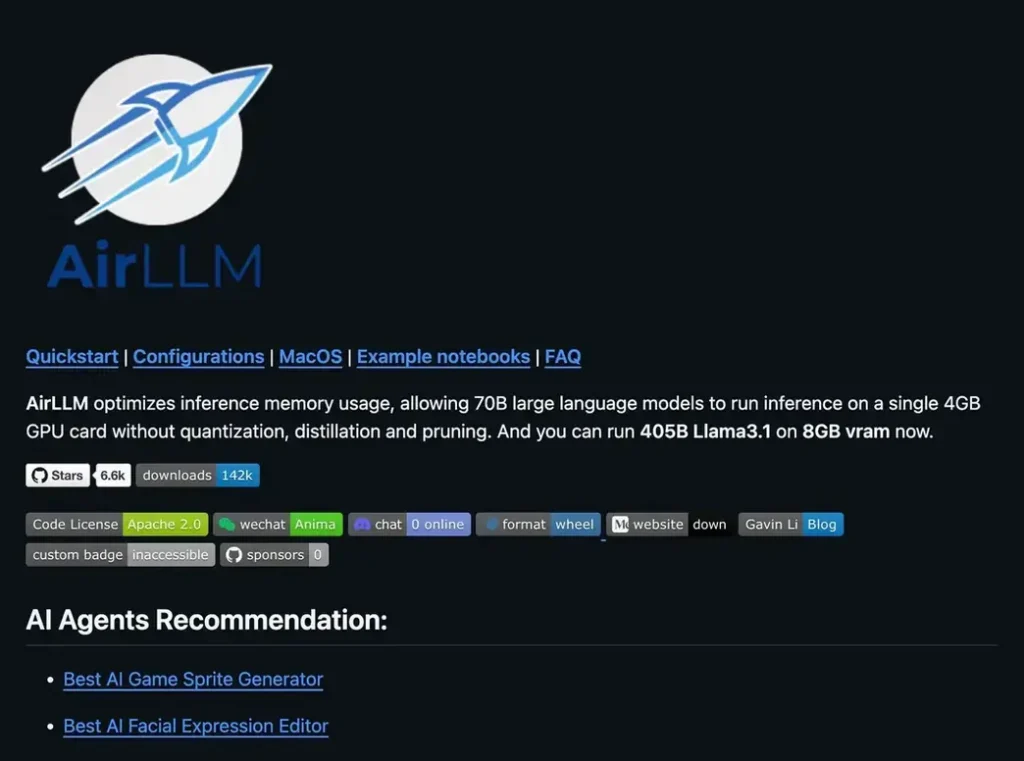
A new innovative open-source framework called “AirLLM” democratizes access to large language models by enabling them to run on low-memory GPUs, even those with as little as 4GB of VRAM. This guide explores how this layer-streaming technology bypasses traditional hardware limitations, reduces costs, and prioritizes privacy for individual developers and researchers.
For too long, the incredible power of state-of-the-art large language models like LLaMA 2/3 (70B+ parameters) or Mixtral has been locked behind a formidable barrier: the need for expensive, enterprise-grade GPUs with colossal amounts of VRAM.
This hardware requirement has traditionally placed cutting-edge AI out of reach for independent developers, students, and early-stage startups, creating a significant impediment to innovation and experimentation.
Imagine the frustration of having a brilliant AI idea but lacking the thousands of dollars required for an A100 or H100 GPU, or the recurring cloud costs that quickly add up. This is where a groundbreaking solution emerges, leveling the playing field and opening up the world of massive LLMs to virtually anyone with a consumer-grade graphics card.
What is AirLLM and Why it Matters
AirLLM is an open-source Python inference engine designed to execute extremely large language models on hardware with constrained memory. Unlike conventional LLM runtimes that demand the entire model reside in GPU memory simultaneously, AirLLM employs a clever layer-by-layer streaming methodology.
This means instead of loading the whole model, it loads only a single layer into the GPU at a time, performs its computation, frees that memory, and then loads the next layer. This innovative approach drastically reduces peak memory usage.
In essence, AirLLM makes a strategic trade-off: it sacrifices a degree of raw speed for unparalleled accessibility, allowing truly massive models to run on ordinary consumer GPUs.
Why is this a monumental shift?
- Democratizes Large AI Models: Previously, only those with access to high-end hardware could experiment with 70B+ parameter models. AirLLM empowers solo developers, indie hackers, students, and early-stage startups to locally leverage cutting-edge AI, fostering broader participation and innovation.
- Reduces Cloud Costs: Instead of incurring significant monthly expenses for cloud GPU instances, developers can now prototype and run powerful models locally. This dramatically lowers the cost of experimentation and iteration, making AI development more sustainable.
- Privacy-First AI: With models running entirely on your local machine, sensitive data never leaves your environment. This is crucial for applications requiring stringent privacy, compliance with regulations, or simply for users who prefer to maintain full control over their information.
How AirLLM Works Under the Hood
To appreciate AirLLM’s ingenuity, let’s first consider the traditional approach to running LLMs:
Traditional LLM Inference:
Typically, an LLM runtime will load all model layers—which can amount to tens or hundreds of gigabytes of data—directly into the GPU’s video memory (VRAM). It then performs the inference computations. This method requires VRAM equal to or greater than the full model size, which is why it swiftly fails on low-memory GPUs.
AirLLM’s Approach:
AirLLM adopts a sophisticated layer-streaming architecture. Here’s how it operates:
- Storage on Disk: The entire model’s weights are initially stored on disk, either on your CPU RAM or an SSD.
- Layer Loading: Only one layer of the model is loaded into GPU memory at a time.
- Forward Pass: That specific layer performs its forward pass computation.
- Memory Release: Once its computation is complete, the layer is unloaded, freeing up the GPU memory it occupied.
- Next Layer: The next layer is then loaded, and the process repeats until the entire model inference is complete.
This dynamic loading and unloading ensures that GPU memory usage remains exceptionally low throughout the process.
The key trade-off for this ultra-low VRAM usage is slower inference. The constant movement of data between disk/CPU and the GPU introduces overhead, making the process less rapid than if the entire model were GPU-resident. However, for many use cases, this accessibility gain far outweighs the speed reduction.
Key Features of AirLLM
AirLLM isn’t just a memory-saving trick; it comes packed with features designed for flexibility and ease of use:
- Ultra-Low GPU Memory Usage: Its flagship feature, allowing you to run formidable 70B parameter models on GPUs with just 4GB of VRAM, and even 100B+ models on common consumer hardware.
- No Mandatory Quantization: Unlike many other optimization techniques, AirLLM does not require aggressive quantization by default. This means it can preserve the model’s original quality, which is crucial for applications where precision is paramount.
- Optional Quantization Support: For scenarios where speed is a priority, AirLLM provides support for 4-bit and 8-bit quantization, allowing users to balance quality and performance as needed.
- Hugging Face Compatibility: Seamlessly integrates with the vast ecosystem of Hugging Face Transformers, making it compatible with a wide array of popular open-source LLMs.
- Open-Source & Extensible: Being fully open-source, AirLLM can be easily customized, extended, and adapted for specific research or production experiments.
AirLLM vs. Other LLM Optimization Techniques
It’s helpful to understand how AirLLM distinguishes itself from other common methods used to optimize LLMs:
| Feature | AirLLM | Quantization |
|---|---|---|
| Memory Reduction | Very High | High |
| Accuracy Loss | None (default) | Possible |
| Speed | Slower | Faster |
| Hardware Needs | Very Low | Medium |
- AirLLM vs. Model Sharding: Model sharding typically involves distributing parts of a large model across multiple GPUs or even different nodes in a cluster. AirLLM, conversely, is designed to work efficiently on a single GPU, making it ideal for individual users and single-machine setups.
- AirLLM vs. LoRA / Fine-Tuning: Low-Rank Adaptation (LoRA) and other fine-tuning techniques focus primarily on improving training efficiency or adapting models to specific tasks with less data. AirLLM’s core innovation lies in optimizing inference memory efficiency, allowing the execution of already-trained large models on limited hardware.
Real-World Use Cases
The accessibility provided by AirLLM unlocks a myriad of practical applications:
- Local AI Assistants: Deploy powerful chatbots and intelligent agents directly on your device, enabling private, high-performance interactions without reliance on cloud APIs.
- AI Research & Education: Students and researchers can freely experiment with and analyze the behavior of massive models, conducting cutting-edge work without the prohibitive cost of enterprise-grade hardware.
- Prototyping AI Products: Innovators can validate new AI product ideas and features locally, iterating rapidly before committing significant investment to expensive cloud infrastructure.
- Edge & On-Prem AI: Ideal for scenarios requiring on-premise deployments, such as secure government environments, industrial settings, or locations with limited internet connectivity, where cloud access is restricted or undesirable.
Performance Expectations
While AirLLM is a game-changer for accessibility, it’s crucial to set realistic performance expectations:
- What to Expect: Inference will generally be slower than models fully resident in GPU memory. AirLLM is best suited for batch processing, research and development, and low-Query Per Second (QPS) workloads where immediate, ultra-low latency responses are not the primary requirement.
- What Not to Expect: AirLLM is not designed for real-time, high-throughput production inference systems or ultra-low latency applications where every millisecond counts. For those demanding scenarios, investing in higher-end GPUs or cloud solutions remains necessary.
Who Should Use AirLLM?
AirLLM is an invaluable tool for:
- Developers with Limited Hardware: Anyone eager to work with large LLMs but equipped with only consumer-grade GPUs.
- AI Researchers & Students: Those in academia needing to explore powerful models without institutional enterprise hardware.
- Indie Founders & Startups: Innovators looking to prototype and develop AI solutions cost-effectively.
- Privacy-Focused Applications: Projects where data sovereignty and local processing are non-negotiable.
It may not be the ideal solution for:
- High-traffic production APIs.
- Real-time inference systems demanding instantaneous responses.
Final Thoughts
AirLLM stands as a compelling testament to the power of software innovation in overcoming hardware constraints. By intelligently rethinking how large language models are loaded and executed, it dramatically lowers the barrier to entry for working with cutting-edge AI.
If you’re passionate about exploring the capabilities of massive LLMs but are hesitant to invest heavily in specialized GPUs, AirLLM presents an incredibly compelling, accessible, and privacy-conscious alternative. It empowers a broader community to engage with and advance the field of artificial intelligence, proving that sometimes, ingenuity is more powerful than raw hardware.
Key Takeaways
- AirLLM is an open-source Python engine that enables large language models (70B+ parameters) to run on low-memory GPUs (as little as 4GB VRAM) using a layer-streaming architecture.
- It democratizes access to powerful AI by significantly reducing hardware costs and allowing local execution, thus enhancing privacy.
- AirLLM works by loading only one model layer into GPU memory at a time, performing computation, then unloading it before loading the next, drastically lowering peak memory usage.
- While it offers unparalleled accessibility and does not require mandatory quantization (preserving model quality), its key trade-off is slower inference speed compared to models fully resident in GPU memory.
- Ideal for individual developers, researchers, students, and privacy-focused applications, but not suited for high-throughput, real-time production systems.
Join our community by subscribing to our Weekly Newsletter to stay updated on the latest AI updates and technologies, including the tips and how-to guides. (Also, follow us on Instagram (@inner_detail) for more updates in your feed).
(For more such interesting informational, technology and innovation stuffs, keep reading The Inner Detail).