
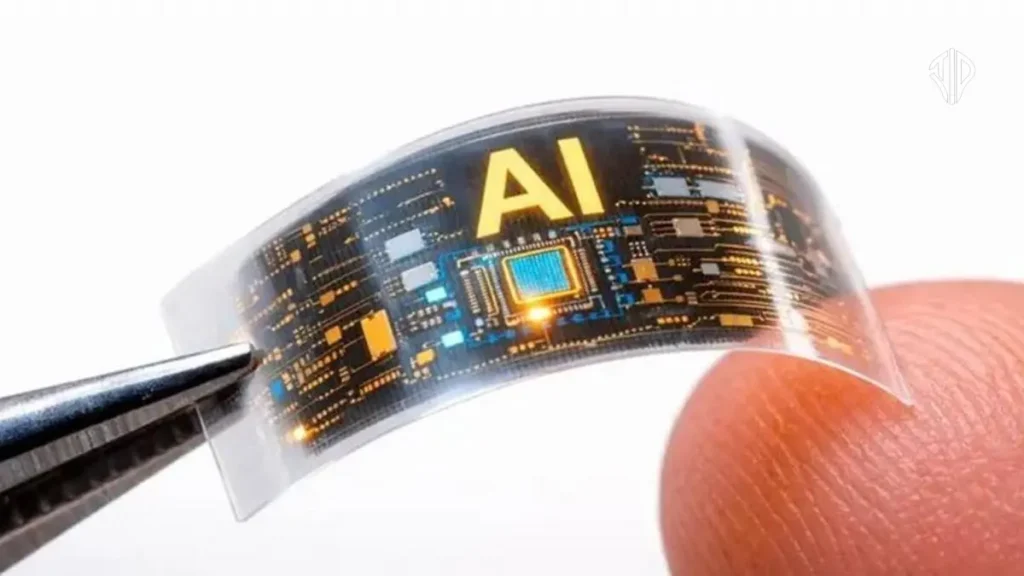
A groundbreaking innovation from Chinese researchers introduces an ultra-thin, flexible AI chip family, poised to revolutionize smart wearables by addressing current limitations in performance and form factor.
This advanced chip processes data directly on the device, offering unparalleled accuracy, energy efficiency, and cost-effectiveness for next-generation personal tech.
Imagine a future where your fitness tracker isn’t just a gadget on your wrist, but an imperceptible part of your clothing, offering real-time health insights without ever needing a recharge for days. This future is now significantly closer, thanks to a remarkable breakthrough that redefines what a computer chip can be.
Current Smart Wearables
Today’s smart wearables, from smartwatches to health patches, rely on traditional semiconductor chips. These components are inherently stiff, demanding significant power to operate, and are susceptible to damage from repeated flexing or impact.
These characteristics pose substantial challenges: they dictate the bulky designs of many wearables, necessitate frequent charging, and limit the integration of technology into truly flexible or stretchable materials.
Consequently, while innovative, many smart devices still feel like distinct electronic units rather than truly integrated parts of our daily lives.
FLEXI: A Breakthrough in Wearable AI
Addressing these critical limitations, researchers from Tsinghua University and Peking University in China have unveiled FLEXI, a revolutionary family of flexible AI chips.
These chips are not just ultra-thin—they are described as being thinner than your hair, yet remarkably robust, capable of enduring thousands of folds without compromising integrity.
FLEXI integrates artificial intelligence directly into its architecture, marking a significant leap forward in designing more capable and comfortable smart wearables.
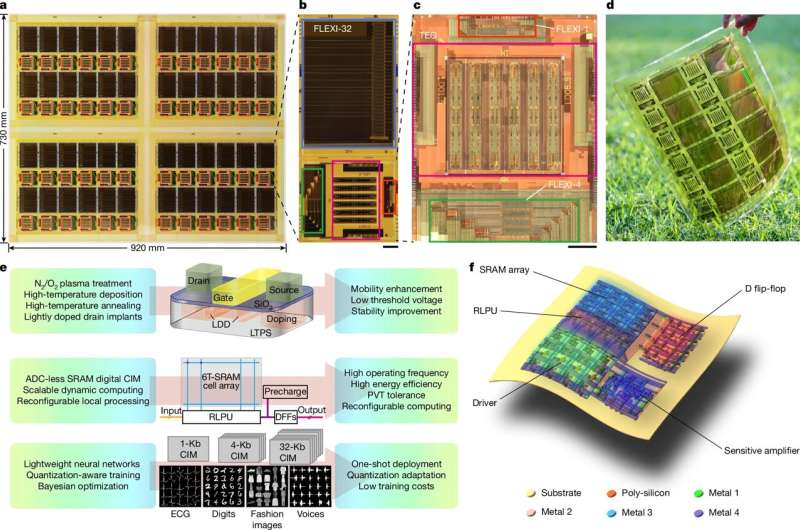
AI Directly on the Chip: A Paradigm Shift
What sets FLEXI apart is its innovative approach to AI processing. Unlike most current wearables that often offload complex data analysis to external devices or the cloud, FLEXI processes information directly on the chip itself. This is achieved through a design where AI is wired into the chip’s circuitry, allowing memory components to perform calculations on the stored data.
This “in-memory computing” dramatically reduces the need for data to travel between different parts of the chip, which in turn saves significant time and power. The result is real-time processing of complex sensor data, such as identifying health issues, with unprecedented efficiency.
Real-World Performance That Impresses
The capabilities of FLEXI have been rigorously tested in real-world scenarios. Scientists collected data from volunteers, demonstrating the chip’s exceptional accuracy in health monitoring and activity tracking.
FLEXI achieved an impressive 99.2% accuracy in detecting irregular heartbeats and tracked daily movements, including cycling and walking, with 97.4% accuracy.
Beyond its precision, FLEXI excels in power efficiency and cost-effectiveness. During research, the chip consumed less than 1% of the energy of a standard chip, making it incredibly economical to operate.
Furthermore, mass production costs are projected to be less than a dollar per chip, presenting a highly viable and robust solution for manufacturers. Its ability to withstand mechanical stress and ensure long-term operational stability further underscores its potential to unlock the true power of smart devices.
Unlocking the Full Potential of Smart Wearables
The advent of FLEXI chips signifies a pivotal moment for smart wearable technology. By offering an ultra-thin, highly flexible, energy-efficient, and cost-effective AI solution, Chinese researchers are paving the way for devices that are more integrated, more intuitive, and ultimately, more helpful.
From advanced health monitoring embedded seamlessly into clothing to entirely new categories of flexible electronics, FLEXI promises to transform how we interact with technology, making it an almost invisible extension of ourselves.
Key Takeaways
- Chinese researchers have developed FLEXI, an ultra-thin, flexible AI chip family poised to revolutionize smart wearables.
- FLEXI integrates AI directly on the chip, utilizing “in-memory computing” for real-time, highly efficient, and low-power data processing.
- The chips demonstrated exceptional accuracy (99.2% for irregular heartbeats, 97.4% for activity tracking), consumed less than 1% of standard chip energy, and are projected to cost under a dollar per chip.
- This innovation addresses the limitations of current rigid and power-hungry hardware, enabling truly integrated, comfortable, and intelligent next-generation wearable devices.
Join our community by subscribing to our Weekly Newsletter to stay updated on the latest AI updates and technologies, including the tips and how-to guides. (Also, follow us on Instagram (@inner_detail) for more updates in your feed).
(For more such interesting informational, technology and innovation stuffs, keep reading The Inner Detail).