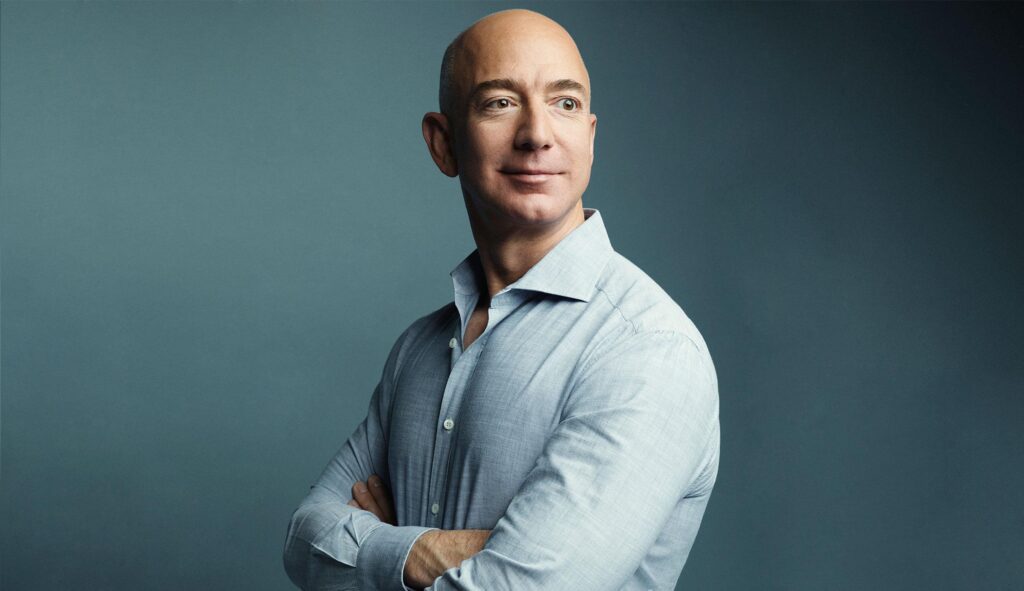
Jeff Bezos, the founder of Amazon and Blue Origin, recently offered a profound look into his philosophy on business, innovation, and the thrilling technological golden ages we inhabit. Far from being “retired,” Bezos asserts that he is the “least retired person in the world” because work is too much fun, a view supported by his wife, Lauren, who knows it makes him happy.
Bezos shared essential insights for entrepreneurs, predictions for the next two decades, and a firm belief that true success is built not on fleeting trends, but on the stubborn adherence to fundamental customer desires.
The Long Game: Strategy and the Customer
In a world rapidly changing due to technologies like AI, Bezos stresses that thinking long-term is crucial. This discipline forces companies to identify points of stability—things that will not change—to build a durable strategy.
He highlighted that customer needs change very slowly. For instance, customers will always want faster deliveries and lower prices from Amazon, just as Blue Origin customers will always desire more reliable rockets. These big, customer-based ideas, rooted in unchanging human nature, should be the center of a company’s strategy.
This focus leads to his core advice for entrepreneurs: “be stubborn on the vision and flexible on the details”. He noted that people who are right often change their minds frequently, while those who are wrong are often stubborn on the details. Ultimately, a founder’s job is to focus on reality, which he notes is “undefeated” and “wins every time”.
When it comes to the balance between personal life and professional ambition, Bezos prefers “work life harmony” over “work life balance”. He argues they are not a strict tradeoff; if you are happy at home, you will be better at work, and vice versa.
The Art of Invention: Managing Ideas and Trusting Intuition
Bezos considers himself fundamentally an inventor, and his favorite work involves small groups, a big whiteboard, and inventing. However, he learned a critical lesson early in Amazon’s history: the need to manage the rate of new ideas.
A former executive, Jeff Wilkey, once warned Bezos that he had enough ideas per minute/day/week to “destroy Amazon”. The insight was profound: releasing ideas too quickly created a backlog, work-in-process, and distraction without adding value. Bezos learned he had to “release the work at the right rate that the organization can accept it”. This led him to prioritize better, keep lists of ideas, and build a senior team with the leadership bandwidth to accept a greater volume of ideas per unit time, resulting in a company skilled at inventing and doing more than one thing at a time.
He also emphasized the importance of “wandering,” which may seem inefficient but is a form of humility. Often, in life or business, you can see the mountaintop but not the trail, necessitating exploration. While inventing requires time for dreaming and learning (a dose of inefficiency), building requires efficiency and iteration.
Regarding decision-making, while data is essential (competitors will beat you if you ignore it), only looking at data means you will not “win big”. The biggest breakthroughs rely on intuition, gut, and heart, as customers often do not know what to ask for until it is invented.
The Nature of Bubbles and the AI Revolution
Recalling the dot-com bubble burst in 2000, when Amazon’s stock plummeted from $113 to $6, Bezos noted that the stock price can be completely disconnected from the fundamentals of the business. During that dramatic stock drop, Amazon’s core metrics—number of customers, gross profits, and repeat purchases—all improved every single month.
Drawing on Benjamin Graham’s wisdom, Bezos stated that the stock market is a voting machine in the short term, but a weighing machine in the long term. The founder’s job is simply to “build a heavy company”.
Bezos is optimistic about the current excitement surrounding AI, classifying it as an “industrial bubble”. Unlike financial bubbles (like the 2008 crisis), industrial bubbles, such as the biotech bubble of the 90s, leave lasting societal benefits even if many investors lose money.
- The Internet Analogy: The fiber optic cable laid during the internet bubble remained and was used, even after the companies that laid it went bankrupt. Society benefited greatly from this infrastructure.
- AI as an Enabler: AI is a “horizontal enabling layer” that will affect “every company in the world,” increasing productivity and quality in industries from manufacturing and hotels to consumer products.
Bezos views this era as one of multiple simultaneous golden ages, including space travel, AI, and robotics. This rapid rate of change provides fantastic opportunities for entrepreneurs.
Blue Origin: Space Abundance and Lunar Ambition
Bezos affirmed his intense focus on Blue Origin. Current milestones include the imminent launch of the New Glenn vehicle carrying NASA’s Escapade satellite to orbit Mars (late October/early November) and the building of a lunar lander.
Blue Origin is tackling ambitious challenges to enable deep space travel:
- Hydrogen Propellant: They are developing solar-powered cryocoolers (kept at a frigid 20 Kelvin) to solve the historical problem of liquid hydrogen (the highest performing rocket fuel) boiling away. This will make it a storeable propellant in space.
- Lunar Harvesting: Research is underway to build solar cells directly from lunar regolith (Moon soil), which is necessary to make staying on the Moon cost-effective.
- The Moon’s Gift: The Moon is crucial because it is close (3.5 days away) and has a low gravitational field, requiring 30 times less energy to lift mass than off Earth. This allows it to be used as a rocket fuel depot for exploration of the rest of the solar system.
Looking ahead, Bezos made striking predictions:
- Space Data Centers: Within 10 to 20 years, giant gigawatt training clusters and data centers will be built in space, where 24/7 solar power and the absence of weather will allow them to beat the cost of terrestrial data centers. This continues the pattern of space technology (like communication and weather satellites) making Earth better.
- Millions in Space: Bezos believes that in the next couple of decades, millions of people will be living in space. Interestingly, these people will live there mostly because they choose to, not out of necessity, as robots will be more cost-effective for performing necessary work.
The Future of Meaning
Addressing anxieties about the rise of super-intelligences, Bezos maintained a confident outlook. Though computers can already beat humans at complex tasks like chess, he affirmed his belief that “we will still have meaning in our lives”.
For those interested in exploring these futuristic themes, Bezos, a lifelong reader of science fiction classics, highly recommends The Culture Series. He singled it out for its “interesting utopian take on the intersection of humanity and artificial intelligence”.
Key Takeaways
- Focus on long-term strategies built around stable, unchanging customer needs.
- Be stubborn on the vision but flexible on the details.
- Manage the rate of new ideas to avoid overwhelming the organization.
- Embrace “wandering” and intuition alongside data in decision-making.
- View the AI revolution as an industrial bubble with lasting societal benefits.
Join our community by subscribing to our Weekly Newsletter to stay updated on the latest AI updates and technologies, including the tips and how-to guides. (Also, follow us on Instagram (@inner_detail) for more updates in your feed).
(For more such interesting informational, technology and innovation stuffs, keep reading The Inner Detail).