
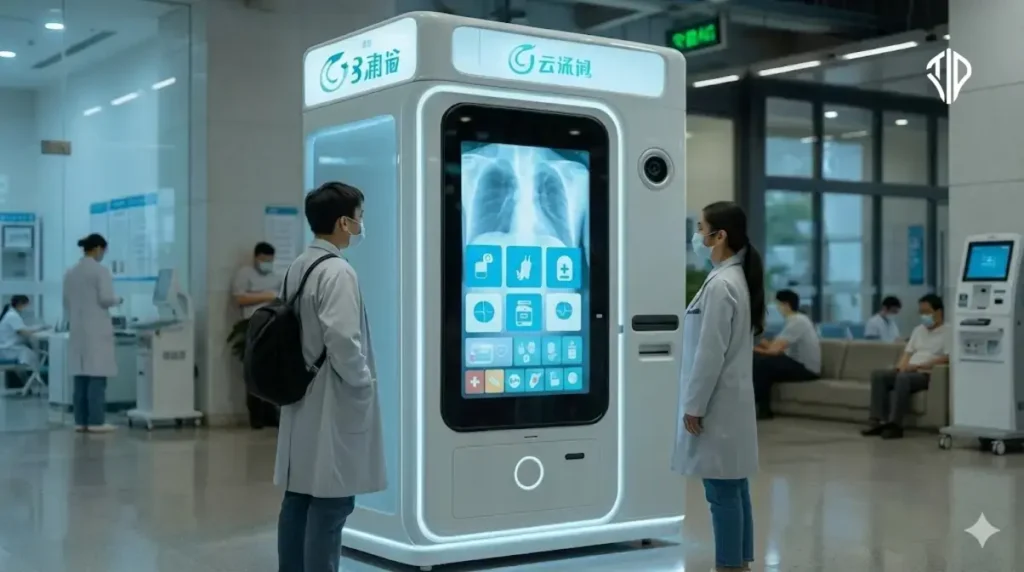
China rolls out another revolutionary feat in medical domain, where people can get their complete body checkup in less than 10 minutes from an ATM-like machine called “Health Kiosks”. These digital medical kiosks can assess your basic vitals, connect you to a doctor via video, and even print a prescription, all for the price of a cup of coffee.
This isn’t a scene from a sci-fi movie; it’s the reality unfolding across China, where AI-powered ‘Health Kiosks’ are rapidly transforming everyday healthcare.
The Dawn of Accessible Health: China’s Digital Leap
China has emerged as a global leader in digital healthcare, a market valued in the tens of billions of RMB. With substantial government investment, particularly in expanding telemedicine to rural areas, the nation is committed to a simple yet powerful idea: if patients cannot easily reach hospitals, then healthcare must come to them.
This philosophy is visibly manifesting in hundreds of metro stations in cities like Shanghai, where over 250 kiosks serve thousands of users monthly, offering swift access to medical support.
These innovative kiosks are not designed to replace traditional medical facilities but to complement them. By handling common ailments—a persistent cold, a minor skin rash, or a quick blood pressure check—they alleviate the burden on hospitals, allowing them to focus on more serious cases.
Industry giants like Ping An Good Doctor have spearheaded this movement, deploying over 1,200 kiosks across 28 provinces, facilitating millions of consultations annually. The result? A remarkable 70% reduction in waiting times compared to conventional clinics and an impressive 87% patient satisfaction rate, thanks to AI-powered symptom analysis and a vast network of remote doctors.
A Hybrid Model: The Best of Both Worlds
One of the most compelling aspects of China’s smart health system is its ingenious blend of artificial intelligence and human expertise. The kiosks leverage AI for preliminary assessments, conducting initial symptom analysis and vital sign measurements. However, every prescription, every diagnosis, is subject to the stringent approval of a licensed remote doctor before being issued.
This ensures a critical human oversight, marrying the speed and efficiency of AI with the indispensable judgment and empathy of medical professionals.
Currently, these kiosks can dispense a selection of 38 approved over-the-counter medications for common conditions, from everyday allergies to minor irritations. It’s a prime example of technology amplifying human capabilities, rather than superseding them.
As a leading figure at China Ping An Doctor aptly put it, “AI doesn’t replace doctors, but doctors who use AI may replace those who don’t.” This ethos underscores a collaborative future where AI empowers medical practitioners to deliver more efficient and widespread care.
Precision, Trust, and Stringent Standards
In healthcare, trust and accuracy are non-negotiable. China’s digital health kiosk ecosystem is built upon a foundation of rigorous standards and comprehensive oversight. Companies operating these kiosks must secure multiple operating licenses, a testament to the complexity and seriousness of their function.
Furthermore, every AI algorithm undergoes mandatory certification tests to validate its reliability and safety. To maintain optimal performance and public confidence, each kiosk is subjected to a thorough technical inspection every three months. This meticulous approach ensures that innovation doesn’t come at the expense of responsibility or patient safety.
The Architects of Change: Industry Giants
The rapid deployment and success of these health kiosks owe much to the involvement of major technology players.
- Ping An Good Doctor: A trailblazer with 1,200 kiosks facilitating 3.5 million annual consultations and achieving an 87% patient satisfaction rate.
- Alibaba Health: Operating 500 hybrid clinics that combine AI with human doctor consultations, supporting 2.4 million AI-assisted diagnoses in 2023. Their system boasts a 94% accuracy for common conditions and has contributed to a 30% reduction in healthcare costs.
These statistics vividly illustrate how, when seamlessly integrated with expert medical supervision, artificial intelligence can dramatically expand healthcare access while simultaneously maintaining—and even enhancing—quality and affordability.
A Glimpse into Tomorrow’s Healthcare
The future of China’s digital health revolution is poised for explosive growth. Projections indicate that the number of health kiosks could reach 15,000 nationwide by the end of this year, with an astonishing 40% of China’s population expected to utilize telemedicine services by 2027. By 2030, the digital health market is forecast to swell to 45 billion RMB, signaling not merely growth, but a profound transformation of the entire healthcare landscape.
Consider the impact: if each of these thousands of kiosks serves just ten people daily, that translates to 150,000 health interactions every single day—equivalent to providing care for a small city through technology alone. This expansion holds particular significance for bridging the urban-rural health gap.
While 80% of kiosks are currently in cities, the growing 20% in rural regions represent a lifeline for communities often hours away from the nearest hospital. For an elderly individual in a remote village, the ability to quickly check blood pressure or consult a doctor online can be a proactive measure that prevents minor issues from escalating into major emergencies.
Technology with a Human Heart: A Model for the World
China’s unique approach to digital health marries the speed and efficiency of machines with the irreplaceable empathy of human doctors. It focuses on resolving everyday health concerns that collectively make a colossal difference to public well-being. Each quick interaction within these kiosks reflects a vision of medicine that is accessible, affordable, and safe.
This model offers a powerful insight for the rest of the world, demonstrating that the future of healthcare isn’t about replacing doctors with robots, but about vastly extending their reach and capabilities. When technology is thoughtfully designed, regulated with precision, and imbued with a commitment to human well-being, it can render healthcare more human, not less.
As global medical costs and waiting times continue their upward trend, China’s innovative approach provides a compelling blueprint for what is achievable when ingenuity meets pressing public need.
The next time you find yourself navigating a bustling public space, imagine the profound impact of being able to address your health concerns in minutes – and perhaps, in the process, contribute to a healthier society for all.
Key Takeaways
- China is rapidly deploying AI-powered health kiosks in public spaces, significantly improving access to basic healthcare, especially in rural areas.
- These kiosks utilize a hybrid model, combining AI for preliminary assessments with mandatory human doctor oversight for diagnoses and prescriptions.
- The system has resulted in a 70% reduction in waiting times and an 87% patient satisfaction rate, thanks to efficiency and a vast network of remote doctors.
- Rigorous certification, multiple operating licenses, and quarterly technical inspections ensure the reliability, safety, and public trust in these digital health services.
- Major tech companies like Ping An Good Doctor and Alibaba Health are driving this transformation, demonstrating how AI, integrated with expert supervision, can expand healthcare access, quality, and affordability globally.
Join our community by subscribing to our Weekly Newsletter to stay updated on the latest AI updates and technologies, including the tips and how-to guides. (Also, follow us on Instagram (@tid_technology) for more updates in your feed).
(For more such interesting informational, technology and innovation stuffs, keep reading The Inner Detail).
