
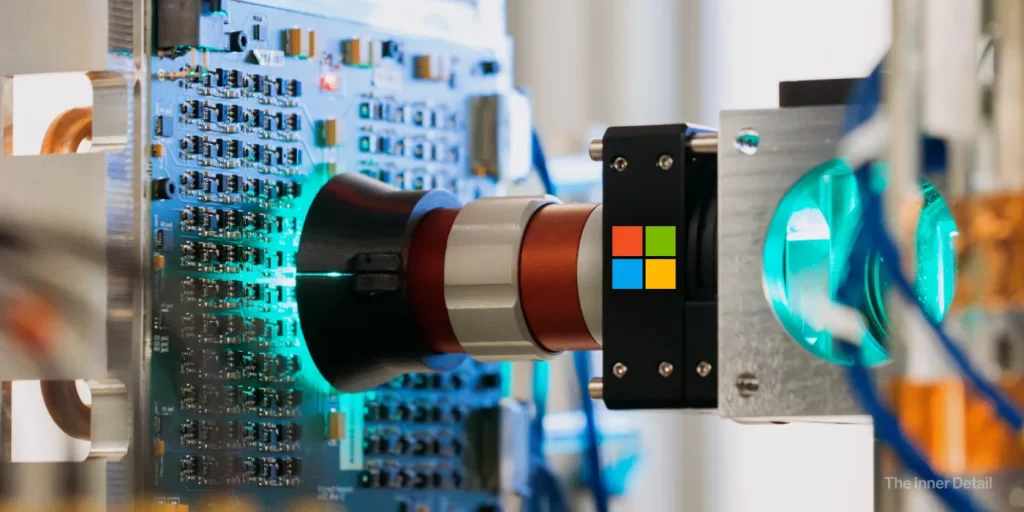
Microsoft’s Research team is working on a World’s First Analog Optical Computer (AOC) which is capable of solving complex computations including running AI models 100 times faster and with only a fraction of energy.
AI has been the frontier of technology for the past few years, being immensely helpful in saving time, increasing efficiency and automating processes. However, do you know about the energy that’s being consumed to run loads of AI Data centers? According to reports, it consumes 82 terawatts of energy per year, which is equivalent to Switzerland’s annual energy consumption. That’s why, companies are looking for alternative ways to either power the data-centers (like Google planning to switch to Nuclear) or the method of operating AI.
A small, dedicated team of Microsoft has spent four years developing an Analog Optical Computer (AOC) that promises to revolutionize how we tackle everything from financial logistics to the power-hungry demands of artificial intelligence.
At its core, Microsoft’s AOC is designed to be a game-changer, aiming for a staggering 100 times faster performance and 100 times greater energy efficiency for specific, challenging problems. What makes this even more compelling is that it’s built using readily available, commercial parts – think micro-LED lights, optical lenses, and sensors found in your smartphone cameras. This choice makes the technology affordable and paves the way for easier manufacturing through existing supply chains.
The Analog Optical Advantage
To truly grasp the significance of the AOC, it’s crucial to understand how it differs from the digital computers we use every day. A traditional computer operates on binary code, representing information as discrete bits of 0s and 1s. Every calculation, no matter how complex, is broken down into these fundamental digital operations.
An Analog Optical Computer, however, takes a different approach. Instead of converting information into binary code, it uses physical systems – in this case, light – to embody computations directly. Photons, the particles of light, do not interact with each other, but when they pass through components like digital sensors, their varying intensities can be harnessed to perform calculations such as addition and multiplication. This analog nature allows the AOC to sidestep some of the inherent limitations of digital computing, especially when dealing with certain types of problems.

Potential of an Optical Computer
The AOC truly shines in solving what are known as “optimization problems.” These are challenges that require finding the absolute best solution from an almost incomprehensible number of possibilities. A classic example is the “traveling salesman problem”: finding the most efficient route among many cities. While trivial for a few cities, the complexity explodes exponentially with more locations.
Microsoft’s researchers demonstrated the AOC’s prowess in two critical real-world scenarios:
- Financial Transactions: In collaboration with Barclays Bank PLC, the AOC successfully tackled a complex delivery-versus-payment (DvP) securities problem. This involves efficiently settling financial obligations between multiple parties while adhering to regulations, minimizing costs, and working within strict time and balance constraints. The digital twin of the AOC demonstrated its ability to resolve problems with up to 1,800 hypothetical parties and 28,000 transactions – a massive step towards practical application in large clearinghouses.
- Medical Imaging: Another promising application is in magnetic resonance imaging (MRI) scans. The AOC was used to reconstruct MRI scans with a high degree of accuracy. Crucially, this research indicates that the device could theoretically slash MRI scan times from 30 minutes to just five. Imagine the impact this could have on patient experience and the capacity of medical facilities.
A Future Powering AI: Faster, Greener LLMs
Perhaps one of the most exciting prospects for the AOC lies in its potential to supercharge artificial intelligence workloads, particularly for large language models (LLMs) that currently consume vast amounts of energy. While initially, the team didn’t see a clear path, a serendipitous conversation with AI and machine learning expert Jannes Gladrow revealed the AOC’s unique capabilities for AI.
The research suggests that a future version of the AOC could execute complex reasoning tasks, like “state tracking” (similar to a chess player needing to understand the rules, current board state, and anticipate future moves), with a fraction of the energy required by current GPUs. Gladrow estimates an astonishing hundred-fold improvement in energy efficiency for these tasks – a monumental leap in hardware performance that could redefine sustainable AI.
AOC’s Digital Twin
A key enabler in this research is the development of a “digital twin.” This is a sophisticated computer-based model that precisely mimics the behavior of the real AOC hardware in a digital environment. It simulates the same inputs, processes, and outputs, allowing researchers to:
- Solve optimization problems at scales that are useful for real-world situations, beyond the current prototype’s physical limitations.
- Experiment with how different problems, both in optimization and AI, would map and run on the AOC hardware without needing the physical machine.
- Share the technology more broadly, with Microsoft publicly sharing its optimization solver algorithm and the digital twin itself, inviting researchers globally to explore this new computing paradigm.
Looking Ahead: A Sustainable Computing Vision
While the current AOC is a prototype with 256 “weights” (parameters, which define complexity), researchers envision future iterations with millions or even billions of weights, becoming smaller and more powerful. Francesca Parmigiani, who leads the team, emphasizes that while the AOC is not a general-purpose computer, its specialized capabilities could make it “extremely successful” across a wide range of applications.
This achievement, detailed in a paper published in the scientific journal Nature, marks a significant milestone for Microsoft and the broader computing industry. It offers a tangible vision of a future where specialized hardware, driven by the principles of light, works in harmony with traditional digital systems to solve humanity’s most pressing challenges – all while paving the way for a more sustainable and energy-efficient technological future.
Key Takeaways
- Microsoft Research has developed an Analog Optical Computer (AOC) that uses light to solve complex problems.
- The AOC aims for 100x faster performance and 100x greater energy efficiency for specific optimization and AI tasks.
- The AOC has shown promise in financial transactions (DvP securities) and medical imaging (MRI scan time reduction).
- A digital twin enables researchers to experiment and scale the AOC’s capabilities.
- Future iterations of the AOC could significantly improve the energy efficiency of large language models (LLMs).
Join our community by subscribing to our Weekly Newsletter to stay updated on the latest AI updates and technologies, including the tips and how-to guides. (Also, follow us on Instagram (@inner_detail) for more updates in your feed).
(For more such interesting informational, technology and innovation stuffs, keep reading The Inner Detail).
