

The technology job market in 2025 represents a landscape of unprecedented opportunity coupled with intense competition. This comprehensive analysis examines hiring trends in 2025 across major domains, in-demand skills, interview structures, and emerging growth areas specifically focused on the US and Indian markets.
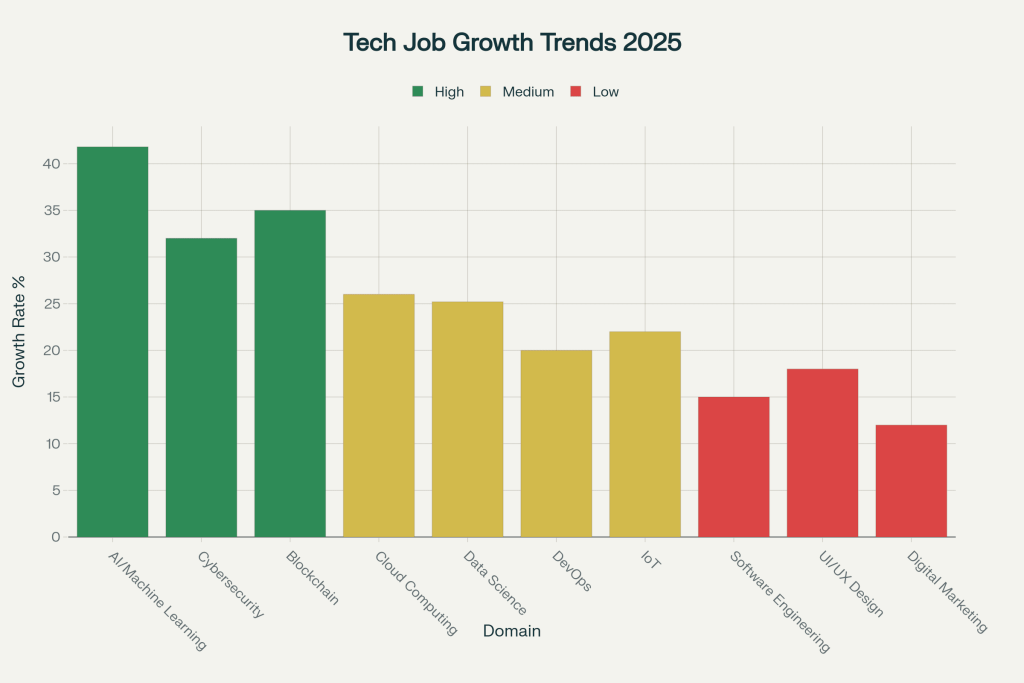
Our research indicates that while AI/Machine Learning roles command the highest premiums with 41.8% growth, traditional domains like software engineering continue to offer the largest volume of opportunities with over 650,000 projected openings.
Table of Contents
- Executive Summary and Key Market Insights
- Domain-Specific Salary Analysis
- Skills Framework and Market Demand Analysis
- Interview Structures and Success Strategies
- Remote Work and Geographic Trends
- Growing Skills and Emerging Technologies
- Industry-Specific Insights and Opportunities
- Dashboard of 2025 Hiring Trends Report
- Conclusion and Strategic Recommendations
Executive Summary & Key Market Insights
The 2025 tech hiring landscape reveals several critical trends that job seekers and students must understand to make informed career decisions. Artificial Intelligence and Machine Learning domains emerge as the highest-growth sector with 41.8% year-over-year expansion, while cybersecurity follows closely with 32% growth driven by increasing digital threats.
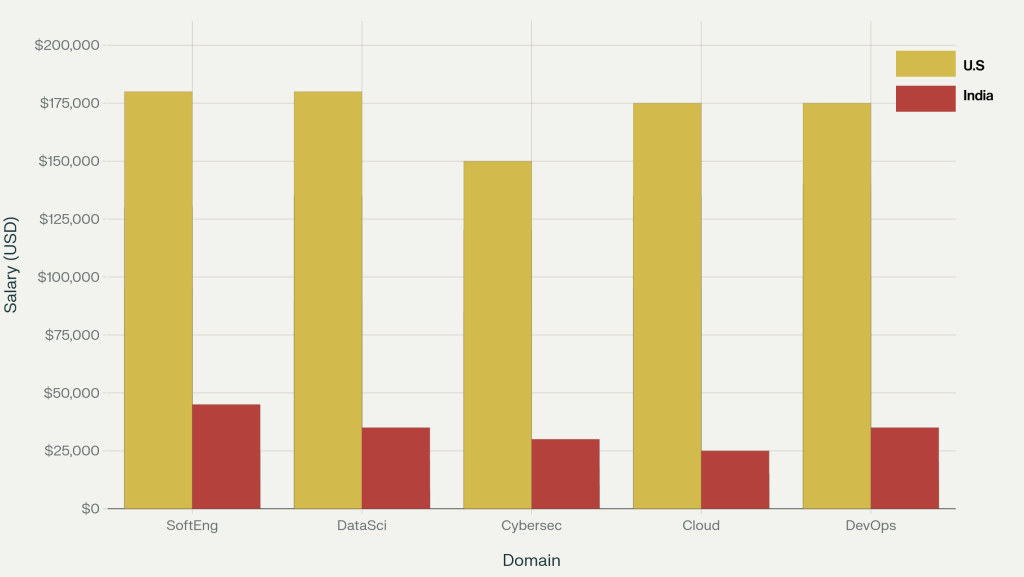
Salary disparities between countries remain significant, with US tech professionals earning 4-6 times more than their Indian counterparts across all domains. However, India’s tech market shows robust growth with 36% expansion in AI/ML roles and emerging opportunities in tier-2 cities like Coimbatore and Chennai.
Remote work has become standard rather than exceptional, with 75% of tech roles now offering remote options and additional salary premiums ranging from 5-15% for remote positions. The shift toward skills-based hiring has accelerated, with 82% of employers prioritizing practical skills over traditional degree requirements.
Domain-Specific Salary Analysis
Software Engineering: The Foundation Domain
Software engineering remains the backbone of the tech industry, offering consistent career growth and substantial earning potential. In the United States, entry-level software engineers command salaries starting at $95,000, progressing to $130,000 for mid-level positions and reaching $180,000 for senior roles. The Indian market presents more modest figures with entry-level positions at $12,000, mid-level at $25,000, and senior positions reaching $45,000.
The interview process for software engineering roles has intensified significantly. Candidates can expect 3 technical rounds, 2 behavioral interviews, and approximately 6 hours of total interview time with success rates averaging only 15%. The process typically includes algorithmic coding challenges, system design discussions, and increasingly complex implementation requirements with emphasis on error handling and clean code practices.
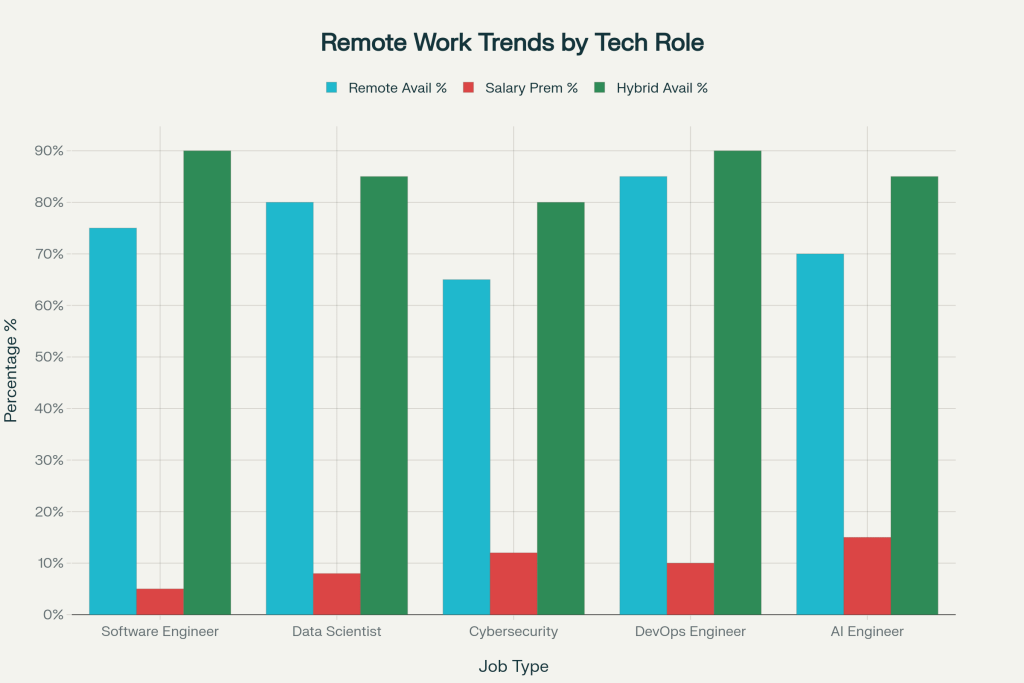
Remote work opportunities abound in software engineering, with 75% of positions offering remote options and 90% providing hybrid arrangements. The salary premium for remote positions averages 5%, making it an attractive option for professionals seeking location independence.
AI and Machine Learning: The Growth Leader
AI/Machine Learning represents the fastest-growing tech domain with 41.8% expansion in 2025, reflecting unprecedented demand for professionals capable of developing intelligent systems. US market salaries for AI/ML professionals start at $110,000 for entry-level positions, escalate to $156,000 for mid-level roles, and peak at $200,000 for senior specialists. Indian market compensation ranges from $15,000 to $40,000 across experience levels.
The skill requirements have become increasingly specialized, with 71% of job postings requiring Python expertise, 32.9% demanding AWS proficiency, and 26% requiring Azure knowledge. Natural Language Processing skills remain crucial despite the LLM revolution, appearing in 19.7% of job requirements. Deep learning expertise is mentioned in 28.1% of postings, making it essential for career advancement.
AI/ML interview processes are notably rigorous, involving 3 technical rounds, system design challenges, and 7 total interview hours with the lowest success rate at 12%[interview data]. Candidates must demonstrate proficiency in machine learning algorithms, model deployment, and ethical AI considerations.
Cybersecurity: The Critical Defense
Cybersecurity emerges as the second-fastest growing domain with 32% expansion, driven by escalating digital threats and regulatory requirements. US cybersecurity professionals earn between $85,000-$150,000, while Indian counterparts receive $10,000-$30,000. The salary premium for cybersecurity skills averages 30%, the highest among all technical domains.
Key skills in high demand include cloud security, Zero Trust architecture, and AI-driven security solutions. The integration of AI into security operations creates particular demand for SOC Analysts with automation skills. Risk management, incident response, and ethical hacking remain foundational competencies.
Interview structures emphasize practical security knowledge with 2 technical rounds, 2 behavioral sessions, and 5 total hours, achieving a 25% success rate[interview data]. Candidates face scenario-based questions, security architecture discussions, and hands-on penetration testing challenges.

Data Science: The Analytical Powerhouse
Data science maintains strong market position with 25.2% growth and median salaries reaching $156,998 in 2025. US data scientists earn $90,000-$180,000 across experience levels, while Indian professionals receive $8,000-$35,000. The field shows particular strength in versatile professionals who combine multiple domain expertise rather than narrow specialization.
Machine learning skills appear in 77% of AI-related job postings, making ML proficiency essential for data science advancement. SQL expertise remains fundamental, appearing in 17.1% of requirements alongside Python and statistical analysis capabilities. The market demonstrates high-value positioning with 32% of roles offering $160,000-$200,000 salaries.
Interview processes require 2 technical rounds, 1 behavioral session, totaling 4 hours with 20% success rates[interview data]. Candidates must demonstrate statistical thinking, data pipeline knowledge, and business insight generation capabilities.
Cloud Computing: The Infrastructure Enabler
Cloud computing shows robust 26% growth with 476,000 projected job openings, representing the largest absolute opportunity volume. US cloud professionals earn $95,000-$175,000, while Indian counterparts receive $8,000-$25,000. Cloud architects command the highest premiums at $25-40 lakhs annually in India.
AWS dominates skill requirements appearing in 32.9% of job postings, followed by Azure at 26%. Cloud security expertise becomes increasingly valuable as organizations expand their digital infrastructure. DevOps integration and automation capabilities are essential for career advancement.
Cloud computing interview processes involve 2 technical rounds, 1 behavioral session, spanning 4 total hours with 30% success rates[interview data], the highest among technical domains. The focus emphasizes practical cloud architecture knowledge and cost optimization strategies.
Skills Framework and Market Demand Analysis
Programming Languages: The Foundation Skills
Python maintains its dominant position with 95% demand score and 15% salary premium, driven by its versatility across web development, data science, and AI applications. JavaScript follows closely with 90% demand score, remaining essential for both frontend and backend development. Java sustains its enterprise stronghold with 85% demand score, particularly valued in large-scale business applications.
Emerging languages gain traction with Rust showing 35% salary premium despite lower overall demand, appealing to systems programmers seeking memory safety. Go demonstrates 28% salary premium, particularly valuable in cloud infrastructure and microservices development. TypeScript rises in popularity as organizations seek type-safe JavaScript alternatives.
Cloud and Infrastructure Skills
Cloud computing skills command 20% salary premiums with AWS leading market demand. Container technologies show strong growth with Docker skills offering 18% premiums and Kubernetes providing 22% premiums[skills data]. Infrastructure as Code capabilities become essential for modern DevOps practices.
Cloud security expertise particularly valuable as organizations expand digital footprints. Multi-cloud strategies drive demand for professionals skilled across AWS, Azure, and Google Cloud Platform. Edge computing and serverless architectures represent emerging specializations.
Data and Analytics Skills
SQL remains foundational despite commoditization, appearing in 50,000 job openings with 5% salary premium[skills data]. Data engineering skills show strong demand as organizations build data infrastructure to support AI initiatives. Machine learning operations (MLOps) expertise becomes critical for productionizing AI models.
Business intelligence and visualization skills maintain importance for translating data insights into actionable business strategies. Real-time analytics capabilities gain prominence as organizations seek immediate insights.
Interview Structures and Success Strategies
Technical Interview Evolution
Technical interviews have become significantly more demanding, with companies raising standards across all levels. LeetCode “hard” problems now commonplace at major technology companies, requiring comprehensive preparation beyond basic algorithmic knowledge. Implementation completeness expectations have intensified, with interviewers expecting error handling, input validation, and clean code within standard time constraints.
System design interviews gain prominence, particularly for senior roles where candidates must demonstrate scalability thinking and architectural expertise. The emphasis shifts from theoretical knowledge to practical application, with companies seeking candidates who can solve real-world challenges.
Domain-Specific Interview Patterns
Software engineering interviews average 6 hours across 3 technical rounds and 2 behavioral sessions, with 15% success rates reflecting intense competition[interview data]. Candidates face algorithmic challenges, system design problems, and coding implementation tests. Behavioral rounds increasingly focus on leadership potential and collaborative skills.
Data science interviews require 4 hours with emphasis on statistical thinking and business problem-solving capabilities[interview data]. Candidates must demonstrate end-to-end project experience from data collection through insight generation. Technical presentations become common to assess communication skills.
AI/ML interviews demand 7 hours with the most rigorous technical assessment[interview data]. Candidates face model design challenges, algorithm optimization problems, and ethical AI discussions. Live coding of machine learning implementations tests practical skills beyond theoretical knowledge.
Success Rate Analysis and Preparation Strategies
UI/UX design shows highest success rates at 40%, reflecting less saturated competition and clearer evaluation criteria[interview data]. Product management achieves 35% success rates due to business focus rather than pure technical assessment[interview data]. Traditional engineering domains show 15-25% success rates, indicating intense competition for available positions[interview data].
Preparation strategies must adapt to new realities. Candidates should focus on complete implementation rather than just algorithmic solutions. Mock interviews gain critical importance for calibrating performance expectations. Portfolio development becomes essential for demonstrating practical capabilities beyond interview performance.
Remote Work and Geographic Trends
Remote Work Adoption Patterns
Remote work transforms from exception to standard practice, with 75% of software engineering roles offering remote options and 90% providing hybrid arrangements. Data science leads remote work adoption with 80% of positions available remotely, followed by DevOps at 85%[remote data]. Cybersecurity shows more conservative adoption at 65% remote availability due to security considerations[remote data].
Salary premiums for remote work range from 5-15% across different domains. AI engineers command highest remote premiums at 15%, followed by cybersecurity at 12%[remote data]. The geographic arbitrage opportunity exists as companies adjust compensation based on location.
Geographic Market Dynamics
Silicon Valley maintains salary leadership despite 7.3% decline, reflecting market maturation and increased competition from other regions. Florida emerges as high-growth market with 12.1% year-over-year salary increases as companies establish operations outside traditional tech hubs. Baltimore/Washington D.C. area shows 5.8% growth, driven by government technology initiatives and cybersecurity demand.
India’s tier-2 cities gain prominence with Coimbatore showing 9% of AI/ML hiring, following Bangalore’s continued leadership. Chennai and Hyderabad demonstrate strong growth in technology hiring, offering alternatives to traditional hubs. Cost advantages in emerging markets create opportunities for both employers and remote workers.
Startup vs Enterprise Hiring Differences
Startup hiring emphasizes speed and cultural fit with streamlined processes averaging 2-3 weeks compared to enterprise timelines of 6-8 weeks. Startups show greater flexibility in experience requirements and willingness to train candidates with adjacent skills. Equity compensation becomes significant factor with 57.28% of startups believing ESOPs effectively retain talent.
Enterprise hiring maintains structured processes with multiple approval levels and comprehensive background checks. Large companies offer more specialized roles with clear career progression paths and established training programs. Benefit packages typically more comprehensive including health insurance, retirement planning, and professional development budgets.
Growing Skills and Emerging Technologies
Artificial Intelligence and Automation
Generative AI skills show explosive demand with organizations racing to implement AI-powered solutions across business functions. Prompt engineering emerges as new specialization with 135.8% growth in job postings. AI ethics becomes critical capability as organizations address responsible AI deployment.
AI-driven automation transforms existing roles rather than eliminating them entirely, with workers gaining 31% productivity increases when properly trained. Machine learning operations (MLOps) expertise becomes essential for scaling AI initiatives beyond experimental phases.
Extended Reality and Immersive Technologies
AR/VR technologies enter mainstream business applications beyond gaming and entertainment, creating demand for specialized developers. Healthcare and retail sectors lead adoption, requiring professionals who understand industry-specific implementation challenges. Immersive experience design combines technical skills with user experience expertise.
Quantum Computing and Advanced Technologies
Quantum computing transitions from research to practical applications in finance, cryptography, and optimization. Early specialization provides significant career advantages as the field matures over the next 3-5 years. Hybrid classical-quantum systems require understanding of both traditional computing and quantum principles.
Sustainable Technology and Green Computing
Green technology skills gain prominence as organizations address environmental sustainability requirements. Energy-efficient computing practices become standard considerations in system design. Carbon footprint optimization influences architectural decisions and technology choices.
Industry-Specific Insights and Opportunities
Financial Technology (Fintech)
Fintech maintains high compensation levels with average salaries of $123,495 in the US market. Blockchain and cryptocurrency expertise commands premiums despite market volatility. Regulatory compliance knowledge becomes increasingly valuable as governments establish cryptocurrency and digital asset frameworks.
Payment processing and digital banking skills remain foundational as traditional financial institutions undergo digital transformation. Risk management and fraud detection capabilities leverage AI and machine learning for real-time decision making.
Healthcare Technology
Healthcare technology shows steady growth driven by digital transformation initiatives and telehealth adoption. US healthcare tech salaries range from $75,000-$130,000, while Indian positions offer $8,000-$25,000. Regulatory compliance expertise particularly valuable given HIPAA and patient privacy requirements.
Electronic health records (EHR) systems require specialized knowledge combining healthcare workflows with technical implementation. Medical device integration and telehealth platforms represent high-growth specializations.
Marketing Technology (MarTech)
Marketing technology roles expand rapidly as organizations seek data-driven marketing approaches. Marketing automation specialists command growing demand for email campaigns, lead nurturing, and customer journey optimization. Customer data platform (CDP) expertise becomes essential for unified customer experiences.
AI-powered marketing tools require professionals who understand both marketing strategy and technical implementation. Attribution modeling and marketing analytics drive evidence-based marketing decision making.
Dashboard of 2025 Hiring Trends Report
This page provides you a complete overview of the Hiring Trends Report of 2025:
Conclusion and Strategic Recommendations
The 2025 technology job market presents both exceptional opportunities and significant challenges for job seekers and students. AI/Machine Learning domains offer the highest growth potential at 41.8%, while traditional software engineering provides the largest volume of opportunities with over 650,000 projected openings (growth data). Remote work has become standard practice rather than a perk, fundamentally changing how professionals approach career planning and geographic limitations.
Strategic career development requires focusing on high-growth, high-premium skills such as AI/ML, cloud computing, and cybersecurity while maintaining foundational programming competencies. The shift toward skills-based hiring creates opportunities for non-traditional candidates who can demonstrate practical capabilities through portfolios and project work.
Geographic arbitrage opportunities exist for remote workers, while emerging markets like India’s tier-2 cities offer growth prospects for both employers and employees. Continuous learning becomes non-negotiable as technology evolution accelerates and skill requirements shift rapidly.
Interview preparation must adapt to heightened expectations, with candidates needing comprehensive technical knowledge, practical implementation skills, and strong communication capabilities. Success in 2025’s competitive market requires strategic positioning, continuous skill development, and adaptability to emerging technologies and work arrangements.
The professionals who will thrive in 2025 are those who combine technical excellence with business acumen, embrace continuous learning, and position themselves at the intersection of high-growth domains like AI, cloud computing, and cybersecurity while maintaining the communication and collaboration skills essential for remote and hybrid work environments.
Join our community by subscribing to our Weekly Newsletter to stay updated on the latest AI updates and technologies, including the tips and how-to guides. (Also, follow us on Instagram (@inner_detail) for more updates in your feed).
(For more such interesting informational, technology and innovation stuffs, keep reading The Inner Detail).
References:
- https://www.linkedin.com/pulse/key-changes-tech-job-market-2025-ig-recruit-flljf
- https://www.upgrad.com/blog/software-engineer-salary-in-us/
- https://365datascience.com/career-advice/career-guides/data-scientist-job-outlook-2025/
- https://www.lpu.in/blog/2025-cyber-security-career-trends-salary-expectations-and-demand/
- https://unitedcode.net/when-will-the-tech-job-market-recover-2025-hiring-outlook-layoffs-and-policy-shifts/
- https://www.indeed.com/career/software-engineer/salaries
- https://www.usdsi.org/data-science-insights/resources/factsheet-data-science-careers-in-2025
- https://economictimes.com/jobs/fresher/6-essential-cybersecurity-skills-you-need-to-thrive-in-2025/articleshow/117320092.cms
- https://www.imocha.io/blog/tech-hiring-trends
- https://codesubmit.io/blog/software-engineer-salary-by-country/
- https://imarticus.org/blog/too-many-data-scientists-market-trends-in-2025/
- https://ine.com/blog/top-5-cybersecurity-career-paths-for-new-graduates-in-2025
- https://www.nucamp.co/blog/coding-bootcamp-india-ind-getting-a-job-in-tech-in-india-in-2025-the-complete-guide
- https://www.hireborderless.com/post/how-much-money-can-you-save-hiring-indian-vs-american-software-engineers
- https://pg-p.ctme.caltech.edu/blog/data-science/is-data-science-good-career
- https://amityonline.com/blog/top-cybersecurity-skills
- https://www.roberthalf.com/us/en/insights/research/data-reveals-which-technology-roles-are-in-highest-demand
- https://www.levels.fyi/t/software-engineer/locations/india
- https://www.kdnuggets.com/is-data-science-a-good-career-to-start-in-2025-and-beyond
- https://www.imd.org/blog/digital-transformation/cybersecurity-career-paths/
- https://www.designgurus.io/blog/the-roadmap-to-clearing-technical-interview-in-2024
- https://in.indeed.com/career/medical-technologist/salaries
- https://300hours.com/fintech-career-path/
- https://thecmo.com/career/the-top-5-martech-jobs-you-need-to-hire-for/
- https://www.coursereport.com/blog/technical-interviews-in-2025-how-to-stand-out-in-the-age-of-ai
- https://www.coursera.org/articles/health-information-technology-salary
- https://georgiafintechacademy.org/fintech-salary-guide-2025-complete-compensation-overview/
- https://www.upgrad.com/blog/career-in-digital-marketing/
- https://bmsperformance.com/insight/how-to-conduct-a-technical-interview-in-2025/
- https://www.coursera.org/in/articles/health-informatics-salary
- https://in.indeed.com/career-advice/career-development/how-build-successful-career-fintech
- https://in.linkedin.com/jobs/marketing-technology-jobs
- https://gdhinc.com/tech-interview/
- https://www.payscale.com/research/IN/Industry=Health_Care_Information_Technology_(IT)_Services/Salary
- https://www.siecindia.com/blogs/top-10-fintech-jobs/
