
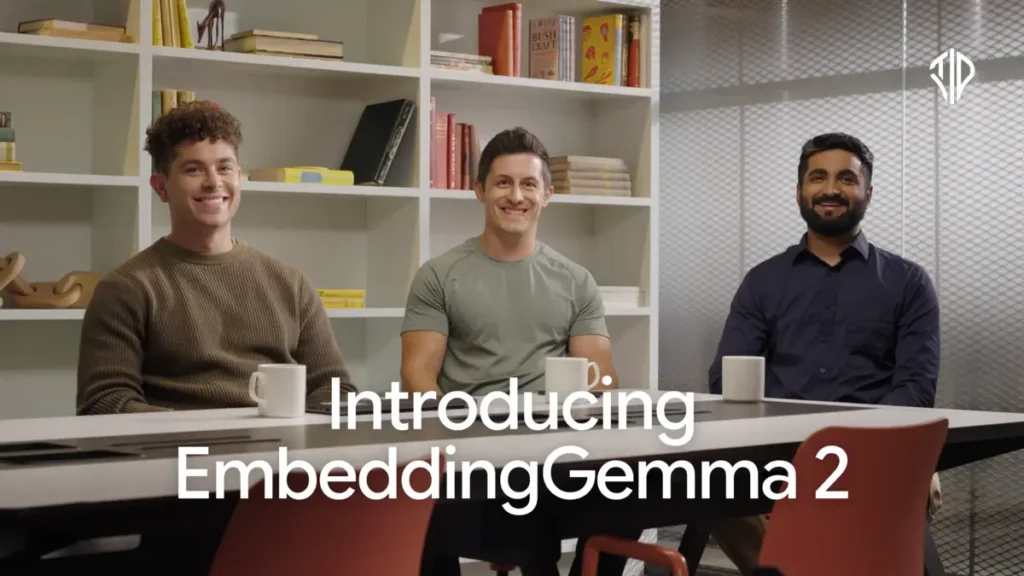
Google has launched a new AI “EmbeddingGemma 2”, an open multimodal model that’s built specifically for efficient on-device and offline applications.
Artificial intelligence has traditionally been a heavyweight champion, requiring massive server racks, endless rows of cooling fans, and cloud connections that constantly drain your battery.
For years, running complex search systems that understand not just text, but images, audio, and video, meant relying on distant server farms. But the landscape of artificial intelligence is shifting dramatically toward the edge.
Users now expect their devices to be smart, private, and capable of functioning entirely offline without sacrificing the sophisticated features they have come to rely on in the cloud.
Think of how humans naturally process the world around us. When you search for a memory, you do not just look at text strings; your brain seamlessly blends what you read, the sound you heard, and the visual snapshot of the moment.
Traditional search systems, however, treat these formats as completely alien to one another. Building an application that could search through code, documents, audio clips, and video frames simultaneously used to require chaining together multiple heavy, specialized models. This created high latency, high compute costs, and a massive memory footprint that could never dream of fitting inside a mobile device.
Google has changed this dynamic with the release of EmbeddingGemma 2, an open multimodal model designed specifically to bridge the gap between heavy cloud-based retrieval systems and lightweight on-device execution.
Built under the permissive Apache 2.0 license, this model solves the age-old dilemma of balancing high retrieval accuracy with low latency, proving that you no longer need a data center in your pocket to run advanced artificial intelligence.
Key Takeaways
- Modular Architecture: EmbeddingGemma 2 allows developers to load only specific components (text, code, vision, audio) to save memory and processing power.
- Unified Vector Space: All media modalities are mapped into a single 768-dimensional vector space, enabling seamless cross-modal search.
- Matryoshka Representation Learning (MRL): Efficiently truncates vectors down to smaller dimensions (like 128d or 256d) to drastically reduce storage requirements while maintaining high accuracy.
- Superior Performance: The model achieves a 14 percent improvement in code retrieval benchmarks compared to its predecessor.
- Developer-Friendly: Integrates natively with the sentence-transformers library and supports a wide ecosystem including Ollama, vLLM, and MLX.
Understanding the Architecture of EmbeddingGemma 2
At the core of EmbeddingGemma 2 is a brilliant design philosophy: modularity and unification. Based on the powerful foundation of Gemma 4, this sub-1B parameter model maps text, source code, images, video, and audio into a single, shared 768-dimensional vector space. This means that a text query can mathematically intersect with an audio recording, a video clip, or a line of code because they all live in the exact same semantic neighborhood.
The model achieves this unification by replacing traditional chained models with specialized, modular encoders that project their outputs into that shared 768-dimensional backbone. Depending on what your application demands, you can load only the specific components you need at runtime.
The modular setup offers distinct size tiers:
- 270M Parameters: The text and code baseline, featuring an adapted Gemma 4 decoder with an 8,192-token context window.
- 440M Parameters: Adds the vision encoder to handle images, visual documents, PDFs, charts, and video frames.
- 570M Parameters: Incorporates a dedicated speech and sound encoder alongside the text and code base.
- 740M Parameters: The full multimodal model, integrating text, code, vision, and audio simultaneously.
Unlocking Superior Code Understanding and Multimodal Retrieval
For developers working locally, code search and technical document retrieval have always been a bottleneck. EmbeddingGemma 2 delivers a massive leap forward, scoring 14 percent higher than its predecessor on the Massive Text Embedding Benchmark for code.
This makes it an exceptional choice for local codebase indexing, developer tooling, and agentic code search workflows where an AI agent needs to scour through thousands of files instantly.
Beyond code, native multimodal retrieval unlocks entirely new categories of on-device user experiences. Because text, images, video, and audio project into the same shared vector space, you can perform cross-modal queries effortlessly.
You can search through a personal photo library using a text prompt, find a specific second in a video clip by describing what happened, or match an audio recording of a sound to a descriptive text file, all without sending a single byte of data to an external server.
Maximizing Efficiency with Matryoshka Representation Learning
One of the most innovative features packed into EmbeddingGemma 2 is its support for Matryoshka Representation Learning, commonly referred to as MRL.
Named after traditional Russian nesting dolls, MRL allows the 768-dimensional vectors to be dynamically truncated down to lower dimensions—such as 512, 256, or 128—while retaining a remarkably high degree of semantic accuracy.
In practical terms, this feature is a game-changer for vector database storage and on-device memory management. Storing a million 768-dimensional vectors in bfloat16 precision consumes roughly 1.5 gigabytes of memory.
By truncating those vectors down to 128 dimensions, the storage requirement drops to just 250 megabytes. This sixfold reduction allows developers to store six times as many embeddings within the exact same memory budget, making large-scale local indexes entirely feasible on modern smartphones.
Getting Started with EmbeddingGemma 2 in Python
Integrating EmbeddingGemma 2 into your python development workflow is remarkably straightforward, thanks to its native support within the sentence-transformers library. To begin experimenting with the model, you first need to install the required packages with support for all media modalities.
pip install -U sentence-transformers[image,audio,video] transformers
Once installed, loading the model is as simple as defining your model identifier. To load the full multimodal model, you can initialize the SentenceTransformer class directly with the Google checkpoint.
If you are operating under strict memory constraints, you can selectively disable unused encoders at load time by passing configuration arguments. This ensures that disabled encoders are never loaded into your device memory, saving both weight allocation and peak runtime memory.
Applying Task Prompts for Precision Retrieval
EmbeddingGemma 2 has been trained using short task instructions to steer its representations for specific use cases. When performing retrieval tasks, you should distinguish between your queries and your documents by utilizing specific prompt names within the encode method.
For cross-modal searches involving images, audio, or video, you pass the media as a dictionary keyed by its modality without requiring a prompt. You can also handle interleaved inputs—such as a product listing containing text, an image, and a video clip—by marking where each item goes using structural tags like <|image|>, <|video|>, or <|audio|>.
If you decide to leverage Matryoshka Representation Learning to compress your vector database, you can apply dimension truncation either dynamically during encoding or statically at load time. To truncate a specific query dynamically, pass the desired dimension alongside normalized embeddings.
Future-Proofing Local AI Development
EmbeddingGemma 2 represents a significant milestone in the democratization of artificial intelligence. By stripping away the requirement for heavy cloud infrastructure and packaging top-tier multimodal retrieval into a modular, highly efficient framework, Google has opened the floodgates for a new generation of local applications.
Whether you are building an offline personal assistant that indexes your family photos and voice notes, or an advanced coding agent that understands your entire workspace locally, this model provides the raw power and flexibility needed to succeed.
Developers can dive right in by accessing the model weights directly on Hugging Face under the Apache 2.0 license. With support across popular frameworks like vLLM, SGLang, MLX, Ollama, LMStudio, and LiteRT, integrating EmbeddingGemma 2 into your existing stack has never been easier.
Take advantage of efficient fine-tuning techniques with Unsloth, or explore the live on-device demos in the Google AI Edge Gallery to see firsthand how multimodal semantic search on your smartphone is transforming the way we interact with technology.
Join our community by subscribing to our Weekly Newsletter to stay updated on the latest AI updates and technologies, including the tips and how-to guides. (Also, follow us on Instagram (@inner_detail) for more updates in your feed).
(For more such interesting informational, technology and innovation stuffs, keep reading The Inner Detail).
