
Quick response codes have quietly transformed from an obscure manufacturing tracking tool into a fundamental bridge connecting physical items to digital destinations. Originating from automotive supply chains, these square pixel patterns now manage everything from restaurant menus and boarding passes to multi-factor authentication and point-of-sale retail transactions. Understanding how they operate reveals a sophisticated blend of optical design and error correction mathematics.
While many consumers view them as simple digital hyperlinks, modern square matrices carry complex data payloads and serve as critical infrastructure across global financial networks. Examining their underlying anatomy, capabilities, and security challenges provides essential context for navigating an increasingly scan-driven world.
The Industrial Origins on a Factory Floor
The journey of the quick response format began in 1992 when engineer Masahiro Hara sought a replacement for traditional one-dimensional barcodes that could hold more data and scan faster. Inspired by the grid structure of the board game Go, his team developed a two-dimensional matrix capable of storing thousands of characters rather than just a dozen.
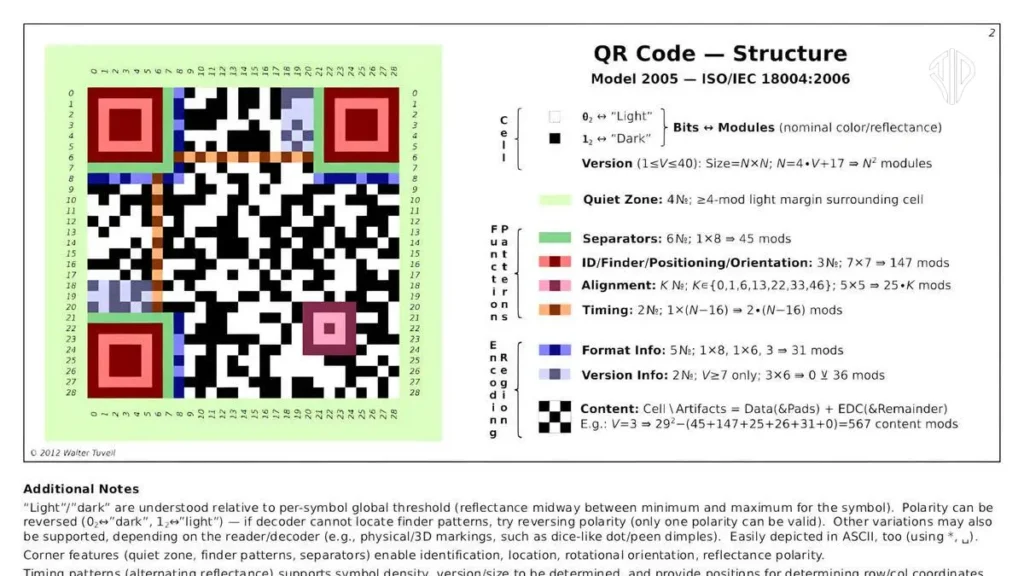
To ensure scanners could identify the pattern instantly from any angle, the team analyzed print materials to find an uncommon black-to-white width ratio. That specific proportion became the basis for the three prominent square targets positioned in the corners of every standard layout. Released under an open standard without licensing fees, the technology eventually spread worldwide, culminating in native camera app integration on smartphones.
Anatomy and Error Correction Mechanics
At a microscopic level, a quick response graphic consists of individual modules acting as binary bits. Specialized alignment markers, timing patterns, and quiet zones ensure that scanning software can parse the information accurately even when photographed at awkward angles or on curved surfaces.
Resilience against damage is achieved through advanced mathematical error correction algorithms similar to those used in optical discs and space probes. By encoding redundant data across four distinct security levels, the system allows scanners to reconstruct missing information. This mathematical redundancy is the exact reason why logos can be placed directly in the center of a matrix without breaking functionality.
Expanding Applications and Future Retail Standards
Beyond opening websites or joining Wi-Fi networks, these codes facilitate device pairing for smart home ecosystems, transmit cryptographic keys for passkeys, and drive massive instant payment economies globally. Retail networks are preparing for a major shift toward two-dimensional point-of-sale scanning, which will allow a single code to serve both inventory management systems and consumer-facing product information pages.
Regulatory mandates in various regions now require digital passports accessible via matrix scans for heavy industrial batteries and electric vehicle components. These developments cement the format as permanent digital infrastructure rather than a passing marketing trend.
Navigating Security Risks and Quishing
Because these graphical codes are essentially untrusted containers for text strings, malicious actors frequently exploit them to direct unsuspecting users toward credential-harvesting phishing pages or malware downloads. Security analysts track this growing vector under the term quishing, highlighting a surge in fraudulent scans distributed via email campaigns, public kiosks, and tampered payment stickers.
Protecting devices requires basic digital hygiene habits such as reviewing URL previews before opening links, verifying physical kiosk stickers, and treating unsolicited codes in messages with extreme caution. Utilizing static formats pointing to controlled domains helps avoid broken links or expired third-party dynamic redirect services.
Key Takeaways
- Quick response codes originated in automotive supply chains in 1992 as an evolution of traditional barcodes.
- Advanced mathematical error correction allows matrices to remain functional even when partially damaged or displaying central logos.
- Modern applications range from payment processing and smart home device pairing to regulatory digital passports.
- Users must stay vigilant against quishing, a growing security threat involving fraudulent scans designed to steal credentials.
Join our community by subscribing to our Weekly Newsletter to stay updated on the latest AI updates and technologies, including the tips and how-to guides.
(Also, follow us on Instagram (@tid_technology) for more updates in your feed and our WhatsApp Channel to get daily news straight to your Messaging App).
