
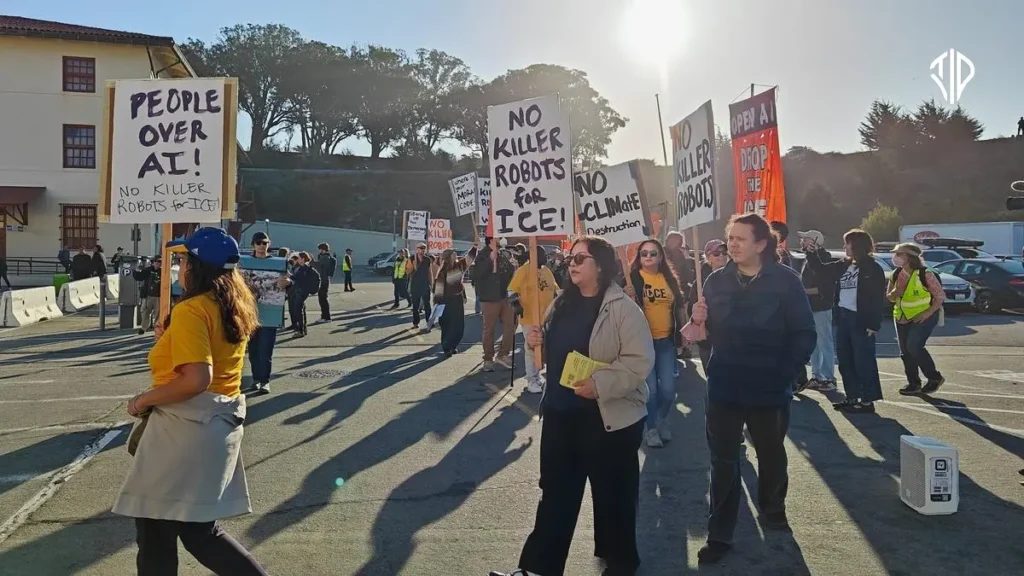
As artificial intelligence firms continue to secure major enterprise and government partnerships, public scrutiny surrounding their operational ethics has intensified. As reported by The Verge, OpenAI’s annual DevDay event in San Francisco opened with coordinated demonstrations, featuring labor organizations, activist groups, and community members demanding increased accountability from industry leadership.
The demonstration outside the Fort Mason venue brought together more than a dozen groups, including the Tech Workers Coalition, Bay Resistance, and the Service Employees International Union.
Participants directed their grievances toward several facets of the modern AI industry, highlighting military contracts, immigration enforcement technology agreements, and the massive energy and water demands associated with modern computing infrastructure.
A Central Focus on Government Contracts and Ethics
Among the primary grievances voiced by demonstrators were the commercial and defense partnerships established by major artificial intelligence laboratories.
Activists specifically targeted agreements involving federal agencies, calling for leadership to terminate contracts that support immigration enforcement or military operations.
Flyers distributed at the entrance urged technology workers to reconsider their employment choices and pressed corporate leadership to sign ethical pledges.
The demonstration underscored a growing tension within the technology sector between high-performance model development and the ethical implications of deploying advanced systems in national security contexts.
Environmental Concerns Over Compute Infrastructure
Beyond government partnerships, the protest highlighted the escalating environmental footprint of large-scale artificial intelligence operations. The rapid expansion of data centers required to train and run modern frontier models has sparked debates regarding regional power grids, water consumption, and carbon emissions.
Activists distributed informational materials questioning the sustainability of current scaling laws, noting that the exponential growth in computational power directly translates to increased strain on local municipal resources.
These concerns reflect broader conversations among environmental researchers regarding how the technology industry plans to balance efficiency gains with ecological preservation.
The Broader Movement Against Power Concentration
The events at DevDay mirror a wider wave of public skepticism and labor organizing directed at Silicon Valley institutions. Across the industry, coalitions of researchers, engineers, and community advocates are challenging the centralized control exercised by a handful of prominent laboratories.
As regulatory bodies deliberate on appropriate frameworks for artificial intelligence governance, grassroots movements continue to exert external pressure on corporate decision-makers.
These developments indicate that the future trajectory of artificial intelligence will be shaped not only by engineering breakthroughs, but also by persistent public discourse regarding societal responsibility and corporate governance.
Key Takeaways
- OpenAI’s DevDay event faced coordinated protests from labor organizations and activist groups demanding industry accountability.
- Demonstrators raised concerns over military contracts, immigration enforcement tech agreements, and massive resource consumption.
- Rapid scaling of data centers has sparked environmental debates regarding water usage, power grids, and municipal strain.
- Grassroots movements and labor coalitions are actively challenging the centralized control of major AI laboratories.
Join our community by subscribing to our Weekly Newsletter to stay updated on the latest AI updates and technologies, including the tips and how-to guides.
Also, follow us on Instagram (@tid_technology) for more updates in your feed and our WhatsApp Channel to get daily news straight to your Messaging App.
