
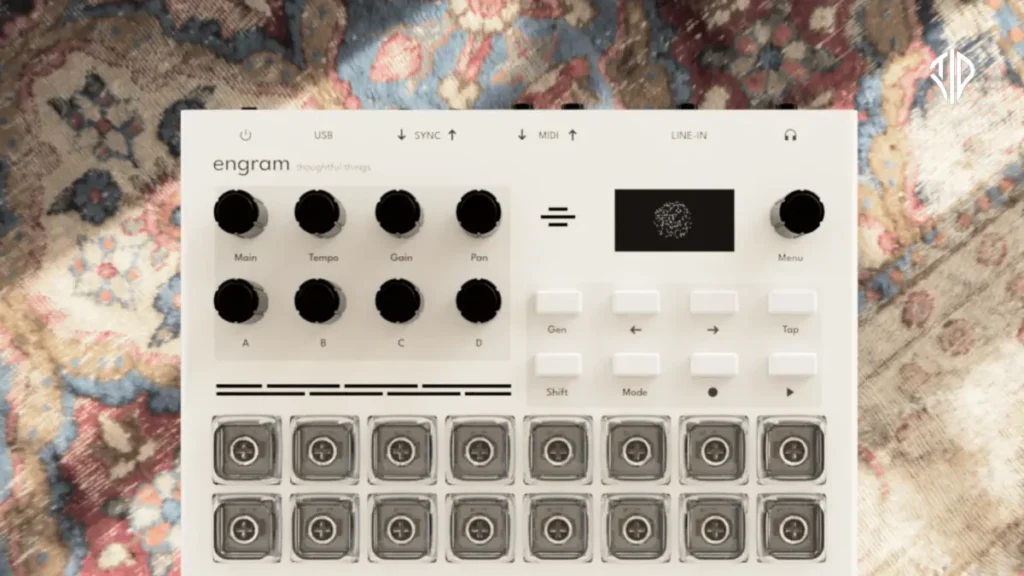
The intersection of generative models and physical music production is taking an experimental turn as hardware startups look beyond automated pop song generators. As reported by The Verge, a new music technology startup called Thoughtful Things has launched a crowdfunding campaign for its debut instrument, Engram. The device functions as a sampler and groovebox, but its core engine relies on deliberately manipulating and breaking incoming audio using local artificial intelligence models.
Rather than offering a turnkey tool designed to output radio-ready tracks at the press of a button, Engram leans heavily into glitch art, noise music, and sound design. It treats artificial intelligence errors not as bugs to be patched out, but as expressive musical characteristics. By focusing on local inference rather than cloud-based generation, the instrument opens up new possibilities for musicians interested in tactile, unpredictable sound manipulation.
Understanding The Hardware And Local AI Architecture
Engram operates entirely offline, completely disconnected from the internet. Inside its enclosure, the device runs a custom-trained, compact AI model designed specifically for audio processing. According to documentation from the creators, the underlying models have been trained exclusively on open datasets containing commercially licensed audio under CC-BY or similar permissive terms, steering clear of unvetted scraped internet data.
The absence of cloud dependency means latency is kept to a minimum while giving artists total control over their signal flow. Founder Evan King demonstrated the concept by using a microphone to feed vocal inputs requesting acoustic elements like a piano, which the device then rendered into fragmented, textured digital artifacts. The instrument functions similarly to a traditional field recorder, but instead of capturing physical reality, it records and samples the hidden geometry of latent space.
Circuit Bending Meets Neural Networks
The design philosophy behind Engram draws heavily from the traditions of circuit bending, a DIY practice where artists physically modify low-voltage electronic circuits to create unexpected sounds. In this context, the hardware allows users to push the custom AI models past their operational thresholds, fracturing algorithms to produce uncanny sonic textures.
Furthermore, Thoughtful Things plans to make the device firmware entirely open. This openness invites developers and musicians to tweak the software or load entirely custom models onto the hardware. Such extensibility transforms the device from a static commercial product into a modular platform for experimental electronic music composition.
Pricing, Availability, and Market Context
The initial hardware run is being distributed through a Kickstarter campaign, with early backing tiers starting at $675, which the company indicates reflects a thirty percent discount off the anticipated retail price. While the commercial viability of niche hardware geared toward noise and glitch artists remains to be seen, the project signals a growing appetite for physical computing tools that decentralize AI away from massive tech monopolies and place it directly into the hands of independent creators.
Key Takeaways
- Thoughtful Things has launched a crowdfunding campaign for Engram, a new sampler and groovebox driven by local AI.
- The instrument focuses on glitch art, noise music, and treating AI hallucinations as expressive musical features rather than bugs.
- Engram operates entirely offline with open firmware, allowing musicians and developers to load custom models and modify software.
- Early backing tiers on Kickstarter start at $675, offering a thirty percent discount off the anticipated retail price.
Join our community by subscribing to our Weekly Newsletter to stay updated on the latest AI updates and technologies, including the tips and how-to guides.
(Also, follow us on Instagram @tid_technology for more updates in your feed and our WhatsApp Channel to get daily news straight to your Messaging App).
