
The Impact of Generative Intelligence on Entry-Level Jobs
Concerns about generative intelligence dismantling entry-level job markets have dominated corporate discussions for years. Many experts warned that companies would immediately substitute junior staff with automated workflows.
A new study challenges that widespread assumption by analyzing broad federal employment data. The research indicates that recent college graduates have not yet experienced unusual spikes in unemployment due to artificial intelligence.
Research Findings on Recent College Graduates
Researchers Robert Fairlie and Jane Wu from Munich’s CESifo institute examined US employment trends. They focused specifically on bachelor’s degree holders aged 22 to 25.
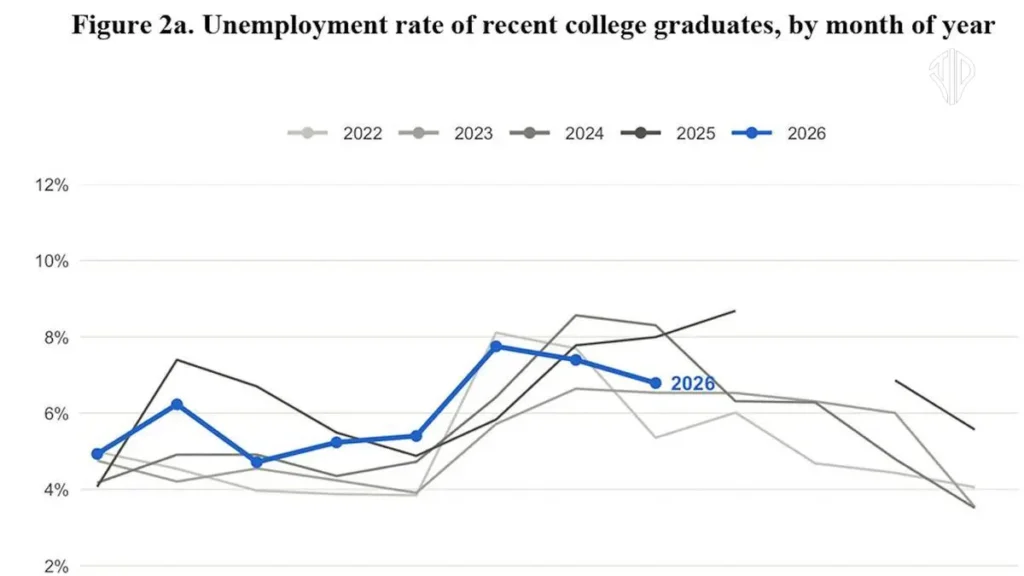
The findings show an unemployment rate of 7.3 percent for this group in summer 2026. This figure sits comfortably within the range recorded over the preceding four years.
That stability runs counter to growing anxiety that corporations are actively cutting junior positions. Many routine office tasks like document summarization and basic analysis are well within current software capabilities.
Comparing Census Data with Payroll Tracking
Corporate leaders have frequently predicted severe hiring contractions for new graduates. However, broad Census Bureau microdata from 2022 through 2026 tell a more nuanced story.
The 7.3 percent rate was higher than the 6.3 percent recorded in 2022. It remained below the 7.8 percent peak observed in 2024 during normal labor market fluctuations.
Researchers also compared recent graduates with non-degree holders of the same age. They found no statistically significant divergence in employment trajectories during the studied period.
This data appears to conflict with other recent findings, notably a Stanford University study. The Stanford research utilized payroll records from human resources provider ADP to track specific occupations.
That payroll tracking revealed weaker employment trends in occupations heavily exposed to AI. CESifo researchers measured overall unemployment rather than payroll additions within specific corporate silos.
Measuring unemployment captures both active job availability and total individuals seeking work. A company might reduce specific entry-level openings while overall unemployment remains stable if workers adapt.
Key Takeaways
- Recent college graduates aged 22 to 25 show an unemployment rate of 7.3 percent in summer 2026, remaining stable compared to prior years.
- Census Bureau data indicates employment trends for recent graduates do not show a catastrophic collapse despite rising corporate AI spending.
- Macro-level surveys measure overall unemployment, capturing a broader picture than specific corporate payroll tracking methods.
- Experts caution that the technology’s footprint may still be too subtle for macro-level surveys to isolate fully.
Navigating the Future of the AI Transition
Experts caution that the absence of a visible trend does not mean AI has zero effect. The technology’s footprint on the labor market may simply be too subtle for macro-level surveys to isolate yet.
Corporate spending on enterprise AI solutions continues to climb steadily. Executives and venture capitalists continue to warn of potential disruptions as software capabilities accelerate.
Subsequent graduating classes entering the labor market in coming years may face different realities. For now, the class of 2026 appears to be navigating the early phases of the AI transition without a catastrophic collapse in employment.
Join our community by subscribing to our Weekly Newsletter to stay updated on the latest AI updates and technologies, including the tips and how-to guides.
(Also, follow us on Instagram (@tid_technology) for more updates in your feed and our WhatsApp Channel to get daily news straight to your Messaging App).
